
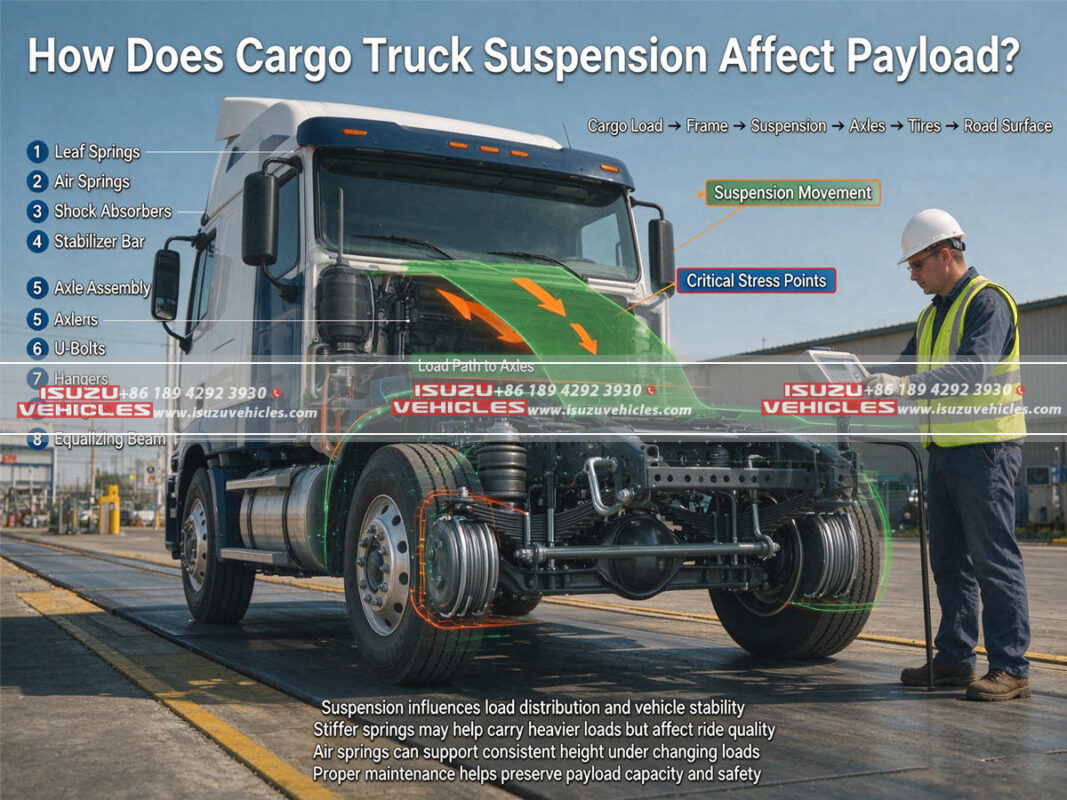
When evaluating a commercial truck, most buyers naturally focus on engine power, cargo capacity, fuel consumption, and body dimensions, but the suspension system is another critical factor that directly influences how effectively the vehicle can carry its payload. Although suspension components are often associated with driving comfort, their actual responsibilities extend much further, including supporting the vehicle’s weight, maintaining tire contact with the road, controlling body movement, and distributing loads across the axles. For businesses that operate cargo trucks every day, these functions have a direct impact on transportation safety, vehicle stability, tire wear, and long-term operating costs.
A properly designed suspension system allows a cargo truck to carry its rated payload while maintaining predictable handling and sufficient ground clearance under different road conditions. However, suspension capacity should never be confused with the vehicle’s official payload rating. Even if a truck is equipped with heavy-duty springs or additional air suspension components, its maximum legal carrying capacity remains limited by the manufacturer’s gross vehicle weight rating (GVWR), axle ratings, tire capacities, chassis design, and applicable transportation regulations.
This distinction is particularly important for logistics companies, construction suppliers, food distributors, and fleet operators purchasing an ইসুজু কার্গো ট্রাক for demanding transportation applications. Whether the vehicle is a compact delivery truck, a large বক্স ট্রাক, or a refrigerated vehicle transporting temperature-sensitive products, understanding the relationship between suspension performance and payload helps buyers choose a configuration that is suitable for their actual working conditions.
At ISUZU Vehicles, suspension configuration should be considered alongside the chassis, cargo body, axle arrangement, and intended operating environment when selecting a commercial vehicle. Understanding how these systems work together provides a more realistic picture of the truck’s carrying capability and overall transportation performance.
1. What Is a Cargo Truck Suspension System and How Does It Work?
A cargo truck suspension system connects the vehicle’s axles and wheels to its chassis, allowing the wheels to move vertically in response to uneven road surfaces while helping control the movement of the vehicle body. Without an effective suspension system, every pothole, road joint, speed bump, and uneven surface would transfer much greater impact forces directly into the chassis and cargo compartment.
The suspension system performs several important functions simultaneously. It supports the weight of the vehicle and its cargo, absorbs road impacts, controls excessive bouncing and body roll, maintains stable tire contact, and helps distribute dynamic forces during acceleration, braking, and cornering. These functions become especially important when a truck carries a heavy or unevenly distributed payload.
Main Components of a Truck Suspension System
Although suspension configurations vary according to vehicle size and application, most commercial truck systems contain several basic components that work together to support the vehicle and control its movement.
- Leaf springs: Commonly used on commercial trucks because they can support substantial loads and provide a relatively straightforward mechanical structure. Their spring characteristics can be selected according to the vehicle’s intended carrying requirements.
- Coil springs: Used in certain vehicle configurations to absorb vertical movement and provide controlled suspension travel, although they are less common as the primary load-supporting element on many heavy commercial trucks.
- Shock absorbers: Control the speed of suspension movement and reduce repeated bouncing after the wheels encounter road irregularities.
- Air springs: Use compressed air to support vehicle weight and allow suspension characteristics or ride height to be adjusted within the system’s designed operating range.
- Stabilizer bars: Help control body roll during cornering and sudden changes in direction.
- Suspension bushings and mounting components: Connect moving parts while reducing vibration and allowing the suspension to operate through its intended range of movement.
These components do not independently determine the truck’s payload rating. Instead, they work with the chassis, axles, tires, and braking system to ensure that the vehicle can carry its approved load while maintaining suitable road behavior.
Why Suspension Performance Changes with Cargo Weight
When a cargo truck is empty, its suspension supports primarily the weight of the chassis, cab, body, fuel, equipment, and other permanently installed components. Once cargo is loaded, the additional weight increases the force acting on the suspension springs, causing them to compress according to their design characteristics.
As the payload increases, the suspension must operate within a greater portion of its available working range. If the cargo weight approaches the vehicle’s rated limit, the springs, axles, and tires must support significantly greater loads than they experience during unloaded operation. A correctly selected suspension system accommodates this change without excessive compression or loss of vehicle stability.
2. How Suspension Type Influences Payload Capacity
Different suspension designs offer different advantages in commercial transportation, and the appropriate choice depends on vehicle weight, axle configuration, cargo characteristics, road conditions, and operating frequency. For most buyers, the key consideration is not simply which suspension feels softer or stronger, but which system can support the intended load while maintaining safe handling and acceptable durability.
Leaf Spring Suspension for Heavy Cargo
Leaf spring suspension remains a common choice for commercial cargo trucks because of its relatively simple construction, dependable load-supporting characteristics, and ability to withstand demanding operating conditions. A typical system consists of several curved steel leaves arranged in a spring pack, with the leaves working together to support the axle and absorb vertical movement.
One important advantage is that manufacturers can adjust spring thickness, leaf quantity, geometry, and other design characteristics to suit different vehicle configurations. This makes leaf springs practical for medium-duty and heavy-duty applications, including construction material transportation, general freight delivery, and industrial cargo operations.
For example, a truck transporting packaged building materials may require a suspension system capable of handling frequent changes in payload weight, while a vehicle carrying heavy machinery may need a configuration designed around higher axle loads and more demanding road conditions. In both cases, the suspension must be matched to the complete vehicle rather than selected independently.
Air Suspension for Flexible Load Support
Air suspension uses air springs, compressors, control valves, and associated components to support the vehicle and regulate suspension pressure. Depending on the system design, air suspension can automatically adjust air pressure in response to changes in vehicle load, helping maintain a more consistent ride height as cargo weight varies.
This feature can be particularly useful for vehicles that frequently alternate between fully loaded and empty journeys. For instance, a distribution truck may carry a substantial quantity of goods on its outbound journey but return with little or no cargo. An appropriately designed air suspension system can adapt to these changing operating conditions within its permitted load range.
However, air suspension does not automatically increase the truck’s legal payload capacity. The vehicle remains subject to its rated GVWR, axle limits, tire ratings, and other engineering restrictions. Its main advantages relate to load-leveling capability, ride characteristics, and, where equipped, improved control over suspension height.
Independent Suspension and Its Applications
Independent suspension allows individual wheels to move more independently of one another, which can improve ride comfort and wheel control on uneven surfaces. It is widely used in passenger vehicles and certain light commercial vehicle configurations, although conventional heavy-duty cargo trucks often rely on more robust axle and suspension arrangements designed for substantial load-bearing requirements.
For smaller delivery vehicles, the choice of suspension may involve balancing maneuverability, comfort, vehicle weight, and cargo capacity. The most suitable design depends on the manufacturer’s original engineering specifications and the conditions under which the truck is expected to operate.
3. How Suspension Affects Actual Payload, Axle Loads, and Vehicle Stability
One common misunderstanding among truck buyers is that installing stronger springs automatically allows a vehicle to carry more cargo. In reality, suspension components are only one part of the overall load-bearing structure, and the actual payload is determined by the limits of the complete vehicle.
মৌলিক সম্পর্কটি নিম্নরূপে প্রকাশ করা যেতে পারে:
Payload Capacity = Gross Vehicle Weight Rating (GVWR) − Curb Weight
The curb weight includes the vehicle in its specified operating condition, with permanently installed equipment and other items accounted for according to the manufacturer’s definition. The GVWR represents the maximum permitted operating weight of the completed vehicle.
For example, if a commercial truck has a GVWR of 10,000 kg and a curb weight of 4,500 kg, its nominal payload capacity is 5,500 kg. This does not mean that every axle can automatically support the additional weight in any distribution pattern. The actual loading arrangement must also comply with individual axle ratings, tire capacities, and applicable regulations.
Front and Rear Axle Load Distribution
Most conventional cargo trucks carry a substantial proportion of their cargo over the rear axle, particularly when the cargo compartment is positioned behind the cab. However, placing too much weight toward the rear can overload the rear axle even when the truck’s total weight remains below its GVWR.
Similarly, placing heavy equipment too far forward can increase the load on the front axle and affect steering behavior. Proper cargo positioning helps maintain a suitable distribution of weight between the front and rear axles, allowing the suspension and tires to operate within their approved limits.
Suspension Compression and Ground Clearance
As cargo weight increases, suspension springs compress and the distance between the chassis and axle generally decreases. This is a normal characteristic of a load-bearing suspension system, but excessive compression can indicate that the vehicle is approaching or exceeding its designed operating limits.
Insufficient remaining suspension travel may increase the likelihood of the suspension reaching its bump stops, particularly when the truck travels over potholes or uneven roads. Repeated impacts can place additional stress on the chassis, cargo body, suspension mounts, and other components.
Vehicle Stability During Cornering and Braking
Suspension condition also influences how a loaded cargo truck responds to steering and braking inputs. When a truck carries heavy cargo, its center of gravity may become higher or shift away from the ideal position, increasing the demands placed on the suspension and tires during cornering.
Uneven cargo distribution, worn shock absorbers, damaged springs, or incorrectly adjusted air suspension can contribute to excessive body movement and unpredictable handling. A properly maintained suspension system helps control these movements, but it cannot compensate for unsafe loading practices or excessive vehicle weight.
4. How Suspension Influences Cargo Protection and Transportation Efficiency
Payload is not only about how much weight a truck can carry; it is also about how effectively the vehicle can transport that weight without damaging the goods or creating unnecessary operating problems. Different cargo types respond differently to road vibration, sudden impacts, and changes in vehicle movement, which means suspension performance can have a significant influence on transportation quality.
Protecting Fragile and Temperature-Sensitive Cargo
For businesses transporting electronics, glass products, precision instruments, furniture, and other fragile merchandise, excessive vibration can gradually damage cargo even when the vehicle remains within its rated payload. A suspension system that effectively controls road impacts helps reduce the amount of vibration transmitted through the chassis and cargo body, particularly when combined with suitable tires, properly secured loads, and appropriate packaging.
This is especially relevant for a বক্স ট্রাক used in urban distribution, where frequent braking, acceleration, road joints, and uneven streets create repeated changes in vehicle movement. A suitable suspension configuration helps maintain a more controlled ride, reducing unnecessary movement that could affect sensitive products during transportation.
Refrigerated transportation has similar requirements. A রেফ্রিজারেটর ট্রাক may carry fresh food, dairy products, frozen goods, or pharmaceutical products, and excessive vehicle vibration can place additional stress on the cargo body, refrigeration equipment, door seals, and internal components. Although suspension does not directly control cargo temperature, maintaining stable vehicle movement can help protect the equipment and the goods being transported.
Businesses can explore the ইসুজু ফ্রিজে ট্রাক পরিসর when comparing commercial vehicles for cold-chain transportation, paying attention to the combined weight of the insulated body, refrigeration unit, fuel or battery systems, and intended cargo.
Maintaining Tire Contact and Traction
The suspension system also helps keep the tires in contact with the road surface, which is essential for transferring driving, braking, and steering forces effectively. When a heavily loaded truck encounters an uneven road, the suspension must respond quickly enough to control wheel movement and reduce excessive bouncing.
Poorly maintained shock absorbers, damaged springs, or worn suspension bushings can make it more difficult to control wheel movement, particularly when the vehicle is carrying a substantial load. This can affect braking consistency, tire wear, and overall vehicle handling. A properly maintained suspension system therefore contributes to safer payload transportation, especially on routes where road quality varies considerably.
দীর্ঘমেয়াদী পরিচালন ব্যয় হ্রাস করা
A well-matched suspension system can help reduce unnecessary wear on tires, chassis components, cargo body connections, and other vehicle systems. When suspension components operate within their intended limits, they are better able to control road impacts and prevent excessive movement that could gradually damage surrounding structures.
For fleet operators, this can mean fewer unexpected repairs, more predictable maintenance schedules, and improved vehicle availability. However, the benefits depend on correct vehicle specification, suitable loading practices, and regular maintenance rather than simply choosing a suspension with the highest possible spring rate.
5. How to Choose the Right Suspension for Different Cargo Truck Applications
There is no single suspension design that is ideal for every commercial vehicle because different industries have different payload requirements, operating environments, and transportation schedules. A truck that spends most of its working life on highways may need a different suspension configuration from a vehicle regularly operating on construction sites or unpaved roads.
General Cargo and Box Truck Applications
For general cargo transportation, the suspension should provide a practical balance between load-bearing capability, ride stability, durability, and maintenance costs. A multi-leaf spring system is often a practical choice for conventional commercial trucks because it provides reliable mechanical load support and is relatively straightforward to inspect and maintain.
Businesses using a box truck for regional distribution should also consider how frequently the vehicle operates at full payload. Some trucks carry nearly the same weight every day, while others alternate between fully loaded and empty journeys. This difference can influence the appropriate spring characteristics and whether an alternative suspension arrangement is worth considering.
In addition, the cargo body itself must be included when evaluating the suspension requirements. A large enclosed box body, tail lift, interior equipment, and other accessories all contribute to the vehicle’s curb weight, reducing the weight available for cargo.
Refrigerated and Freezer Truck Applications
Refrigerated trucks present a slightly different challenge because their bodies are generally heavier than standard dry cargo compartments due to insulation panels, internal linings, refrigeration equipment, and additional sealing components. The suspension must therefore accommodate the weight of the complete vehicle while providing sufficient support for the intended refrigerated cargo.
For example, a truck transporting frozen meat may have a substantial insulated compartment and a relatively dense payload. If the cargo is concentrated toward the rear, the rear suspension and axle must be capable of supporting the resulting load distribution without exceeding their rated capacities.
In this application, selecting the right suspension involves evaluating the complete vehicle weight, refrigeration equipment, cargo dimensions, and expected loading pattern. A suspension that performs well on an ordinary dry cargo truck should not automatically be assumed suitable for a refrigerated model with a significantly different body weight.
Construction and Industrial Cargo Transportation
Construction trucks frequently encounter rough roads, uneven surfaces, temporary work areas, and repeated loading operations. Under these conditions, suspension durability and resistance to impact become particularly important. A properly specified heavy-duty leaf spring arrangement may provide a practical solution because of its mechanical simplicity and suitability for demanding commercial applications.
However, the suspension must be selected together with the frame, axles, tires, and other chassis components. Increasing spring stiffness without considering the rest of the vehicle can create a harsher ride and transfer more vibration into the chassis and cargo body, potentially increasing maintenance requirements rather than improving overall performance.
Urban Mini Truck and Last-Mile Delivery Applications
Compact commercial vehicles used for urban distribution usually operate under different conditions from larger heavy-duty cargo trucks. They frequently encounter stop-and-go traffic, narrow streets, parking restrictions, speed bumps, and relatively short delivery routes.
For these applications, suspension design must balance load support with maneuverability and ride comfort. An unnecessarily heavy or excessively stiff suspension may reduce efficiency and make an empty vehicle uncomfortable, while an inadequately specified system may struggle when the truck carries its maximum permitted cargo weight.
Businesses considering smaller commercial vehicles can also compare the ISUZU mini truck models to identify configurations suitable for local delivery, light commercial transportation, and other urban applications.
6. Common Suspension Problems That Reduce Payload Performance
Even a well-designed commercial truck suspension system can lose its effectiveness when components become worn, damaged, or incorrectly adjusted. For businesses operating vehicles over long distances or under demanding working conditions, identifying early signs of suspension problems is important for preventing more serious mechanical issues.
Worn or Broken Leaf Springs
Leaf springs are exposed to repeated loading cycles, road impacts, and vibration throughout the vehicle’s working life. Over time, excessive stress, corrosion, poor maintenance, or overloading can cause individual leaves to crack or lose their intended spring characteristics.
Common warning signs include uneven vehicle height, unusual noises from the rear axle, excessive suspension movement, and visible damage to the spring pack. Broken or weakened springs should be inspected and repaired using components that meet the vehicle manufacturer’s specifications rather than replaced with unsuitable alternatives.
Damaged Shock Absorbers
Shock absorbers control suspension oscillation, helping prevent the vehicle from continuing to bounce after encountering a road irregularity. When they become worn, the truck may experience excessive bouncing, reduced ride stability, and increased movement of the cargo body.
These problems can become more noticeable when the vehicle is carrying heavy cargo because the suspension is operating under greater loads. Regular inspection helps identify oil leakage, damaged mounting points, and reduced damping performance before the problem affects other components.
Incorrect Air Suspension Pressure or Ride Height
Vehicles equipped with air suspension depend on correctly functioning air springs, air lines, valves, and height-control components. Air leakage or incorrect ride-height settings can cause the chassis to sit unevenly, potentially affecting axle loading, suspension geometry, and vehicle stability.
Drivers and maintenance personnel should follow the manufacturer’s recommended operating procedures and avoid adjusting air pressure beyond the approved specifications in an attempt to compensate for excessive cargo weight.
Overloading and Uneven Cargo Distribution
Overloading remains one of the most common causes of premature suspension wear. When cargo weight exceeds the vehicle’s approved limits, suspension springs may experience excessive compression, tires may become overloaded, and other chassis components may be subjected to forces beyond their intended operating range.
Uneven cargo distribution can create similar problems even when the total vehicle weight appears acceptable. For example, concentrating too much weight at the rear can overload the rear axle, while positioning heavy cargo too far forward can create excessive front axle loading.
Operators should weigh the completed vehicle when necessary and verify individual axle loads, especially when a truck has received a new cargo body, tail lift, or other equipment that changes its weight distribution.
7. How ISUZU Vehicles Help Buyers Select the Right Cargo Truck Configuration
Choosing a commercial truck should involve more than comparing engine power or the advertised maximum payload. Suspension design, chassis construction, axle arrangement, wheelbase, tires, and cargo body specifications must all work together to provide a reliable transportation solution.
ISUZU যানবাহন offers different commercial vehicle platforms and body configurations for businesses operating in logistics, industrial transportation, food distribution, and urban delivery. Depending on the intended application, buyers can consider suitable ELF, N-Series, F-Series, and GIGA-based chassis configurations, subject to the specifications and availability of individual models.
Evaluate the Complete Vehicle Weight
Before selecting a truck, buyers should calculate the expected operating weight rather than focusing only on the maximum cargo weight. The completed vehicle includes the chassis, cab, cargo body, spare tire, fuel, optional equipment, driver, and other items that contribute to its operating weight.
For instance, a refrigerated cargo truck will generally have a different curb weight from a standard dry box truck because of its insulated body and refrigeration equipment. The available payload must therefore be calculated using the actual completed vehicle specifications.
Consider the Road Conditions and Daily Workload
A vehicle operating mainly on highways may prioritize ride stability, efficient operation, and protection of sensitive cargo. A truck working in construction areas or on poorly maintained roads may require a more robust chassis and suspension configuration designed for those conditions.
Buyers should also consider daily mileage, the frequency of loading and unloading, the percentage of fully loaded journeys, and the availability of local maintenance services. These details help determine which suspension arrangement offers the most practical balance between initial investment and long-term operating costs.
Provide Accurate Requirements Before Ordering
When requesting a commercial vehicle quotation, customers should provide the intended cargo type, maximum cargo weight, cargo dimensions, required body length, operating environment, and expected daily transportation distance. It is also useful to specify whether the vehicle will carry heavy machinery, palletized products, refrigerated goods, or general merchandise.
এই তথ্য দিয়ে, ISUZU যানবাহন can help buyers evaluate suitable chassis and body configurations for their intended applications. The final vehicle specification should always be checked against the manufacturer’s approved weight ratings and applicable local regulations.
Ultimately, cargo truck suspension affects payload by supporting the vehicle’s weight, controlling suspension movement, helping maintain tire contact with the road, and influencing how effectively the truck manages heavy cargo under changing driving conditions. Leaf spring systems remain a practical choice for many conventional commercial applications, while air suspension can offer additional load-leveling and ride-quality advantages where appropriate. Neither system should be viewed as a way to exceed the vehicle’s rated capacity. For businesses selecting an ISUZU cargo truck, box truck, or refrigerator truck, the most reliable approach is to match the suspension to the complete vehicle specification, distribute cargo correctly, and maintain all load-bearing components throughout the truck’s service life.