
Eia kekahi kaʻa kinaiahi arrives at an emergency scene, carrying thousands of liters of water is only part of the job. The vehicle must also deliver that water through hoses, nozzles, monitors, and other firefighting equipment at a pressure and flow rate suitable for the incident. If the pressure is too low, firefighters may struggle to achieve the required water reach or maintain an effective discharge pattern. If it is unnecessarily high, the system may create excessive stress on hoses, fittings, valves, and other components, increasing the risk of equipment damage and making the water stream more difficult to control.
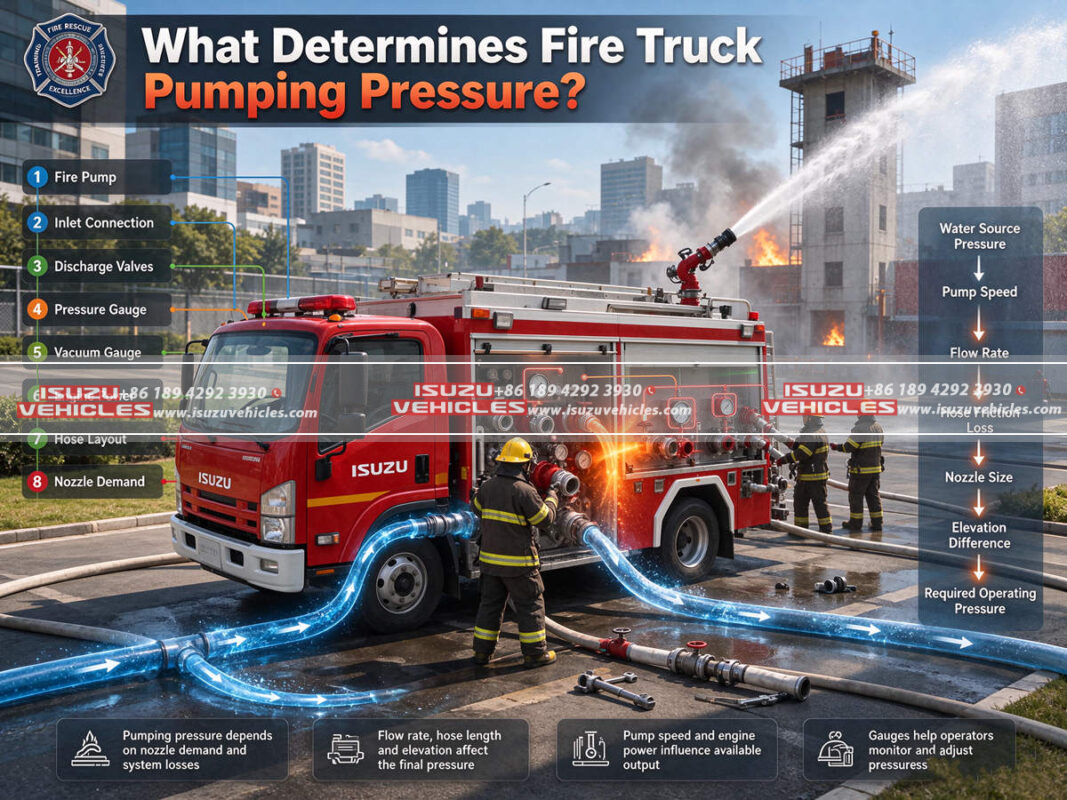
'O kēia ke kumu fire truck pumping pressure is one of the most important performance considerations when designing, purchasing, and operating a firefighting vehicle. It is not determined by the fire pump alone, because the final pressure available at the nozzle also depends on the water supply, pump speed, piping dimensions, hose length, elevation difference, nozzle design, and the number of discharge outlets being used at the same time.
For fire departments evaluating different firefighting vehicles, understanding these factors makes it easier to compare pump specifications and choose a configuration that matches local emergency-response requirements. ISUZU Vehicles offers firefighting truck configurations designed for different applications, from compact municipal fire engines to larger water-foam and aerial firefighting vehicles. Whether a department is selecting a standard water fire truck or a specialized vehicle for industrial operations, the relationship between pump pressure and water flow pono e nānā pono ʻia.
1. Understanding Fire Truck Pumping Pressure
Fire truck pumping pressure refers to the pressure generated by the fire pump to move water from the onboard tank or an external water source through the vehicle’s discharge system. The pump draws water into its inlet and uses mechanical energy from the vehicle’s engine or another approved power source to increase the water pressure before sending it toward hoses, monitors, and nozzles.
However, the pressure displayed on the pump panel is not necessarily the same as the pressure experienced at the nozzle. As water travels through the system, some of its energy is lost because of friction inside the piping and hose, changes in direction, fittings, valves, and differences in elevation. The pump operator therefore needs to consider the entire water delivery route rather than relying on the pump gauge alone.
Pressure and flow rate are not the same thing
Pressure and flow rate are closely related, but they describe different aspects of pump performance. Pressure indicates the force available to move water through the system, while flow rate describes the volume of water delivered over a given period, commonly measured in liters per minute (L/min) or gallons per minute (GPM). A pump may be capable of producing high pressure at a relatively low flow rate, while another configuration may deliver a much larger volume of water at a lower pressure.
For example, a hose line used for a small localized fire may require a different combination of pressure and flow from a large roof-mounted monitor used during an industrial emergency. A high-pressure reading does not automatically mean that a fire truck can deliver enough water to control a large fire, just as a high flow rating does not guarantee that the water will reach the required location with sufficient pressure.
Fire departments should therefore evaluate the pump’s rated flow and pressure together, considering the intended hose diameter, nozzle characteristics, monitor requirements, and operating conditions. A well-designed firefighting system provides the appropriate combination of these two performance factors rather than maximizing one specification without considering the other.
2. Fire Pump Design, Impeller Size, and Pump Speed
The fire pump is the central component responsible for creating the pressure needed to distribute water throughout the firefighting system. Most conventional fire engines use centrifugal pumps, in which a rotating impeller transfers mechanical energy to the water. As water enters the center of the impeller, the rotating blades accelerate it outward toward the pump casing, where part of its velocity energy is converted into pressure before the water reaches the discharge outlets.
The pump’s design has a direct influence on its pressure and flow characteristics. Impeller diameter, blade geometry, casing design, internal clearances, inlet arrangement, and the number of pump stages all affect the performance that can be achieved. A pump designed for high-volume firefighting may have different operating characteristics from one intended for a smaller vehicle or a specialized high-pressure application.
How impeller design affects pressure
The impeller is one of the most important parts of a centrifugal fire pump because it determines how efficiently mechanical energy is transferred to the water. Its diameter and blade design influence the pressure and flow characteristics at different operating speeds. A larger or specially designed impeller may support a different performance range, but the final result also depends on the pump casing, clearances, inlet conditions, and the manufacturer’s engineering specifications.
Some firefighting pumps use multiple stages to achieve higher discharge pressures. In a multistage arrangement, water passes through more than one impeller stage, allowing pressure to increase progressively. This design can be useful for applications requiring higher pressure, although the pump must still operate within its rated limits and receive an adequate water supply.
Why pump speed matters
Fire pump speed is another major factor affecting performance. In a centrifugal pump, increasing rotational speed generally increases the potential flow rate and pressure, provided that the pump receives sufficient water and operates within its permitted range. However, raising the speed also increases the power required to drive the pump and can lead to excessive vibration, heat, or mechanical stress if the system is not designed for that operating condition.
Many fire trucks use a power take-off (PTO) or a dedicated pump drive arrangement to transfer power from the engine to the fire pump. The transmission ratio, PTO specifications, drive shaft arrangement, and engine power available at the selected operating speed must all be compatible with the pump. If the drive system cannot supply the required power, the pump may not achieve its rated performance under demanding conditions.
For this reason, pump selection should always be coordinated with the vehicle chassis and powertrain. A large pump installed on an unsuitable chassis may create unnecessary engineering compromises, while a properly matched engine and pump combination can provide more dependable performance throughout the vehicle’s intended service life.
3. Water Supply and Pump Inlet Conditions
Even a powerful fire pump cannot deliver its rated performance if it does not receive enough water at the inlet. The water supply is therefore one of the first things firefighters and pump operators need to consider when establishing a firefighting operation. A fire truck may initially draw water from its onboard tank, but longer incidents often require a connection to a fire hydrant, water reservoir, portable tank, or supporting water tanker.
When the pump receives water from an external source, the inlet pressure and available supply volume can influence the system’s operating conditions. If the water source cannot provide enough volume, the pump may experience insufficient inlet supply, making it difficult to maintain the required discharge flow. In some circumstances, inadequate inlet conditions can also increase the risk of cavitation, a damaging condition in which vapor bubbles form and collapse inside the pump.
Onboard water tank capacity
The onboard tank provides an immediate water supply before firefighters establish a connection to another source. Its capacity affects how long the truck can operate independently, but tank volume alone does not determine the pump’s pressure. A vehicle with a relatively small tank can still have a powerful fire pump, provided that the pump and water supply system are properly designed. The difference is that the smaller tank may need to be replenished sooner during an extended operation.
For example, a compact urban fire engine may carry enough water for initial attack operations, while a larger industrial firefighting vehicle may use a higher-capacity tank to support longer periods of water delivery. In both cases, the pump must receive water at a suitable rate, and the vehicle needs a practical method of replenishment when the onboard supply becomes insufficient.
External water sources and tanker support
When hydrants are unavailable or the fire occurs in a remote area, a kaʻa pahu wai can help maintain the water supply for firefighting operations. The tanker transports water to the incident and may support a relay or portable water-supply arrangement, depending on the equipment and operating plan. This is particularly important for rural communities, industrial facilities, construction sites, and large outdoor incidents where the nearest reliable water source may be some distance away.
However, the tanker itself does not automatically determine the fire engine’s discharge pressure. Its role is to provide water to the pumping system, while the fire pump controls the pressure and flow delivered to the hoses and monitors. The water supply arrangement must be designed so that the fire pump receives sufficient volume without creating excessive inlet restrictions or unstable operating conditions.
4. Hose Length, Diameter, Friction Loss, and Elevation
After water leaves the pump, it travels through the vehicle’s piping and firefighting hose before reaching the nozzle. During this journey, the water loses some pressure because of friction between the moving water and the internal surfaces of the pipes and hoses. This is known as hāʻule kūʻē, and it is one of the most important reasons why the pressure at the pump panel can differ from the pressure required at the nozzle.
Friction loss is influenced by several factors, including hose length, internal diameter, flow rate, hose condition, and the number of fittings or restrictions along the route. As the hose becomes longer, water generally experiences more resistance. Similarly, a smaller-diameter hose creates greater resistance than a larger hose when carrying the same flow under comparable conditions.
How hose diameter affects pumping pressure
Consider two hose lines carrying water at the same flow rate. The line with the smaller internal diameter will generally produce greater friction loss because the water must move through a narrower passage. The larger-diameter hose can reduce this resistance, although it may be heavier, more difficult to handle, and less convenient for certain firefighting tasks.
This is why fire departments use different hose sizes for different purposes. Smaller attack lines can be practical for certain close-range operations, while larger-diameter hoses are commonly used when higher water volumes must be delivered over longer distances. The pump operator must use the appropriate pressure calculation or approved operating chart for the hose and nozzle combination rather than assuming that one pump pressure will work for every line.
Elevation and vertical water delivery
Elevation also affects the pressure required to deliver water. When water is pumped upward to an elevated floor, rooftop, or aerial platform, the pump must overcome the additional pressure associated with the vertical height. The higher the discharge point, the greater the pressure needed to lift the water, even before friction losses in the hose and piping are considered.
This becomes particularly important during high-rise firefighting. A fire truck positioned at street level may need to supply water through a long hose line to firefighters working several floors above ground. The pump operator must account for the vertical elevation, hose friction, nozzle requirements, and any additional system losses when determining the required pump discharge pressure.
For aerial firefighting vehicles, water may also need to travel through dedicated piping or waterways incorporated into the ladder or platform assembly. These systems introduce their own engineering requirements, and the pump pressure must remain within the limits specified for the vehicle’s waterway, monitor, hoses, and fittings.
5. Nozzle Type, Discharge Flow, and Firefighting Equipment
The nozzle is the final point where water leaves the firefighting system and is directed toward the fire. Its design has a major influence on the pressure and flow requirements of the complete system. Different nozzles are designed for different operating conditions, and the correct choice depends on the fire type, required water volume, working distance, and firefighting strategy.
A smooth-bore nozzle uses a shaped opening to produce a relatively concentrated water stream, while a combination nozzle can provide different discharge patterns depending on its design and adjustment. Some nozzles allow firefighters to select a straight stream or a fog pattern, while others are designed for a specific flow and pressure range. The pump must be operated in accordance with the nozzle manufacturer’s specifications to deliver the intended performance.
Why nozzle pressure matters
Every nozzle has an intended operating range. If the pressure is too low, the stream may not have the desired reach, flow, or pattern. If the pressure is too high, the discharge may become difficult to control, the reaction force may increase, and the nozzle or hose system may be exposed to conditions beyond its intended operating range.
The nozzle’s flow characteristics are also important because the amount of water delivered must be appropriate for the fire. A small fire may not require the same flow as a large industrial fire, while a high-volume monitor may need a much greater water supply than a handheld hose line. Pump operators therefore need to coordinate pressure and flow with the equipment being used rather than focusing only on the pressure gauge.
Fire monitors and aerial water delivery
Fire monitors are designed to discharge larger volumes of water or foam from a fixed or movable position. They are commonly installed on the roof or upper structure of fire trucks and may also be integrated into specialized aerial firefighting equipment. Because monitors can deliver substantial flow rates, their pressure requirements must be considered together with the pump capacity, piping dimensions, monitor design, and required discharge range.
An aerial fire truck may have a dedicated waterway that supplies an elevated monitor or platform-mounted discharge device. The water delivery system must be designed to operate safely throughout the permitted ladder or boom movement, and the pump must provide the required pressure at the monitor without exceeding the limits of the aerial structure and associated equipment.
ISUZU Vehicles offers different firefighting vehicle configurations, including water fire trucks, water-foam fire trucks, and aerial fire trucks. Buyers can review the available kahua kaʻa ahi to compare vehicle types and consider how the pump, tank, monitor, hose outlets, and other equipment should be matched to the intended application.
6. Piping Layout, Valves, and the Overall Pumping System
The design of the vehicle’s internal plumbing system also influences pumping pressure. Water must travel from the tank or external supply through inlet pipes, pump passages, discharge manifolds, valves, and outlets. Every change in direction, restriction, fitting, and connection can contribute to pressure loss, particularly when the system is operating at high flow rates.
A well-designed firefighting vehicle uses appropriately sized piping and a logical arrangement of valves and outlets to minimize unnecessary resistance. Poorly matched pipe diameters, restrictive fittings, damaged valves, or partially closed discharge outlets can reduce the water available to the hose or monitor. These issues may not be obvious when the vehicle is parked, but they can become significant during demanding pumping operations.
Valve position and outlet configuration
Fire trucks commonly have several discharge outlets that allow firefighters to connect different hose lines or operate other firefighting equipment. When multiple outlets are opened, the pump may need to deliver a greater total flow. Depending on the pump’s performance curve and the system design, this can change the pressure available at each outlet.
For example, a vehicle supplying two hose lines and a roof monitor at the same time may require considerably more water than a vehicle operating only one small attack line. If the pump or water supply cannot support the combined demand, the pressure or flow available at individual outlets may decrease. The operator must understand the pump’s rated operating range and manage the outlets accordingly.
Equipment condition and system efficiency
Wear and poor maintenance can also affect pumping performance. Damaged seals, leaking connections, clogged strainers, corroded piping, worn pump components, and faulty pressure gauges may all contribute to unreliable operation. Even if the pump was originally capable of meeting its rated specifications, neglected maintenance can gradually reduce its efficiency and make pressure control less predictable.
Regular inspection should include the pump, piping, valves, gauges, tank connections, hose outlets, and monitor plumbing. Fire departments should follow the manufacturer’s recommended testing and maintenance procedures, and any abnormal pressure readings, vibration, leakage, or unusual operating noise should be investigated before the vehicle is returned to emergency service.
7. How to Select a Fire Truck with the Right Pumping Pressure
Choosing a fire truck should begin with an assessment of the incidents the vehicle is expected to handle. A compact fire engine serving residential neighborhoods may have different pumping requirements from a heavy-duty industrial fire truck protecting fuel storage facilities, warehouses, chemical plants, or large manufacturing sites. The best configuration is not necessarily the one with the highest advertised pressure, but the one that can deliver the required water flow and pressure reliably under the expected operating conditions.
Match the pump to the intended application
Before selecting a vehicle, buyers should identify the types of fires the department expects to encounter, the required hose and monitor arrangements, the distance from available water sources, and whether elevated water delivery is necessary. A water-foam fire truck may be appropriate for facilities where flammable-liquid hazards are a major concern, while a large-capacity water fire truck may be more suitable for operations requiring substantial water delivery.
Buyers should also review the pump’s rated flow and pressure, the performance curve, the permitted operating speed, the engine power available for pump operation, and the water supply arrangement. The specifications should clearly identify the operating conditions associated with the advertised pump rating, rather than presenting a pressure value without explaining the corresponding flow.
Consider the chassis and specialized equipment
The chassis must support the weight of the water tank, pump, firefighting equipment, crew, and other vehicle systems while providing suitable road performance and stability. A larger pump may require additional installation space and power, so the vehicle’s engine, transmission, PTO, axle ratings, and body layout should all be considered during the design process.
Some emergency-response fleets also operate specialized vehicles alongside fire engines. A kaʻa kalaka, for example, can support elevated utility maintenance, streetlight repairs, and other infrastructure work, while a dedicated fire truck is designed for water or foam delivery, rescue, and fire suppression. Although these vehicles may work in the same municipal or industrial environment, their hydraulic and operational systems serve different purposes.
Pēlā nō, a kaʻa kauō can assist with removing disabled vehicles, clearing accident scenes, and recovering vehicles that obstruct emergency access. It does not replace firefighting equipment, but it can be a useful part of a broader municipal and emergency-support fleet.
Why pump testing and operator training are essential
Once a fire truck has been delivered, the department should verify that the pump performs according to its approved specifications and that the pressure gauges, valves, controls, and discharge outlets function correctly. Pump testing should be carried out using appropriate procedures and equipment, with results documented so that changes in performance can be identified over time.
Operators also need practical training in pump engagement, water-source selection, pressure adjustment, hose friction loss, elevation calculations, and the effects of operating multiple discharge outlets. A technically capable pump cannot compensate for incorrect operation, and a well-trained pump operator is essential to ensuring that water reaches firefighters at the required pressure and flow.
For customers considering ISUZU Vehicles firefighting configurations, it is useful to provide details about the local fire risks, expected hose lengths, required monitor capacity, available water sources, operating terrain, and any special foam or aerial equipment requirements. This information helps determine a suitable combination of chassis, fire pump, tank capacity, piping, and discharge equipment.
Ultimately, fire truck pumping pressure is determined by the combined performance of the pump, power source, water supply, piping network, hoses, nozzles, and elevation conditions. A reliable firefighting vehicle must balance pressure with flow, because both are necessary to deliver water effectively and safely. By understanding how these factors interact, fire departments can make better equipment decisions, train pump operators more effectively, and ensure that their vehicles are prepared for the demands of real emergency operations.