
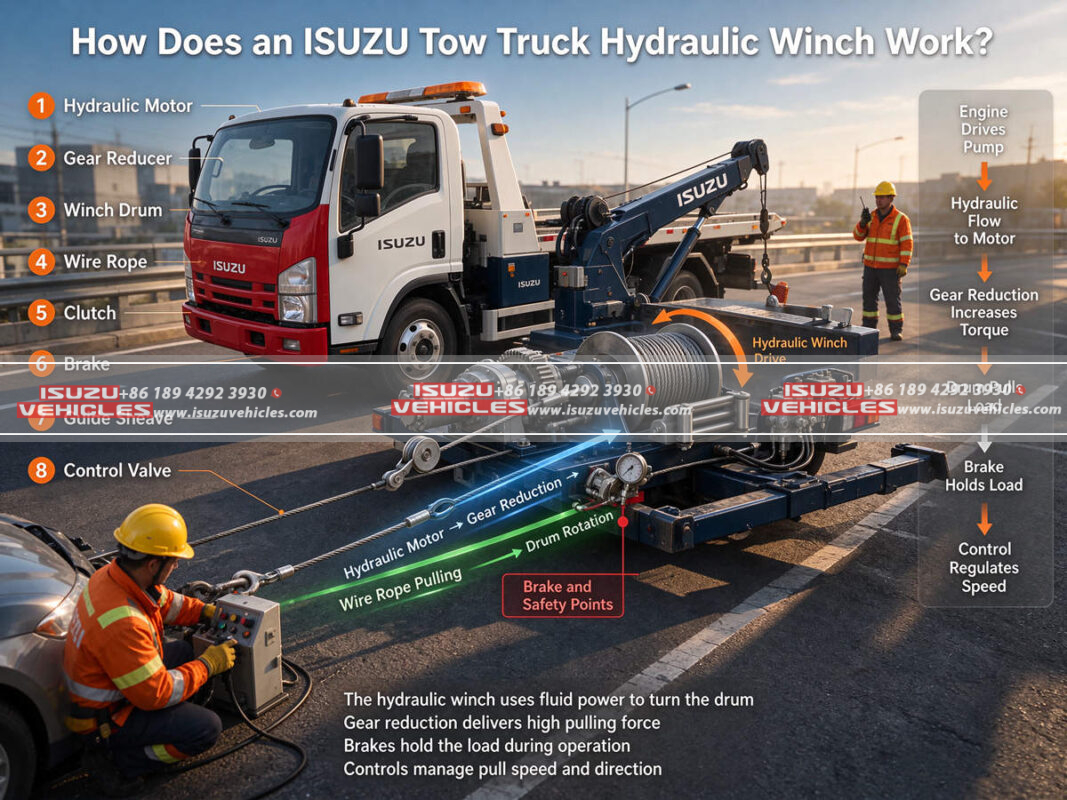
When a vehicle breaks down, becomes trapped in mud, or is involved in a road accident, recovering it safely often requires more than simply connecting a towing cable and pulling it away. Some vehicles cannot move under their own power, while others may be stuck in difficult positions, have damaged wheels, or be located in areas where a conventional towing method is unsuitable. In these situations, an ISUZU tow truck hydraulic winch provides the pulling force needed to recover disabled vehicles in a controlled and efficient manner.
Unlike a conventional electric winch, which relies on an electric motor to generate pulling power, a hydraulic winch uses pressurized hydraulic oil to drive a hydraulic motor connected to a reduction gearbox and cable drum. This arrangement allows the recovery equipment to produce substantial pulling force and operate as part of the truck’s integrated hydraulic system. It is particularly useful for professional recovery vehicles that need to perform repeated pulling operations under demanding working conditions.
For towing companies, roadside assistance providers, commercial fleet operators, and vehicle recovery businesses, understanding how a hydraulic winch works is important when selecting the right recovery truck. ISUZU Vehicles offers different recovery configurations equipped with hydraulic winches, flatbed platforms, lifting booms, and other specialized equipment for different vehicle weights and operating requirements. This article explains the main components of an ISUZU tow truck hydraulic winch, how hydraulic power is generated, how the cable pulls a disabled vehicle, and what operators should know about winch capacity, safety, and maintenance.
1. What Is a Hydraulic Winch on an ISUZU Tow Truck?
A hydraulic winch is a mechanical pulling device powered by hydraulic pressure rather than a directly connected electric motor. It is commonly installed on the front section of a flatbed recovery platform, behind the cab, or in another position determined by the tow truck’s body design. Its primary function is to pull disabled vehicles, machinery, or other approved loads toward the recovery truck using a steel wire rope or synthetic winch line.
During a typical recovery operation, the winch cable is extended toward the disabled vehicle, connected to an appropriate recovery point, and gradually wound back onto the drum. As the drum rotates, the cable becomes shorter, creating a pulling force that moves the recovered vehicle toward the tow truck. On a flatbed wrecker, this process is particularly useful for loading a vehicle onto the inclined platform without requiring the disabled vehicle to move under its own power.
The hydraulic design is well suited to commercial recovery equipment because the truck’s engine can provide mechanical power to a hydraulic pump through a power take-off system. The pump then supplies pressurized oil to the winch motor, allowing the operator to control the pulling operation through hydraulic valves and control levers.
Compared with some electrically driven alternatives, a hydraulic winch can offer practical advantages for frequent heavy-duty recovery work, including continuous-duty capability within its rated operating conditions, flexible installation, and integration with other hydraulic equipment on the truck. However, its actual performance depends on the hydraulic pump, motor displacement, operating pressure, oil flow, gearbox ratio, cable arrangement, and rated winch capacity.
Different recovery jobs also require different winch configurations. A light-duty roadside recovery truck may use a relatively compact hydraulic winch for passenger cars and light commercial vehicles, while a heavy-duty wrecker may require higher-capacity winches, longer wire ropes, and additional recovery equipment. Businesses can explore the ISUZU tow truck category to compare flatbed wreckers, rollback recovery trucks, wheel-lift vehicles, and heavy-duty recovery configurations.
Main Components of a Hydraulic Winch
Although hydraulic winches come in different sizes and designs, most professional recovery systems contain several basic components that work together to convert hydraulic energy into controlled pulling force.
- Hydraulica sentinam: Supplies pressurized hydraulic oil to operate the winch motor.
- HYDRAULICUS motricium, Converts hydraulic energy into rotational mechanical power.
- Reduction gearbox: Reduces rotational speed while increasing the torque available to turn the cable drum.
- Winch drum: Stores the steel cable and rotates to wind or release the winch line.
- Steel wire rope: Transfers pulling force from the winch to the disabled vehicle or recovery attachment.
- Hydraulic control valve: Regulates oil flow and controls the winch’s operating direction and speed.
- Fregit ratio, Helps hold the suspended or pulled load when the winch is stopped.
- Fairlead: Guides the cable onto and off the drum while helping control its routing.
- Power take-off (PTO): Transfers mechanical power from the truck transmission to the hydraulic pump when this arrangement is used.
Each component must be correctly matched to the others because a powerful hydraulic motor cannot deliver its intended performance if the pump cannot supply sufficient oil flow, the gearbox is incorrectly selected, or the cable is unsuitable for the expected working load.
2. How Does the Hydraulic Winch Generate Pulling Power?
The working principle of an ISUZU tow truck hydraulic winch is based on the relationship between hydraulic pressure, oil flow, and mechanical torque. The truck engine provides the initial energy, the hydraulic pump converts mechanical power into hydraulic energy, and the hydraulic motor converts that energy back into rotational movement that drives the winch drum.
Understanding this process makes it easier to see why hydraulic winches are commonly used on professional recovery vehicles and why the hydraulic system must be maintained carefully.
Step 1: The Truck Engine Supplies Mechanical Power
The recovery process begins with the truck engine running according to the manufacturer’s operating procedure. In many hydraulic tow truck configurations, a power take-off is connected to the transmission and transfers engine power to the hydraulic pump.
When the PTO is engaged, it drives the hydraulic pump, allowing the pump to draw hydraulic oil from the reservoir and deliver it into the working circuit. The amount of hydraulic oil supplied per minute, commonly described as flow rate, affects how quickly the hydraulic motor can rotate.
The pump must be properly matched to the winch motor and the other hydraulic equipment installed on the truck. An undersized pump may not provide the required performance, while an incorrectly configured hydraulic circuit can cause excessive heat, pressure problems, or inconsistent operation.
Step 2: The Hydraulic Pump Creates Pressure and Oil Flow
The hydraulic pump moves oil through the circuit, while resistance from the hydraulic motor and the load being pulled causes pressure to develop. This pressure provides the force needed to operate the winch motor.
Two important hydraulic parameters determine how the system performs:
- Pressio hydraulica: Determines the torque-producing capability of the hydraulic motor within its design limits.
- Hydraulic flow rate: Influences the rotational speed of the motor and therefore the speed at which the cable is wound onto the drum.
For example, when a recovery operator needs stronger pulling performance at a controlled speed, the system must provide suitable hydraulic pressure and motor torque. When the objective is to retrieve a lighter vehicle more quickly, the required operating conditions may be different, provided that the winch remains within its rated capacity and operating limits.
A pressure-relief valve is normally incorporated into the hydraulic circuit to help prevent pressure from exceeding the specified maximum. Hydraulic filters also help protect the pump, motor, control valves, and other precision components from contamination.
Step 3: The Hydraulic Motor Converts Energy into Rotation
Once pressurized oil reaches the winch motor, the hydraulic motor converts the energy in the moving fluid into rotational mechanical power. Depending on the winch design, the motor may use a planetary or another approved mechanical arrangement to deliver the required output torque.
The motor’s rotational movement is transmitted through the reduction gearbox, which decreases rotational speed while increasing the available torque at the output shaft. This is essential because pulling a heavy disabled vehicle requires substantial mechanical force, but the winch drum does not need to rotate at extremely high speed.
The combination of hydraulic motor displacement, operating pressure, gearbox reduction ratio, and drum diameter determines the practical pulling characteristics of the winch.
Step 4: The Winch Drum Pulls the Cable
After the gearbox transfers rotational power to the drum, the drum begins winding the steel cable around its surface. As more cable is wound onto the drum, the free cable length becomes shorter and the connected vehicle is pulled toward the recovery truck.
The operator controls this movement using the designated hydraulic control levers or another approved control arrangement. Depending on the system, reversing the hydraulic oil flow or operating a directional control valve allows the winch to rotate in the opposite direction for cable payout or other designated functions.
However, the cable should not simply be released without considering the winch’s braking and free-spool arrangements. The operator must follow the manufacturer’s instructions to prevent uncontrolled cable movement or unexpected load displacement.
3. How Does an ISUZU Hydraulic Winch Recover a Disabled Vehicle?
Although the hydraulic principle remains similar across different winch models, the actual recovery procedure depends on the type of tow truck, the condition of the disabled vehicle, the working environment, and the equipment being used. A flatbed recovery truck, for example, uses its winch to pull a disabled vehicle onto the loading platform, while a heavy-duty wrecker may use its winch together with a boom, underlift, and stabilizing outriggers.
The recovery operation normally follows several stages, each of which requires careful preparation and controlled equipment movement.
Step 1: Positioning the Recovery Truck
Before using the winch, the operator positions the ISUZU tow truck on a suitable surface with enough room for the cable to extend toward the disabled vehicle. The parking brake and other required vehicle safety measures must be applied, and the recovery area should be secured against unnecessary traffic or pedestrian movement.
For flatbed recovery operations, the loading platform is then lowered or tilted according to the manufacturer’s operating instructions. If the recovery configuration requires additional stabilizing supports, the outriggers must be deployed correctly before the winch is used.
Vehicle position is important because pulling at an unsuitable angle can create unnecessary side loading on the winch drum, cable, fairlead, and recovery structure. Whenever possible, the truck should be aligned with the intended pulling direction.
Step 2: Extending the Winch Cable
The operator extends the cable toward the disabled vehicle, either by using an approved free-spool mechanism or through controlled powered operation, depending on the winch design. The cable must be handled carefully to prevent twisting, kinking, and unnecessary contact with sharp edges.
The hook is then connected to an appropriate recovery point using approved shackles, recovery straps, or other compatible accessories. The attachment point must be strong enough to withstand the expected pulling force and should not be confused with ordinary transport tie-down points or components that are not designed for recovery loading.
Step 3: Applying Controlled Pulling Force
Once the cable is connected, the operator takes up slack gradually and checks that the hook, cable, and attachment points are correctly positioned. The winch is then operated at a controlled speed to begin moving the disabled vehicle.
On a flatbed tow truck, the vehicle gradually travels up the inclined platform until it reaches the designated loading position. If the vehicle’s wheels cannot rotate freely, additional preparation or specialized recovery equipment may be required before pulling begins.
The operator should avoid sudden acceleration or shock loading because these forces can exceed the intended working limits of the cable, winch, attachment points, and truck structure. A steady pulling force is generally preferable to abrupt movement, particularly when recovering heavy commercial vehicles.
Step 4: Securing the Vehicle for Transportation
Once the disabled vehicle reaches the required position, the operator secures it using suitable wheel restraints, straps, chains, or other approved transport-securing equipment. The winch should not automatically be treated as the only means of securing the recovered vehicle during transportation.
The loading platform is then returned to its transport position, and all locking devices and restraints are checked before the truck moves onto the road. The recovered vehicle must remain properly supported and secured throughout transportation.
For more demanding accident recovery situations, a professional wrecker may combine hydraulic winching with lifting equipment. For example, the ISUZU 5 Ton Wrecker Recovery Tow Truck uses hydraulic winches alongside a recovery boom, crane arm, and outriggers, illustrating how several hydraulic functions can work together during complex recovery operations.
4. What Determines the Pulling Capacity of a Hydraulic Winch?
One of the most important considerations when choosing an ISUZU tow truck is understanding the difference between hydraulic winch pulling capacity and the overall towing or recovery capacity of the vehicle. These ratings describe different functions and should never be treated as interchangeable.
The winch is responsible for generating pulling force through its cable, while the towing equipment, recovery boom, underlift, flatbed, chassis, and axles have their own operating limits. A tow truck may have a high winch rating without being able to transport a vehicle of the same weight using its wheel-lift system or recovery boom.
Hydraulic Pressure and Motor Displacement
The hydraulic motor’s available torque depends partly on the pressure difference across the motor and its displacement. Higher available pressure can produce greater motor torque within the component’s rated limits, while the motor displacement influences the relationship between oil flow and rotational speed.
However, increasing hydraulic pressure beyond the manufacturer’s specifications is not an acceptable way to increase winch capacity. Excessive pressure can damage seals, hoses, pumps, motors, and mechanical components, potentially creating dangerous operating conditions.
Gearbox Reduction Ratio
The reduction gearbox plays an important role in determining how much torque reaches the winch drum. A suitable reduction ratio allows the hydraulic motor to operate at a practical speed while providing sufficient torque for pulling heavier loads.
As the gearbox increases output torque and reduces rotational speed, the winch can generate the pulling force required for controlled recovery operations. The gearbox must be correctly matched to the hydraulic motor and the mechanical design of the drum.
Drum Diameter and Cable Layers
The effective drum radius also influences pulling force. When the drum contains several layers of cable, the effective winding diameter increases, which changes the mechanical leverage available at the drum and generally reduces the line pull compared with the first cable layer.
This is why manufacturers may specify different pulling capacities depending on the cable layer. Operators should consult the winch load information rather than assuming that the maximum advertised capacity is available throughout the entire cable length.
Single-Line and Double-Line Pulling
Some recovery operations use a single cable line, while others use a snatch block or pulley to create a multi-part line arrangement. A properly configured two-part line can increase the theoretical pulling force available at the load, although the actual result depends on friction, pulley efficiency, cable condition, and equipment ratings.
For example, a snatch block may be attached to a suitable anchor point and used to redirect the cable or create a two-part pulling arrangement. This can provide useful mechanical advantage when recovering a vehicle from a difficult position, but the anchor, pulley, shackles, cable, and winch must all be rated for the forces involved.
Operators should also recognize that increasing mechanical advantage generally changes the amount of cable required and the speed of load movement. The correct rigging arrangement must therefore be selected according to the recovery situation and manufacturer guidance.
5. Hydraulic Winch Safety Features and Operating Precautions
A powerful hydraulic winch can make vehicle recovery considerably easier, but it also introduces significant mechanical and stored-energy hazards. A tensioned steel cable can cause severe injuries if it breaks, while an incorrectly positioned recovery hook or unstable vehicle can create dangerous movement during pulling operations.
Professional ISUZU tow truck operators should understand the main protection devices and follow established recovery procedures rather than relying only on the winch’s pulling capacity.
Hydraulic Relief Valve Protection
A hydraulic pressure-relief valve helps limit the maximum pressure in the hydraulic circuit, protecting the pump, motor, hoses, and other components against excessive pressure under abnormal operating conditions.
Although this valve provides important hydraulic protection, it does not guarantee that the cable or recovery structure cannot be overloaded. The operator must still remain within the winch’s rated line pull and the working limits of every component in the recovery arrangement.
Automatic and Mechanical Braking Systems
Hydraulic winches commonly incorporate a braking mechanism designed to hold the load when pulling stops or when the hydraulic motor is no longer being driven. Depending on the model, the braking arrangement may use a spring-applied, hydraulically released brake or another manufacturer-approved design.
The brake is particularly important when a winch is pulling a vehicle up an inclined flatbed because the recovered vehicle may attempt to roll backward if the pulling force is interrupted.
Operators should never assume that simply releasing a control lever guarantees that the vehicle will remain stationary. The braking system must be maintained and used according to the winch manufacturer’s operating instructions.
Wire Rope and Hook Safety
The steel cable should be inspected for broken wires, corrosion, crushing, kinks, deformation, and other signs of damage before recovery work begins. The hook, safety latch, end connections, and other accessories should also be examined to ensure that they are suitable for the intended load.
During operation, workers should stay clear of the cable’s potential recoil path and avoid standing directly in line with a tensioned wire rope. A suitable winch cable damper or protective blanket may be used where recommended as part of the recovery procedure, but it does not eliminate the risks associated with cable failure.
Avoid Side Pulling and Shock Loading
Whenever possible, the recovery truck should be aligned with the pulling direction to prevent excessive side loading on the drum and fairlead. If the cable must be redirected, an appropriately rated snatch block or guide arrangement should be used according to the manufacturer’s instructions.
Operators should also avoid jerking the cable, accelerating suddenly, or attempting to pull a load that is beyond the rated winch capacity. If the vehicle does not move under a controlled pulling force, the operator should stop and reassess the recovery arrangement rather than increasing hydraulic pressure beyond the permitted limit.
6. Hydraulic Winch Maintenance and Choosing the Right ISUZU Tow Truck
Regular maintenance is essential for keeping a hydraulic winch reliable, especially for recovery companies that perform multiple towing operations every day. The winch operates under considerable mechanical loads, and its hydraulic components are exposed to heat, vibration, contamination, and repeated changes in operating pressure.
A structured maintenance program can help identify developing problems before they lead to equipment failure or unexpected downtime.
Inspect Hydraulic Hoses, Fittings, and Oil
Hydraulic hoses should be inspected for cracks, abrasion, swelling, leakage, and damaged protective coverings. Fittings and connections should be checked for signs of looseness or oil leakage, while the reservoir oil level and fluid condition should be maintained according to the manufacturer’s service requirements.
Hydraulic filters should be replaced at the recommended intervals because contaminated oil can accelerate wear inside pumps, motors, and control valves. The hydraulic system should also be checked for abnormal operating temperatures, unusual noises, and inconsistent winch movement.
Check the Cable, Drum, Gearbox, and Brake
The wire rope should be inspected regularly, paying particular attention to areas that experience repeated bending and contact with the drum. The cable should be wound evenly across the drum to reduce the risk of overlapping, crushing, and uneven loading.
The gearbox should be checked for lubrication condition, abnormal noise, oil leakage, and unusual vibration. The braking system must also be inspected to confirm that it holds the load correctly and releases only under the intended operating conditions.
Selecting the Right Winch Capacity for Your Recovery Business
When selecting an ISUZU tow truck, buyers should consider the types of vehicles they expect to recover, the average recovery weight, the working environment, and the frequency of winch operation. A compact flatbed wrecker may be suitable for passenger cars and light commercial vehicles, while larger recovery businesses handling buses, construction machinery, and heavy trucks may require more powerful winches and integrated lifting systems.
It is also important to evaluate the complete recovery vehicle rather than looking at winch capacity alone. The chassis, axle ratings, hydraulic pump, winch gearbox, cable length, flatbed dimensions, boom capacity, underlift rating, and stabilizer arrangement should all match the intended application.
For businesses that handle several types of commercial equipment, other specialized vehicles may complement the recovery fleet. A grus salsissimus can transport and lift construction materials, machinery, and industrial equipment, while an ISUZU TUBER salsissimus is designed for transporting and unloading bulk materials such as sand, gravel, soil, and construction debris. These vehicles perform different functions, but they can support the broader requirements of construction contractors, municipal operators, and commercial fleet businesses.
Ultimately, an ISUZU tow truck hydraulic winch works by converting engine power into hydraulic energy and then transforming that energy into the rotational force needed to wind a recovery cable around a drum. The hydraulic pump, motor, reduction gearbox, drum, cable, braking system, and control valves must operate together to provide reliable pulling performance. When the winch is correctly specified, properly maintained, and operated within its rated limits, it becomes an essential piece of equipment for recovering disabled vehicles and supporting professional roadside assistance operations. ISUZU volutpat offers different specialized recovery truck configurations to help towing companies and fleet operators select equipment suited to their actual recovery requirements.