
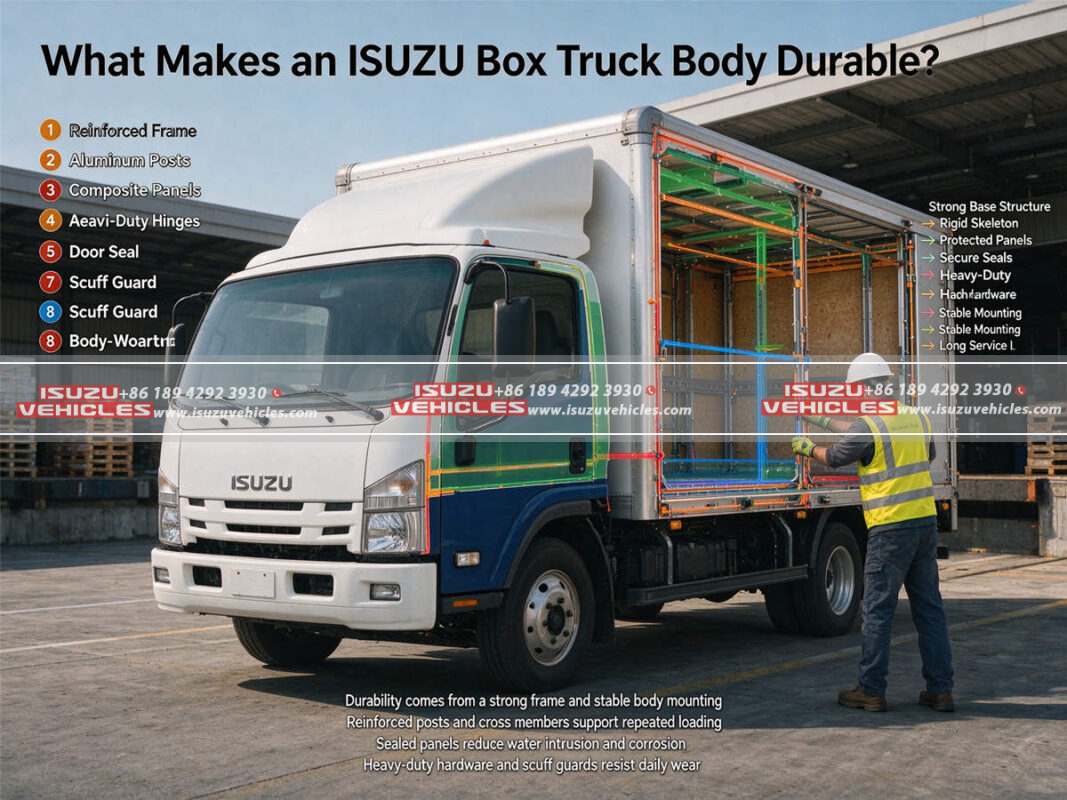
When purchasing a commercial vehicle, buyers often pay close attention to engine horsepower, payload capacity, fuel consumption, and chassis specifications, but one important factor that deserves just as much attention is the durability of the cargo body. For businesses that depend on daily transportation, a damaged or poorly constructed box body can lead to unexpected repair expenses, cargo damage, delivery delays, and unnecessary vehicle downtime. This is particularly important for logistics companies, construction suppliers, manufacturers, and distributors that regularly transport heavy goods across different road conditions.
An ISUZU kaxxa tat-trakk korp is designed around the practical requirements of commercial transportation, where structural strength, weather protection, loading convenience, and long-term reliability all contribute to the vehicle’s overall performance. However, durability does not come from a single component or material. It is the result of several factors working together, including the quality of the body panels, floor reinforcement, structural framework, welding and fastening techniques, protective coatings, door construction, and the way the cargo body is mounted onto the chassis.
Whether a company operates a medium-duty cargo truck for regional distribution or a compact mini truck for urban deliveries, choosing the right body configuration can make a considerable difference to its operating costs over time. Understanding these construction details helps buyers evaluate commercial vehicles more accurately and select a transportation solution that can withstand the demands of everyday business operations.
1. High-Quality Body Materials Provide the Foundation for Durability
The material used to manufacture a box truck body has a direct influence on its structural strength, overall weight, corrosion resistance, and ability to withstand repeated loading and unloading. Different transportation applications require different material characteristics, which is why manufacturers commonly offer steel, aluminum, and composite panel constructions depending on the vehicle’s intended purpose.
Steel Construction for Heavy-Duty Transportation
Steel is widely used in commercial truck body manufacturing because it offers excellent mechanical strength and can withstand considerable impact and structural stress when properly engineered. For businesses transporting machinery, metal products, industrial equipment, and construction materials, a reinforced steel body can provide reliable protection against demanding working conditions.
One important advantage of steel is its flexibility during fabrication. Manufacturers can select different material thicknesses for the floor, side panels, supporting framework, and mounting brackets according to the expected loading conditions. For example, a truck designed to transport heavy industrial equipment may require a stronger floor structure and reinforced lower side panels, while a vehicle carrying ordinary packaged products may not need the same level of reinforcement throughout the cargo compartment.
However, steel is heavier than aluminum and requires suitable corrosion protection, especially when the truck operates in humid environments, coastal regions, or areas where the cargo body frequently comes into contact with water. Protective paint, primer, galvanizing where specified, and proper maintenance can help prevent corrosion from gradually weakening exposed metal surfaces.
Aluminum Panels for Weight Reduction and Corrosion Resistance
Aluminum is another popular material for commercial box truck bodies because it combines relatively low weight with good resistance to atmospheric corrosion. A lighter body can increase the vehicle’s available payload capacity, allowing businesses to transport more goods without unnecessarily increasing the vehicle’s overall weight.
This advantage is particularly useful for urban delivery fleets and companies transporting packaged products over long distances. Nevertheless, aluminum body construction must be properly engineered because panel thickness, structural profiles, fastening methods, and supporting members all affect the finished body’s ability to resist deformation.
For buyers considering an ISUZU box truck, the decision between steel and aluminum should be based on actual cargo weight, loading methods, operating environment, and expected service life rather than simply choosing the thickest or lightest material available.
2. Reinforced Floor Structures and Supporting Frameworks Prevent Deformation
Although the exterior appearance of a box truck attracts attention, the floor and internal supporting framework are among the most important elements determining whether the cargo body can withstand repeated heavy loading. Every time a forklift enters the compartment, pallets are moved, or industrial equipment is secured inside, considerable forces are transferred through the floor and supporting structure.
Heavy-Duty Flooring Handles Repeated Loading
A durable box truck floor must support the combined weight of the cargo, handling equipment, and concentrated loads without excessive bending or permanent deformation. Steel plates are frequently used for demanding applications because they offer good resistance to mechanical damage, while aluminum flooring can provide a lighter alternative when the supporting structure is designed appropriately.
For example, a logistics company transporting palletized machinery may need a floor capable of handling repeated forklift movements, whereas a retail distribution truck carrying cartons and household products may operate satisfactorily with a lighter floor configuration. Selecting the correct flooring material and thickness according to actual loading conditions helps prevent premature wear and unnecessary repair costs.
Crossmembers and Longitudinal Supports Improve Structural Stability
Crossmembers are structural components positioned beneath the cargo floor to distribute loads and transfer forces toward the vehicle chassis. Their dimensions, spacing, material quality, and connection methods influence how effectively the floor handles heavy cargo and road-induced vibration.
Longitudinal supports also contribute to the overall rigidity of the body, helping maintain its shape when the vehicle travels over uneven surfaces or carries unevenly distributed loads. A well-designed combination of crossmembers and longitudinal reinforcement reduces localized stress and helps protect the cargo compartment against long-term deformation.
For this reason, buyers should not evaluate body durability simply by looking at the exterior panels. Asking about floor thickness, supporting beam arrangements, reinforcement locations, and maximum permitted loading conditions provides a much better understanding of the body’s actual capabilities.
3. Strong Welding, Secure Fasteners, and Chassis Connections Matter
Even when high-quality steel or aluminum is used, the finished box body can become unreliable if its individual components are not connected properly. Welding quality, fastener selection, joint design, and assembly accuracy all influence the ability of the cargo compartment to withstand years of vibration, loading impacts, and changing road conditions.
Consistent Welding Quality Strengthens the Body
Welding is commonly used to connect metal framework components, brackets, supports, and other structural elements. Properly executed welds create strong joints that help distribute mechanical forces throughout the structure, while poor welding can produce weak areas that gradually develop cracks under repeated stress.
Manufacturers should pay particular attention to high-stress areas, including floor-to-frame connections, corner joints, door frames, and supporting brackets. Consistent welding quality, suitable joint preparation, and appropriate inspection procedures help ensure that the finished body maintains its structural integrity during normal commercial operation.
Reliable Chassis Mounting Prevents Excessive Movement
The connection between the cargo body and the truck chassis is equally important because the vehicle is constantly exposed to vibration, braking forces, acceleration, cornering, and road impacts. If the mounting arrangement is poorly designed, excessive movement can place additional stress on the body structure and gradually damage its connections.
A suitable mounting system should transfer loads effectively while taking the chassis design and its expected movement into account. Mounting brackets, fastening hardware, and other connection components must be selected according to the manufacturer’s engineering requirements rather than installed using an arbitrary arrangement.
This is particularly important for larger cargo truck configurations, where longer body structures and heavier payloads create greater demands on the supporting chassis. Matching the body to the correct ISUZU vehicle platform is therefore an essential part of achieving long-term durability.
4. Protective Coatings and Weatherproof Design Extend Service Life
Commercial trucks operate in environments that are rarely ideal. Rain, sunlight, road dust, mud, humidity, temperature changes, and occasional chemical exposure can gradually affect exterior surfaces and structural components. A durable box truck body therefore needs more than strong construction materials; it also requires effective protection against environmental damage.
Corrosion Protection Keeps Metal Components in Good Condition
Steel surfaces can gradually rust when protective coatings are scratched or damaged, particularly around door edges, lower side panels, floor joints, and exposed mounting points. If corrosion is allowed to spread, it may eventually affect the strength of the material and require more extensive repairs.
Proper surface preparation, anti-corrosion primers, suitable topcoats, and regular inspections can significantly reduce this risk. Buyers operating vehicles in coastal regions or tropical climates should pay particular attention to corrosion protection because frequent moisture exposure can accelerate deterioration.
Sealed Joints Protect Cargo from External Conditions
An enclosed box body should prevent rainwater, dust, and road debris from entering the cargo compartment through gaps around the roof, walls, corners, and doors. High-quality sealing materials and accurately fitted panels help maintain a protective interior environment while reducing the likelihood of water damage to transported products.
Door seals deserve special attention because rear doors are opened and closed repeatedly throughout the vehicle’s working life. Durable hinges, locking mechanisms, weather-resistant seals, and properly aligned door frames help maintain secure closure even after frequent loading operations.
For businesses transporting valuable merchandise, electronics, furniture, or packaged consumer products, these details are just as important as the strength of the main body framework.
5. Door Design, Cargo Protection, and Practical Loading Features
A box truck body must remain durable not only while driving but also during the repeated loading and unloading activities that take place at warehouses, distribution centers, retail locations, and construction sites. Doors, hinges, locking systems, interior walls, and cargo-securing equipment are therefore essential parts of the overall body design.
Reinforced Rear Doors and Heavy-Duty Hinges
Rear doors are among the most frequently operated components of an enclosed cargo body. They must withstand repeated opening and closing, occasional contact with loading equipment, and vibration during transportation without becoming difficult to operate or losing their ability to seal properly.
Strong hinges, durable locking bars, reinforced door frames, and suitable handles help maintain reliable operation. Depending on the application, buyers can choose conventional swing doors or roll-up doors, with each arrangement offering different advantages in terms of access, maintenance, and available working space.
Interior Protection and Cargo-Securing Equipment
Even a structurally strong box body can suffer unnecessary damage if heavy goods are allowed to move freely during transportation. Cargo may slide during braking, strike the interior walls when the vehicle turns, or damage the floor when poorly secured equipment shifts over uneven roads.
Interior tie-down rings, load-securing rails, protective wall panels, and suitable floor coverings can help reduce these risks. Their positions should be planned around the dimensions, weight, and securing requirements of the cargo rather than added without considering actual operating conditions.
For example, a truck carrying metal components may require reinforced securing points and protective floor sections, while a vehicle transporting furniture may benefit more from smooth interior panels and additional padding to prevent scratches.
6. Matching the Box Body to the Right ISUZU Truck Chassis
One of the most important factors affecting the working life of a box truck is whether its cargo body is correctly matched to the vehicle chassis. A strong body installed on an unsuitable chassis may still experience excessive stress, poor handling, and premature component wear. The vehicle’s frame, suspension, axles, tires, braking system, and engine must all be appropriate for the completed vehicle’s weight and operating requirements.
ISUZU Mini Trucks for Urban Distribution
For businesses making frequent deliveries in congested cities, an Trakk żgħir ISUZU can provide a practical combination of compact dimensions, maneuverability, and useful cargo capacity. Smaller vehicles are particularly suitable for transporting retail products, packaged goods, tools, and light industrial supplies through narrow streets and restricted loading areas.
The cargo body should be designed with the vehicle’s available payload and chassis dimensions in mind. An unnecessarily heavy body can reduce usable cargo capacity, while an oversized compartment may affect maneuverability and vehicle stability.
Businesses interested in compact commercial transportation can explore the ISUZU Mini Truck range to compare available configurations and applications.
Medium and Heavy-Duty Platforms for Larger Cargo Bodies
When transportation requirements increase, medium-duty and larger truck platforms may provide the additional chassis capacity and cargo space required for regional freight and industrial deliveries. ISUZU N-Series and F-Series configurations, for example, can support different body lengths and commercial applications depending on the specific vehicle specifications.
For businesses transporting larger volumes of packaged products, industrial equipment, or general merchandise, selecting a suitable wheelbase and cargo compartment length helps maintain an appropriate balance between loading capacity and road performance.
Buyers can compare available ISUZU Box Truck models u, ISUZU Cargo Truck configurations to identify a vehicle that matches their transportation requirements.
At Vetturi ISUZU, the objective is to provide commercial vehicle solutions that can be configured for different industries and working environments. Customers should provide information about cargo weight, body dimensions, road conditions, loading methods, and daily operating distances so that the appropriate chassis and body combination can be determined.
7. Regular Maintenance Is Essential for Long-Term Box Truck Durability
Even a well-manufactured box truck body requires regular inspection and maintenance if it is expected to remain in good condition over many years of commercial operation. Daily loading activities, road vibration, weather exposure, and accidental impacts can gradually affect different structural components, making preventive maintenance an important part of fleet management.
Inspect the Floor, Panels, and Structural Joints
Fleet operators should periodically check the cargo floor for cracks, deformation, loose panels, and areas showing signs of excessive wear. Side panels, roof joints, corner sections, and supporting brackets should also be inspected for damage, corrosion, or loose connections. Identifying minor problems early can prevent them from developing into more expensive structural repairs.
Maintain Doors, Hinges, and Sealing Systems
Door hinges and locking mechanisms should be checked regularly to ensure smooth operation and secure closure. Worn seals should be replaced when they no longer provide adequate protection against rain and dust, while damaged door frames should be repaired before misalignment causes additional problems.
Clean the Cargo Compartment and Repair Surface Damage
Regular cleaning helps prevent accumulated dirt, moisture, and corrosive substances from damaging interior surfaces. Any scratches or damaged protective coatings on steel components should be addressed promptly, particularly around floor edges and areas exposed to water.
Operators should also ensure that cargo is loaded within the vehicle’s rated capacity and secured according to its weight and dimensions. Overloading, uneven weight distribution, and unsuitable loading equipment can shorten the service life of even a well-engineered truck body.
Ultimately, what makes an ISUZU box truck body durable is the combination of suitable materials, reinforced structural components, reliable manufacturing, effective corrosion protection, strong chassis connections, and consistent maintenance. When these factors are properly considered, a box truck can provide dependable cargo protection and support efficient commercial transportation across a wide range of working conditions. For buyers choosing their next Trakk tal-merkanzija ISUZU, evaluating the complete body and chassis configuration is one of the most practical ways to achieve long-term value and reliable business performance.