
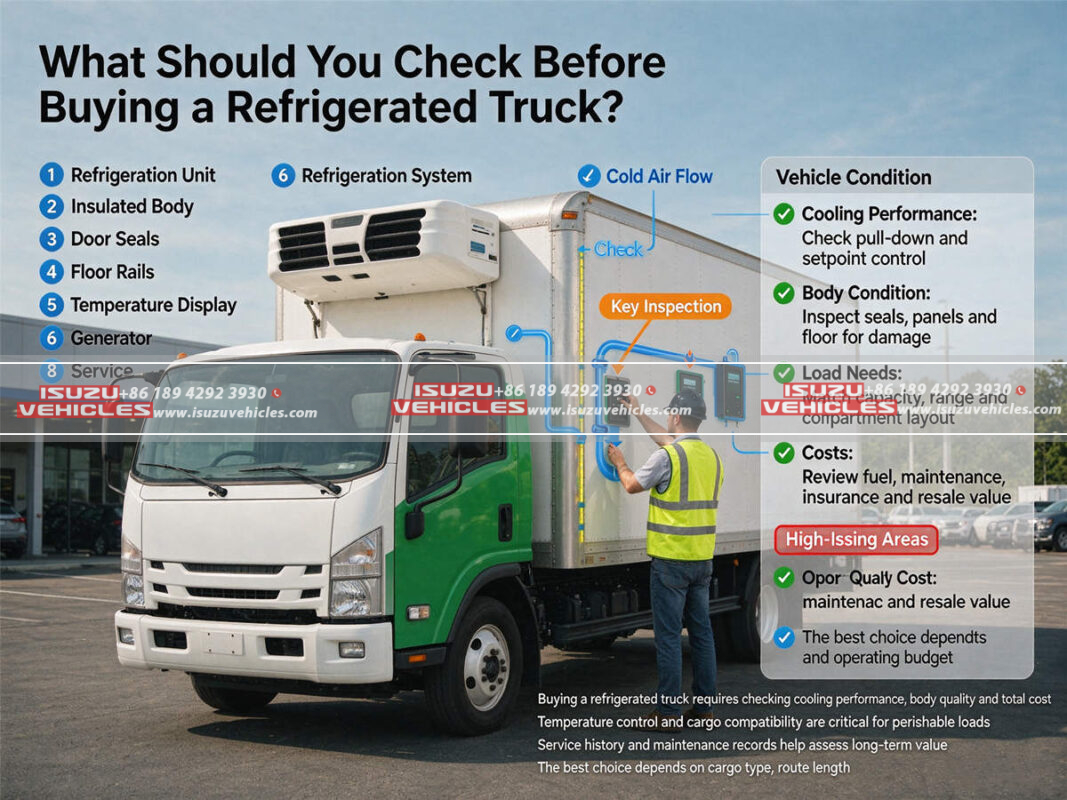
ซื้อ a รถบรรทุกตู้เย็น is an important investment for businesses involved in food distribution, cold-chain logistics, pharmaceutical transportation, agricultural products, and other industries that depend on temperature-controlled delivery. Unlike an ordinary cargo truck, a refrigerated vehicle must do more than transport goods safely from one location to another; it must also maintain a suitable internal temperature throughout the journey, protect products from external heat, and provide consistent cooling performance under different operating conditions. A truck that looks impressive on the outside but has an undersized refrigeration unit, poor insulation, or an unsuitable cargo compartment can quickly become an expensive problem for its owner.
For this reason, choosing the right refrigerated truck requires a comprehensive evaluation of the chassis, engine, refrigeration system, insulated box body, payload capacity, temperature-control equipment, and maintenance requirements. Buyers should also consider the type of products they intend to transport, the distance between delivery locations, local climate conditions, and how frequently the cargo doors will be opened during daily operations. These factors determine whether a particular vehicle can perform reliably in real working environments rather than simply meeting its advertised specifications.
Whether you are purchasing a compact refrigerated delivery van for urban distribution or a large refrigerated cargo truck for regional transportation, understanding these details can help you avoid unnecessary expenses and select a vehicle that offers long-term commercial value. At รถยนต์อีซูซุ, different refrigerated truck configurations are available for businesses with varying transportation requirements, including compact delivery models, medium-duty freezer trucks, and larger refrigerated box trucks.
1. Check the Refrigeration Unit and Its Cooling Capacity
The refrigeration unit is arguably the most important component of a refrigerated truck because it is responsible for removing heat from the cargo compartment and maintaining the required transportation temperature. However, buyers should not judge a refrigeration system simply by its advertised minimum temperature. A unit capable of reaching -20°C under certain conditions may still be unsuitable for a particular operation if its cooling capacity is insufficient for the cargo volume, outside temperature, insulation performance, or frequency of door opening.
Match Cooling Capacity to Cargo Box Dimensions
The first thing to check is whether the refrigeration unit is appropriately matched to the internal dimensions of the insulated cargo body. A small refrigerated compartment generally requires less cooling capacity than a large box truck, while vehicles operating in tropical climates or making frequent deliveries may need additional cooling performance to compensate for greater heat entering the compartment.
For example, a compact refrigerated truck transporting dairy products through a city may operate with a relatively small cargo compartment and frequent stops. In contrast, a large refrigerated truck carrying frozen meat over several hours may require a more powerful refrigeration system, particularly when operating in areas with high ambient temperatures. Selecting the correct unit helps maintain temperature stability without placing unnecessary demands on the equipment.
Understand the Required Temperature Range
Different products require different transportation temperatures, so buyers should identify their actual cargo requirements before selecting a refrigeration unit. Fresh vegetables and fruits generally require controlled cooling rather than freezing, while frozen meat, seafood, and ice cream need significantly lower temperatures. Certain pharmaceutical products also require carefully controlled temperature ranges according to their specific handling requirements.
As a general purchasing reference, refrigerated transportation applications may involve the following temperature ranges, although the exact requirements should always be confirmed against the product manufacturer’s storage and transportation instructions.
- ผลไม้และผักสด: Commonly transported at approximately +2°C to +10°C, depending on the product.
- ผลิตภัณฑ์นม: Often require controlled chilled conditions, commonly around +2°C to +6°C.
- Fresh meat and seafood: Generally require low-temperature transportation, with exact settings depending on the product and applicable food-safety requirements.
- อาหารแช่แข็ง: Frequently transported at approximately -18°C or below, depending on the product specifications.
- ผลิตภัณฑ์ยา: May require specific controlled ranges, such as +2°C to +8°C, or other validated conditions.
A good refrigerated truck should have a reliable temperature-control system that allows the operator to monitor the internal environment and identify temperature deviations promptly. Buyers should also ask whether the refrigeration unit supports continuous operation during loading, unloading, and temporary vehicle stops, because these situations can affect cargo temperature stability.
Inspect the Compressor, Condenser, and Evaporator
The refrigeration compressor, condenser, and evaporator work together to remove heat from the cargo compartment. The compressor circulates refrigerant through the system, the condenser releases heat to the outside environment, and the evaporator absorbs heat from inside the insulated body. If any of these components is incorrectly sized, poorly installed, or inadequately maintained, the entire refrigeration system may struggle to perform as expected.
Before purchasing, check the equipment manufacturer’s specifications, cooling capacity, installation quality, maintenance requirements, and availability of replacement components. It is also advisable to request a practical cooling demonstration rather than relying entirely on written specifications.
2. Examine the Insulated Cargo Box Body and Its Construction
Even the most powerful refrigeration unit cannot maintain stable cargo temperatures efficiently if the insulated box body allows excessive heat to enter. The cargo compartment acts as a thermal barrier between the internal refrigerated environment and the outside atmosphere, so its materials, thickness, joints, and overall construction have a direct influence on refrigeration performance.
Check the Insulation Material and Thickness
Polyurethane (PU) foam is widely used in refrigerated truck bodies because it offers good thermal insulation and can be incorporated into lightweight sandwich-panel structures. These panels generally consist of an inner protective surface, an insulation core, and an exterior protective layer. The quality of the insulation material, its density, installation consistency, and panel thickness all influence the body’s ability to reduce heat transfer.
For ordinary chilled transportation, the insulation requirements may differ from those of a freezer truck designed to maintain sub-zero temperatures. A vehicle carrying frozen seafood over long distances generally needs a more carefully engineered thermal enclosure than a truck transporting fresh vegetables over short urban routes.
Buyers should ask the manufacturer for the insulation material specifications, panel thickness, thermal performance information, and details about how the panels are joined together. They should also inspect the interior and exterior surfaces for cracks, gaps, uneven finishing, or visible signs of poor assembly.
Inspect the Floor, Roof, and Side Panels
The floor deserves particular attention because it must provide sufficient structural strength while maintaining effective thermal insulation. Depending on the application, refrigerated truck floors may incorporate reinforced sandwich panels, aluminum profiles, or specialized flooring systems designed to support cargo loads and facilitate cleaning.
For businesses transporting meat, seafood, dairy products, or frozen food, the floor should be durable, moisture-resistant, and easy to clean. Drainage arrangements may also be necessary depending on the cargo and cleaning procedures. Buyers should check whether the floor can support the expected cargo weight and whether the design allows cold air to circulate effectively throughout the compartment.
The roof and side panels should also be inspected for damage, poor sealing, and weak joints. Any significant gap in the insulated enclosure can increase heat infiltration, making the refrigeration system work harder and potentially increasing fuel or electricity consumption.
Pay Attention to Rear Door Seals
Rear doors are among the most frequently used components of a refrigerated truck, especially in distribution operations involving multiple delivery locations. Each time the doors open, warm outside air can enter the compartment, increasing the cooling load and potentially affecting sensitive products.
Check the condition of the rubber seals, hinges, locking mechanisms, and door frames. The doors should close firmly without leaving visible gaps, and the sealing material should remain flexible and properly positioned. For businesses that make frequent deliveries, reliable door construction is essential for maintaining temperature stability and reducing unnecessary energy consumption.
3. Evaluate the Chassis, Engine, Payload, and Vehicle Dimensions
A refrigerated truck is not simply an insulated box fitted with a cooling machine; it is a complete commercial vehicle whose chassis, engine, suspension, transmission, axles, and braking system must work together under the additional weight of refrigeration equipment and insulation materials. Choosing an unsuitable chassis can result in reduced payload capacity, excessive mechanical stress, poor fuel efficiency, and higher maintenance costs.
Understand the Relationship Between GVW and Payload
One of the most important specifications to check is the gross vehicle weight rating (GVWR), which represents the maximum permitted operating weight of the completed vehicle. The actual available payload is calculated by subtracting the vehicle’s curb weight from its GVWR.
For example, suppose a refrigerated truck has a GVWR of 7,000 kg and a completed curb weight of 4,000 kg. Its nominal payload capacity is 3,000 kg. However, buyers must also consider the weight of the refrigeration system, driver, fuel, accessories, and other operating equipment according to how the manufacturer defines the vehicle’s curb weight.
It is also necessary to check the front and rear axle ratings because a truck may remain below its overall weight limit while exceeding the permitted load on one axle. Proper cargo distribution is therefore essential for maintaining safe operation.
Choose the Appropriate Engine and Transmission
The engine should provide sufficient power and torque for the vehicle’s operating weight, road conditions, and expected driving distance. A refrigerated truck carrying a full cargo load through mountainous areas or operating in hot climates may require a different power configuration from a smaller vehicle making short-distance urban deliveries.
Buyers should compare engine displacement, rated power, maximum torque, emission standards, fuel consumption, transmission ratios, and service requirements. The transmission should also be appropriate for the vehicle’s operating conditions, particularly when the truck frequently starts and stops or operates on steep roads.
It is important to remember that the refrigeration unit may have its own power requirements. Some systems operate through the vehicle engine using a suitable power take-off or dedicated drive arrangement, while others use independent diesel engines or electrical power systems. The buyer should confirm exactly how the refrigeration equipment is powered and whether the arrangement affects vehicle performance and operating costs.
Select the Right Cargo Box Dimensions
The cargo compartment should be large enough for the intended products but not unnecessarily oversized. A larger refrigerated box requires more cooling capacity and generally increases the weight and external dimensions of the completed vehicle. It may also make the truck more difficult to maneuver in crowded urban environments.
For example, a small food distributor making deliveries to restaurants and supermarkets may benefit from a compact refrigerated box truck with a shorter wheelbase. A regional wholesaler transporting larger quantities of frozen products may need a medium-duty or heavy-duty configuration with substantially greater cargo volume.
Businesses can compare available ISUZU Refrigerated Truck models to evaluate different cargo box dimensions, vehicle configurations, and transportation applications.
4. Check Temperature Monitoring, Air Circulation, and Electrical Systems
Maintaining the correct temperature requires more than installing a refrigeration unit with sufficient cooling capacity. The system must also distribute cold air effectively, provide accurate temperature readings, and allow operators to identify problems before they affect the cargo. These features are particularly important for businesses transporting products with strict storage requirements.
Temperature Monitoring and Digital Controls
A modern refrigerated truck should provide a practical temperature-monitoring system that allows the driver or operator to check the internal cargo environment during transportation. Depending on the equipment, the control panel may display the current temperature, target temperature, operating status, alarms, and other refrigeration information.
For professional cold-chain transportation, buyers should consider whether the system supports temperature recording, data export, alarm notifications, and remote monitoring. These functions can help businesses maintain transportation records, investigate temperature deviations, and demonstrate that products have been handled according to the required procedures.
For pharmaceutical transportation and other regulated applications, the monitoring equipment may need calibration, documented validation, and additional temperature sensors positioned according to the applicable quality requirements. A standard temperature display should not automatically be assumed to provide regulatory compliance.
Airflow Distribution Inside the Cargo Compartment
Cold air must circulate properly throughout the cargo compartment to avoid significant temperature differences between different loading positions. If products are stacked too closely together or placed directly against the evaporator airflow outlets, certain areas may become colder while other sections remain warmer.
Before purchasing, inspect the evaporator installation, air outlets, return-air arrangement, and available cargo space. Ask whether the body design supports the airflow requirements of the intended products and whether there are recommended clearance distances between the cargo and interior walls.
For example, a refrigerated truck carrying fresh vegetables should allow sufficient airflow around the products to maintain consistent cooling. Similarly, frozen food should be loaded in a way that does not block the refrigeration system’s air circulation paths.
Electrical System and Refrigeration Protection
The refrigeration equipment depends on reliable electrical connections, control circuits, sensors, and protective devices. Poor wiring, loose connections, inadequate protection, or unsuitable battery capacity can cause intermittent failures and make temperature control unreliable.
Buyers should inspect the wiring arrangement, control panel, electrical protection, battery specifications, and charging system. If the refrigeration unit uses independent power, its separate fuel supply and starting system should also be checked.
For vehicles that need to maintain cooling while parked, it is particularly important to understand the standby operating arrangement and the availability of an external power connection, if supported by the selected refrigeration system.
5. Inspect the Refrigerated Truck’s Maintenance Requirements and Serviceability
A refrigerated truck contains two major systems that require regular maintenance: the vehicle chassis and the refrigeration equipment. A mechanical problem can interrupt transportation, while a refrigeration failure can directly affect the quality and commercial value of the cargo. For this reason, buyers should evaluate the availability of maintenance services, spare parts, technical support, and warranty coverage before completing the purchase.
Check the Availability of Refrigeration Parts
Ask the supplier whether commonly replaced refrigeration components are readily available in the intended operating country. These may include compressors, fans, condenser components, evaporator motors, temperature sensors, control modules, refrigerant-related service components, and door sealing materials.
It is also worth checking whether local technicians have experience servicing the selected refrigeration equipment. A system with excellent cooling specifications may become inconvenient if replacement components are difficult to obtain or specialized repairs require long periods of vehicle downtime.
Understand the Regular Maintenance Schedule
The refrigeration unit should be inspected according to its manufacturer’s recommended service intervals. Typical maintenance activities include cleaning the condenser, checking electrical connections, inspecting fans, examining refrigerant-system performance, testing temperature sensors, and verifying that the evaporator and drainage arrangements remain in good condition.
The vehicle itself also requires normal commercial truck maintenance, including engine oil changes, transmission inspections, brake servicing, suspension checks, tire replacement, and chassis inspections. Combining these maintenance activities into a practical fleet management schedule can help reduce unexpected downtime.
Review Warranty Coverage and Technical Support
Before purchasing, buyers should clarify the warranty coverage for the chassis, engine, transmission, insulated body, and refrigeration equipment. These components may have different warranty conditions, service intervals, and exclusions.
It is also advisable to request operating manuals, refrigeration equipment documentation, electrical diagrams where available, and recommended maintenance procedures. Clear technical documentation makes it easier for local technicians to diagnose problems and helps operators use the vehicle correctly.
6. Consider Your Actual Transportation Business and Operating Environment
The best refrigerated truck is not necessarily the largest or most powerful model. It is the vehicle that matches the business’s daily transportation requirements, cargo characteristics, delivery routes, and available operating budget. Buyers should therefore consider how the truck will be used over its entire working life rather than focusing only on its initial purchase price.
Choose According to the Type of Cargo
Different products require different transportation arrangements. Fresh produce, dairy products, frozen meat, seafood, ice cream, and pharmaceutical products should not automatically be treated as identical refrigeration applications.
For example, a supermarket supplier delivering fresh vegetables and dairy products may need a chilled vehicle with suitable temperature settings and practical loading access. A frozen food distributor may require a freezer truck capable of maintaining lower temperatures throughout longer journeys. Pharmaceutical distributors may need additional monitoring and documented temperature-control procedures.
Businesses should also consider whether different products can safely share the same cargo compartment. Some products have different temperature, humidity, odor-control, or cross-contamination requirements, which may make separate compartments or dedicated vehicles more appropriate.
Consider Climate and Road Conditions
A refrigerated truck operating in a hot tropical region faces different cooling demands from one working in a temperate climate. High outside temperatures increase heat transfer through the insulated body, while frequent door opening introduces additional warm air into the compartment.
Road conditions also influence the vehicle selection. Businesses operating on mountainous roads or poorly maintained routes should pay attention to engine performance, suspension specifications, ground clearance, tire selection, and chassis durability. A suitable refrigerated truck should be capable of handling both its cargo requirements and the road conditions it encounters regularly.
คำนวณต้นทุนรวมในการเป็นเจ้าของ
The initial purchase price is only one part of the investment. Fuel consumption, refrigeration energy requirements, routine maintenance, spare parts, insurance, driver expenses, depreciation, and possible cargo losses should all be included when estimating the total cost of ownership.
For example, a cheaper truck with poor insulation may require more refrigeration operation to maintain the target temperature, increasing energy consumption and potentially reducing equipment service life. A vehicle with a well-designed insulated body and appropriately sized refrigeration unit may have a higher initial cost but offer better operating efficiency over several years.
Buyers should also consider the cost of product spoilage. For a business transporting expensive seafood, meat, or pharmaceutical products, even one serious refrigeration failure can result in losses that exceed the price difference between two vehicle configurations.
7. Why Consider ISUZU Vehicles When Buying a Refrigerated Truck?
When selecting a refrigerated commercial vehicle, buyers should consider the complete package, including the chassis, engine, cargo body, refrigeration equipment, payload, and technical support. A vehicle designed specifically for cold-chain transportation should provide a suitable combination of road performance, cargo protection, and temperature-control capability.
รถยนต์อีซูซุ offers different refrigerated truck configurations based on commercial vehicle platforms such as the ELF, N-Series, F-Series, and GIGA, depending on the model and application. These options allow businesses to consider different cargo volumes and vehicle sizes instead of purchasing a single configuration that may not match their actual requirements.
Compact Refrigerated Trucks for Urban Distribution
Smaller refrigerated vehicles are suitable for businesses that make frequent deliveries to supermarkets, restaurants, convenience stores, food shops, and local distribution points. Their relatively compact dimensions can make them easier to operate in congested urban environments, while appropriately designed insulated bodies provide the temperature-controlled space required for daily deliveries.
Medium-Duty Refrigerated Trucks for Regional Transportation
For distributors transporting larger quantities of fresh or frozen products, medium-duty refrigerated trucks can provide a useful balance between cargo volume, payload capacity, and operating efficiency. Buyers can consider different cargo box lengths and refrigeration configurations according to the intended products and transportation routes.
การขอ ISUZU N-Series truck range และ ISUZU F-Series truck range provide additional options for businesses evaluating commercial chassis platforms for refrigerated transportation.
Larger Refrigerated Trucks for High-Volume Logistics
Businesses operating regional or long-distance cold-chain distribution networks may require larger refrigerated compartments and higher-capacity vehicle platforms. In these situations, buyers should pay particular attention to the completed vehicle’s GVW, payload, axle ratings, refrigeration capacity, and operating costs.
การขอ ISUZU Refrigerated Truck category provides different configurations for comparison, including compact refrigerated vehicles, freezer box trucks, and larger refrigerated cargo trucks.
When requesting a quotation from ISUZU Vehicles, buyers should provide the required cargo box dimensions, intended cargo type, target transportation temperature, estimated cargo weight, daily mileage, operating climate, and preferred refrigeration equipment. Providing these details makes it easier to identify a suitable vehicle configuration and avoid paying for unnecessary specifications.
Ultimately, purchasing a refrigerated truck should be treated as a long-term business decision rather than simply buying a commercial vehicle with a cooling machine. The refrigeration unit must match the cargo requirements, the insulated body must minimize heat transfer, and the chassis must safely support the completed vehicle and its intended payload. By carefully checking these essential components, comparing maintenance requirements, and evaluating actual operating conditions, businesses can choose a refrigerated truck that protects valuable products, improves delivery reliability, and supports sustainable cold-chain operations. With the appropriate configuration from รถยนต์อีซูซุ, companies can build a more dependable transportation system for fresh food, frozen products, pharmaceuticals, and other temperature-sensitive goods.