
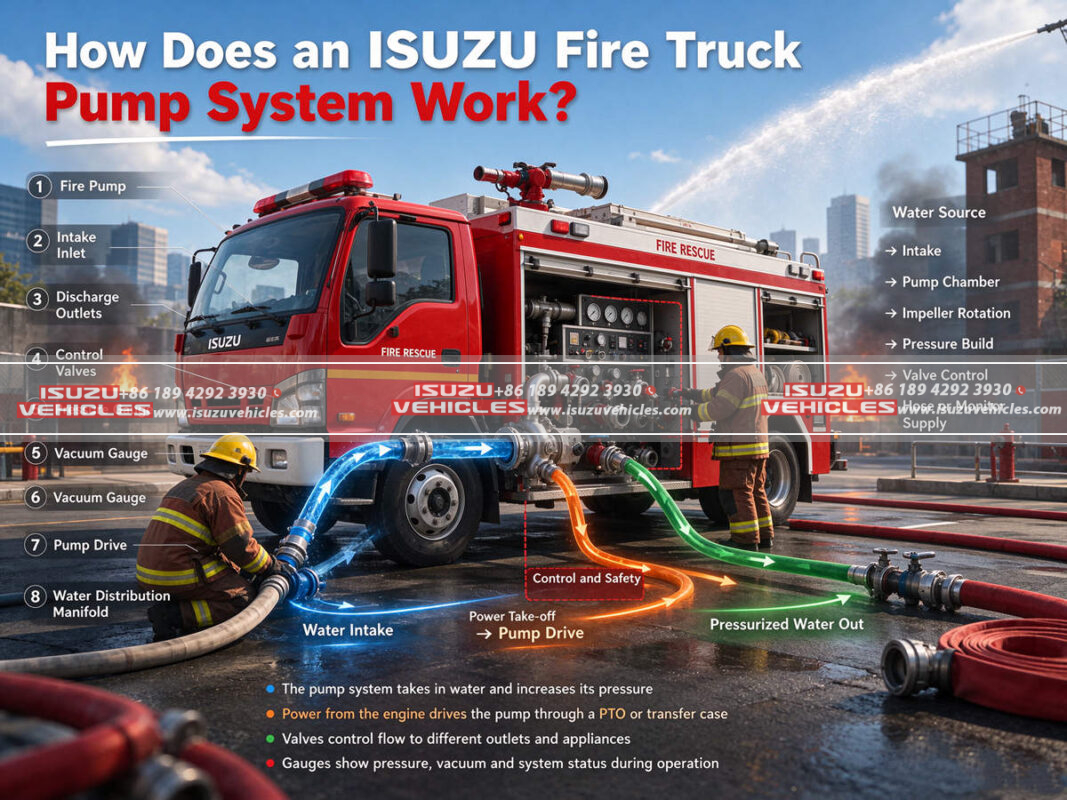
A yong'inga qarshi vosita arrives at an emergency scene, one of its most important jobs is to turn an available water supply into a controlled, reliable stream that firefighters can direct toward the fire. The water tank, hoses, nozzles, and fire monitor are all essential parts of this process, but the component that makes the entire water delivery system work is the yong'inga qarshi nasos. Without a properly designed pump system, even a large-capacity water tank would have limited firefighting value because water must be delivered at the appropriate pressure and flow rate to reach the target effectively.
An ISUZU fire truck pump system is designed to draw water from the onboard tank or an external source, increase its pressure, and distribute it through a network of pipes, valves, hose outlets, and firefighting equipment. Depending on the vehicle configuration, the system may also include a priming device, foam proportioning equipment, a roof-mounted fire monitor, and electronic or mechanical controls that help the operator manage water delivery during an emergency.
Understanding how these components work together is important for fire departments, industrial emergency teams, and fleet buyers who need to select a suitable firefighting vehicle. ISUZU Vehicles offers different fire truck configurations for municipal firefighting, industrial fire protection, water supply, and rescue operations, with pump capacity and equipment layouts selected according to the intended application. This guide explains the working principles of an ISUZU fire truck pump system, from the initial water supply to the final discharge at the nozzle.
1. The Main Components of an ISUZU Fire Truck Pump System
A fire truck pump system is more than a single mechanical pump mounted on the chassis. It is an integrated arrangement of equipment that controls how water enters the vehicle’s pumping circuit, how pressure is generated, and how water is distributed to different firefighting outlets. Although the exact layout varies between models, most conventional water fire trucks share several important components.
Yong'in pompasi
The fire pump is the central component of the system, and many modern fire engines use a markazdan qochma yong'in pompasi because it can deliver substantial water flow while maintaining the pressure required for firefighting. Inside the pump, a rotating impeller accelerates water outward from its center, transferring mechanical energy to the water. The pump casing then collects and directs the moving water toward the discharge outlet, where it enters the vehicle’s firefighting pipeline.
Depending on the vehicle’s intended duties, the pump may be installed in a mid-mounted, rear-mounted, or other suitable position. Its rated flow, working pressure, drive arrangement, and maintenance access should all be considered when designing the vehicle.
Water tank and intake pipeline
The water tank provides an onboard supply that allows firefighters to begin operations without waiting for a hydrant or external water source. Its capacity depends on the vehicle’s size and operational purpose, with compact urban fire engines generally requiring a different tank configuration from heavy-duty industrial firefighting trucks. The tank is connected to the pump through an intake pipeline, usually with valves and strainers or other protective components that help control the water entering the pump.
Power take-off and drive system
The fire pump requires mechanical power to operate. On many commercial-chassis fire trucks, this power is transferred from the vehicle’s engine through a quvvat olish moslamasi (PTO) and an appropriate transmission or drive arrangement. When the operator engages the pump system according to the manufacturer’s procedure, the PTO transfers engine power to the pump, allowing the impeller to rotate and move water through the system.
Valves, piping, and discharge outlets
The pipeline network connects the pump to the different discharge points on the vehicle. Valves allow the operator to select the required water route, while pressure gauges and control instruments help monitor system performance. Depending on the configuration, the outlets may supply hose reels, conventional fire hoses, roof monitors, or other firefighting equipment.
All these components must be matched to one another. A high-capacity pump cannot perform effectively if the intake piping is too restrictive, the water supply is inadequate, or the discharge system is not designed to handle the required flow and pressure.
2. How the Fire Pump Draws Water and Generates Pressure
The operating principle of a conventional centrifugal fire pump is relatively straightforward, although the engineering behind its impeller, casing, seals, and drive system is carefully designed to deliver reliable performance under demanding conditions. When the pump is engaged and supplied with water, the rotating impeller transfers energy to the water, accelerating it outward through the impeller vanes and into the pump casing. The casing collects this moving water and converts part of its velocity energy into pressure before directing it toward the discharge pipeline.
In practical terms, the pump does not create water or increase the amount available in the tank; instead, it provides the energy needed to move the available water through the firefighting system. The actual water flow depends on the pump’s design, operating speed, available inlet supply, and the resistance created by the hoses, pipes, valves, and nozzles.
Step 1: Water enters the pump
When operating from the onboard tank, water flows through the tank outlet and intake pipeline into the pump. The operator opens the appropriate valves according to the vehicle’s operating instructions, allowing the pump to receive a continuous supply. The intake arrangement should provide sufficient water volume while minimizing unnecessary restrictions that could affect pump performance.
Step 2: The impeller accelerates the water
As the impeller rotates, its blades accelerate water outward from the central inlet area toward the outer section of the pump casing. The water gains velocity and mechanical energy, and the casing guides it toward the discharge passage. This process produces the pressure needed to move water into the vehicle’s outlet piping.
Step 3: Pressurized water enters the distribution system
After leaving the pump, water travels through the discharge manifold and the selected outlet. Depending on the firefighting operation, it may be directed to a hose reel, a handheld hose line, a roof-mounted monitor, or another approved discharge device. The operator adjusts the pump and valves to maintain the required flow and pressure within the system’s rated operating limits.
For example, the published specification for the ISUZU Water Tank and Rescue Service Fire Fighting Truck lists a CB10/60 normal-pressure pump with a rated flow of 60 liters per second at 1.0 MPa. This provides a useful example of how manufacturers describe pump performance, although actual discharge performance will still depend on the water supply, hose arrangement, outlet configuration, and operating conditions.
3. How the Priming System Works When Using External Water Sources
One important feature of many fire truck pump systems is the priming system, which helps the centrifugal pump draw water from an external source when the pump and suction hose contain air. This is particularly important when firefighters need to obtain water from a river, lake, portable reservoir, or other unpressurized source rather than relying entirely on the onboard tank or a pressurized hydrant connection.
A centrifugal fire pump is designed to move water, not to remove large quantities of air from an empty suction line. Before it can draw water effectively from a source located below the pump, the pump casing and suction hose generally need to be filled with water. This process is called priming.
Why priming is necessary
Imagine that a fire truck is parked beside a pond, with its suction hose extending into the water. The water level may be lower than the pump inlet, and the suction hose may contain air before the operation begins. If the operator simply engages an air-filled centrifugal pump, it will normally be unable to create the vacuum required to lift water through the hose and fill the pump casing.
The priming device solves this problem by removing air from the pump and suction line, creating a partial vacuum. Atmospheric pressure acting on the surface of the water then pushes water up through the suction hose and into the pump. Once the pump and suction line are properly filled, the centrifugal pump can begin its normal water-moving operation.
Common priming arrangements
Depending on the design, a fire truck may use an electrically driven vacuum primer, a mechanically driven priming pump, or another approved priming arrangement. Some systems use rotary-vane technology to remove air, while others use different positive-displacement or compressed-air principles. The specific design should be identified in the vehicle’s technical documentation.
When drawing water from a pressurized hydrant or operating through an established relay supply, priming may not be necessary because incoming water pressure can fill the pump and intake line. However, the operator must still follow the correct valve sequence and operating procedure to remove trapped air and establish a stable water supply.
For fire departments that regularly work in rural areas or locations without hydrant infrastructure, the priming system is especially important. It expands the range of water sources available to the vehicle and allows the fire engine to operate in places where a conventional pressurized supply may not be accessible.
4. How Water Is Delivered to Hoses, Hose Reels, and Fire Monitors
Once the pump has established a stable supply, the water must be distributed to the equipment used by firefighters. This is the job of the discharge pipeline, valves, hose connections, and other water-delivery components. The operator selects the appropriate outlet and adjusts the pump to provide the pressure and flow required by the chosen firefighting equipment.
Hose reels for rapid water deployment
A hose reel stores a dedicated length of hose on a rotating drum, allowing firefighters to pull the hose toward a working area without first removing and connecting multiple hose sections. Depending on the vehicle configuration, the reel may be connected directly to the pump distribution system and fitted with a nozzle for controlled water discharge.
Hose reels are particularly useful for localized fires, small outdoor incidents, and situations where a compact line can provide an effective initial response. They do not replace larger attack hoses, which may be necessary when a fire requires substantially higher water flow or longer operating distances.
Fire hoses for larger water delivery requirements
Conventional fire hoses allow firefighters to deliver water from the truck to a working position that may be some distance away. Different hose diameters and lengths are used according to the expected flow, pressure, and operating environment. Larger-diameter hoses can generally support higher water volumes with less friction loss, while smaller hoses may be easier to handle in certain close-range operations.
As water travels through the hose, pressure is lost because of friction, bends, fittings, and elevation differences. The pump operator must therefore consider the complete hose arrangement rather than assuming that the pressure shown on the pump panel will be available at the nozzle.
Roof-mounted fire monitors
Many ISUZU fire trucks are equipped with a roof-mounted fire monitor that can discharge a concentrated stream of water or foam over a greater distance. A monitor is particularly useful when firefighters need to control a large fire from a position that provides more separation from heat, smoke, falling debris, or other hazards.
The monitor is connected to the pump through dedicated piping, and its flow and working pressure must match the pump’s capabilities. Some monitors allow horizontal rotation and vertical adjustment so that the operator can direct the stream toward different areas of the incident. Depending on the model, the monitor may be controlled manually or through an electric operating system.
For example, the published ISUZU 8000L Water Fire Truck configuration combines an 8,000-liter water tank with a CB10/40 fire pump and a PS40 fire monitor. This illustrates how the tank, pump, and monitor are specified as parts of one integrated firefighting vehicle rather than as independent components.
5. How the Foam System Works on an ISUZU Water-Foam Fire Truck
Water is an effective extinguishing agent for many ordinary combustible-material fires, but certain incidents involving flammable liquids require a different approach. In these situations, a suv ko'pikli o't o'chirish mashinasi can provide additional firefighting capability by combining water with a suitable foam concentrate through a proportioning system.
The foam system normally includes a dedicated foam tank, foam concentrate piping, a proportioning device, control valves, and compatible discharge equipment. When the operator selects the foam mode, the system introduces a controlled quantity of foam concentrate into the water stream. The resulting solution is then discharged through a compatible nozzle or monitor, where air may be incorporated to produce finished foam.
Foam proportioning and mixing
The proportioning system controls how much foam concentrate is introduced into the water. Different foam concentrates and firefighting applications require different mixing ratios, so the correct ratio must follow the foam manufacturer’s instructions and the fire department’s operating procedures. Some vehicles use around-the-pump proportioning arrangements, while others use different mechanical or electronic systems.
For example, a published ISUZU Rescue Fire Water and Foam Truck configuration uses a CB10/40 centrifugal pump rated at 40 liters per second at 1.0 MPa, together with a foam system offering adjustable 3% or 6% mixing ratios. The specific ratio and foam concentrate must be selected according to the intended fire risk and the equipment’s approved operating requirements.
How foam supports fire suppression
When applied correctly to a suitable flammable-liquid fire, finished foam can form a blanket over the fuel surface, helping to separate fuel vapors from the surrounding air and reduce the risk of re-ignition. Foam can also provide cooling effects depending on its formulation and application method. It is important to understand that not every foam product is suitable for every fuel or hazard, and the selection of concentrate must comply with relevant safety requirements and local regulations.
For industrial facilities, fuel depots, warehouses, airports, and chemical storage areas, a water-foam fire truck can therefore provide a more flexible firefighting platform than a vehicle designed exclusively for water discharge. Buyers should evaluate the water tank, foam tank, pump, proportioning system, monitor, and hose outlets together to ensure that the complete system supports the intended operation.
Fire departments can explore different ISUZU fire truck configurations when comparing conventional water fire engines, water-foam vehicles, rescue fire trucks, and larger industrial firefighting platforms.
6. What Determines Fire Pump Performance?
The performance of an ISUZU fire truck pump system depends on several factors working together. A pump with a high rated capacity may still deliver disappointing results if the water supply is insufficient, the intake line is restricted, or the discharge equipment requires more pressure than the system can provide. For this reason, fire pump performance should be evaluated as part of the complete vehicle configuration.
Pump flow rate and working pressure
Flow rate describes the volume of water delivered over a specific period, while pressure describes the energy available to move that water through the system. Both values are important because different firefighting operations require different combinations of flow and pressure. A large fire monitor may need a high water volume, while a hose line used for a more localized operation may have different requirements.
Buyers should check the manufacturer’s pump performance curve and confirm the rated flow and pressure at the stated operating conditions. A single maximum pressure figure does not provide enough information to determine whether a pump can support several outlets operating simultaneously.
Engine power and PTO compatibility
The vehicle engine must provide sufficient power to drive the pump while maintaining the required operating speed. The PTO ratio, transmission design, pump drive shaft, and available engine power all influence the system’s performance. If the drive arrangement is incorrectly matched, the pump may fail to reach its intended operating point or may place unnecessary stress on the powertrain.
Water supply and intake conditions
The pump must receive enough water to support the required discharge flow. When operating from an onboard tank, the tank outlet and intake piping must be designed to supply the pump properly. When drawing from an external source, suction hose length, diameter, elevation, strainer condition, and priming performance all become important.
Hose length, nozzle design, and elevation
Longer hoses, smaller hose diameters, restrictive fittings, and elevated discharge points can increase the pressure required at the pump. Nozzle design also determines the pressure and flow needed to produce the intended water stream. Firefighters and pump operators must therefore use the appropriate calculations, charts, and operating procedures for the specific equipment being used.
In a high-rise incident, for example, water may need to travel through a long hose line to reach an upper floor. In an industrial emergency, a roof monitor may require a high-volume water supply over a substantial distance. These different operating conditions should be considered when selecting the fire pump and vehicle configuration.
7. Maintenance, Safety, and the Role of ISUZU Vehicles in Firefighting Operations
A fire pump system must remain reliable even when the vehicle spends long periods waiting for an emergency call. Regular inspection and maintenance help ensure that the pump, PTO, piping, valves, gauges, and priming equipment are ready to operate when required. Neglecting these components can result in leaks, reduced performance, difficulty establishing water supply, or unexpected equipment failure during an emergency.
Routine pump maintenance
- Inspect the pump and connections: Check for water leakage, damaged seals, loose fittings, unusual vibration, and visible corrosion.
- Check the PTO and drive system: Inspect the drive shaft, mounting points, lubrication requirements, and engagement mechanism according to the manufacturer’s schedule.
- Test the priming system: Confirm that the primer operates correctly and that the pump can establish the required suction conditions during approved testing.
- Inspect valves and gauges: Make sure the controls move freely and that pressure and vacuum gauges provide reliable readings.
- Check hoses and monitors: Inspect hoses, couplings, nozzles, and monitor movement for damage, leakage, or blockage.
- Follow pump testing procedures: Carry out scheduled performance tests and record the results so that changes in pump performance can be identified.
Operating safety during firefighting
Firefighters should never exceed the rated pressure of the pump, hoses, valves, or other system components. Sudden changes in valve position can also create pressure surges, so operators must follow the approved procedures for opening and closing discharge outlets. When working from an external water source, the crew should monitor the inlet supply and watch for signs of cavitation or unstable pump operation.
Water-foam systems require additional attention because foam concentrate must be compatible with the proportioning equipment and the intended fire hazard. After use, the system should be cleaned or flushed according to the manufacturer’s instructions to prevent concentrate residue from damaging valves, piping, or other components.
Choosing the right vehicle for the wider emergency-response fleet
Fire departments often operate different specialized vehicles to support emergency services and municipal operations. An izolyatsiyalangan paqir yuk mashinasi, for example, is designed for elevated utility and maintenance work, while a dedicated fire truck is engineered to deliver water or foam and support firefighting and rescue operations. Although both may use hydraulic systems and specialized equipment, their working functions and safety requirements are quite different.
Xuddi shunday, a evakuator can help clear disabled vehicles and recover vehicles involved in road accidents, allowing emergency crews to restore access around an incident scene. It does not replace a firefighting vehicle, but it can provide useful support within a broader municipal or emergency-response fleet.
For departments that need additional water transportation, a tanker yuk mashinasi can help supply fire engines working in remote locations or areas with limited hydrant infrastructure. The tanker supports the water supply, while the fire engine’s pump controls the pressure and flow delivered to the firefighting equipment.
ISUZU avtomobillari offers a range of fire truck configurations that can be selected according to local firefighting requirements, including water tank capacity, pump flow, working pressure, foam equipment, hose outlets, monitor type, chassis capacity, and crew arrangement. When requesting a customized vehicle, buyers should provide details about the expected fire risks, available water sources, required discharge equipment, operating terrain, and local service conditions. These details help ensure that the pump system and the rest of the vehicle are designed to work together.
Ultimately, an ISUZU fire truck pump system works by combining a suitable water supply, a powered centrifugal pump, carefully designed piping, control valves, and firefighting discharge equipment to deliver water or foam where it is needed. The pump generates the pressure, but the complete system determines how effectively that pressure is converted into a useful firefighting stream. With appropriate equipment selection, correct operation, and regular maintenance, an ISUZU fire truck can provide a dependable platform for municipal, industrial, and emergency firefighting operations.