
The Unseen Backbone of Roadway Resilience
Every stranded vehicle represents a complex puzzle: a disruption to traffic flow, a safety hazard, a logistical challenge, and a significant cost to its owner. Efficiently resolving these situations demands more than just a strong cable; it requires a meticulously engineered machine designed for power, precision, and unwavering reliability under pressure. The ISUZU tow truck stands as a paramount solution in this critical sector, built upon decades of commercial vehicle expertise. Combining robust chassis engineering with sophisticated recovery technology, these vehicles transform chaotic breakdown scenarios into streamlined operations, minimizing downtime for both the recovered asset and the surrounding infrastructure. Understanding the depth of their capabilities is essential for fleet managers, recovery operators, and municipalities aiming to optimize their incident response strategies and ensure the continuous flow of commerce and daily life on our roadways.
Engineering the Foundation – The ISUZU Chassis Advantage
Built for the Brutal Demands of Recovery Operations
The core of any effective tow truck lies in its underlying structure. ISUZU leverages its globally renowned chassis engineering, proven in the harshest conditions, to create an unparalleled recovery platform.
- Heavy-Duty Frame Rails: Utilizing high-tensile steel with optimized cross-members, ISUZU chassis provide exceptional torsional rigidity, resisting the twisting forces generated during asymmetric lifts, winching from difficult angles, and traversing uneven accident sites without compromising structural integrity or alignment.
- Powerhouse Diesel Engines: Models like the 6HK1-TCS turbocharged diesel deliver massive torque at low RPMs, essential for powering hydraulic recovery systems while crawling up steep inclines or hauling heavy loads from precarious positions, even when operating auxiliary equipment simultaneously; this low-end grunt ensures consistent performance without straining the powertrain.
- Commercial-Grade Drivelines: Robust transmissions (manual or automated), heavy-duty differentials with optional locking capabilities, and reinforced driveshafts are engineered to handle the shock loads inherent in snatch recoveries and the constant strain of moving significantly overweight loads, offering longevity far exceeding lesser platforms.
- Optimized Weight Distribution: Careful engineering ensures critical weight – including the engine, recovery equipment, and potential payloads – is positioned to maximize axle load ratings and maintain optimal steering geometry and braking efficiency, crucial for safe transport even under maximum capacity.
This foundation, shared with ISUZU’s renowned ISUZU dump truck lineup known for enduring punishing construction cycles, provides the essential bedrock upon which advanced recovery capabilities are built.
Aerial Dominance – Boom and Wheel-Lift Technologies
Precision Lifting for Diverse Recovery Scenarios
The visible muscle of the tow truck lies in its lifting apparatus, where ISUZU configurations excel through versatility and strength.
- Articulating Boom Systems: Featuring multiple pivot points, these booms offer unparalleled maneuverability in confined spaces, allowing operators to reach over obstacles, under damaged vehicles, or precisely position hooks without needing perfect alignment behind the casualty vehicle; sophisticated hydraulic controls enable micro-movements for delicate extractions, such as vehicles perched near embankments or entangled in guardrails.
- High-Capacity Wheel-Lifts: Engineered for rapid deployment and efficiency with standard passenger vehicles and light commercial units, modern ISUZU-mounted wheel-lifts incorporate self-aligning cradles and automatic locking mechanisms, significantly reducing operator effort and potential for vehicle damage while providing secure, stable lifting points; their compact design preserves valuable bed space for additional equipment storage.
- Integrated Hydraulic System: A dedicated, high-flow hydraulic system powers both boom and wheel-lift functions, featuring proportional control valves for smooth, precise operation and load-holding valves to prevent accidental lowering, even under hydraulic pressure loss; this system is often driven by a robust power take-off (PTO) directly from the transmission, ensuring consistent power delivery independent of engine speed during critical lifts.
- Underlift Reach and Clearance: Critical specifications include pivoting reach (allowing the boom to swing laterally for off-center pickups) and ground clearance of the underlift assembly, enabling effective operation on uneven terrain, over curbs, or in off-road recovery situations without risking equipment damage.
The Pulling Powerhouse – Winches and Auxiliary Systems
Overcoming Immobility with Controlled Force
When lifting isn’t possible or sufficient, controlled pulling becomes paramount. ISUZU tow trucks are equipped to handle the most stubborn recoveries.
- Primary Recovery Winches: Mounted low and centered for optimal pulling geometry, these winches feature high-tensile steel cables or synthetic ropes with capacities often exceeding 20 tons, driven by powerful hydraulic motors offering variable speed control and infinitely variable pulling power; essential features include spooling guides for even line management and remote control operation allowing the operator to direct the pull from the safest vantage point.
- Auxiliary Winches & Tool Circuits: Secondary winches provide additional pulling angles or assist with equipment handling, while dedicated hydraulic tool circuits power essential devices like spreaders and cutters for extrication, air compressors for inflating tires or powering air tools on scene, and high-output lighting systems for night operations or low-visibility conditions, creating a self-sufficient mobile workshop.
- Dynamic Braking & Load Monitoring: Advanced systems incorporate dynamic braking to control descent under load and load-sensing technologies that provide real-time feedback on winch tension, preventing overload situations that could damage equipment or the casualty vehicle, crucial for safe and responsible recovery operations.
Safety Integration – Protecting Operators and Casualties
Engineering Confidence into Every Recovery
Operating heavy machinery near traffic and damaged vehicles demands uncompromising safety systems.
- Stability Monitoring Systems (SMS): Utilizing sensors on the chassis and outriggers (if equipped), SMS continuously calculates load moment and center of gravity, providing visual and audible warnings if the vehicle approaches an unsafe condition, preventing tip-overs during complex lifts or winching operations on slopes.
- Outrigger Systems: For boom trucks, heavy-duty hydraulic outriggers with large footprint pads provide a stable footprint, lifting the truck tires off the ground and distributing recovery forces directly into the earth, essential for maintaining control when handling heavy loads or performing extended boom reaches.
- Integrated Lighting and Signage: 360-degree LED warning light bars, beacon lights, and reflective conspicuity tape ensure high visibility day and night; arrow boards or message boards guide traffic safely around the recovery scene, protecting both recovery personnel and passing motorists.
- Operator Training Interfaces: Clear, intuitive control layouts, ergonomic positioning, and sometimes integrated camera systems providing views of critical connection points and blind spots reduce operator fatigue and error potential, contributing significantly to overall site safety.
Operational Versatility – Configurations for Every Recovery Need
Matching the Truck to the Task
The term “tow truck” encompasses diverse configurations, each suited to specific recovery challenges commonly mounted on the adaptable ISUZU platform:
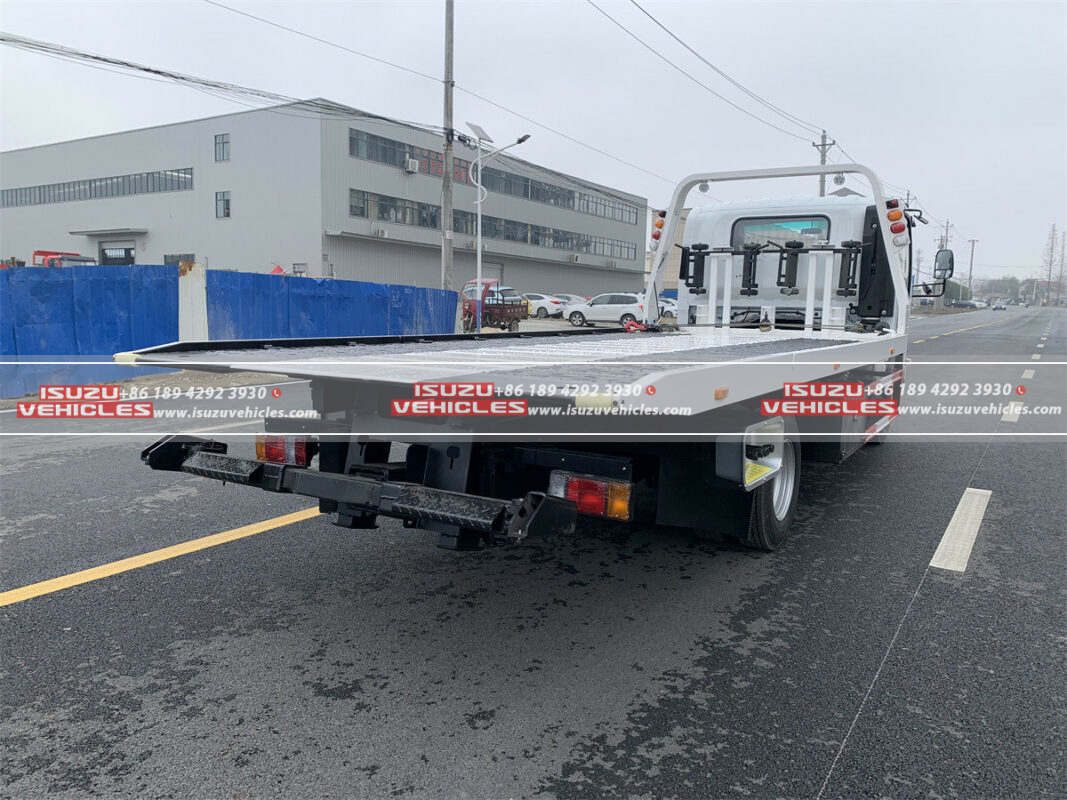
- Light-Duty Flatbeds/Slide Trucks: Primarily for standard passenger vehicles and small SUVs, featuring tilting beds with slide-back mechanisms for easy loading, ideal for accident scenes requiring minimal further damage and highway patrol operations; often based on N-Series chassis.
- Medium-Duty Integrated Tow Trucks (Boom & Wheel-Lift): Combining a robust articulating boom with a wheel-lift, this versatile configuration handles everything from sedans to large vans, box trucks, and light-duty pickups, suitable for both accident recovery and roadside assistance; typically found on F-Series chassis.
- Heavy-Duty Rotators: The pinnacle of recovery technology, featuring a rotating boom with exceptional lifting capacity (often 40+ tons) and reach, capable of righting overturned semi-trucks, buses, construction equipment, and performing complex industrial recoveries; built on the formidable ISUZU Giga (C/E) chassis platform.
- Landoll/Detach Trailers: Utilizing an ISUZU tractor unit, these systems offer immense flexibility for transporting specialized recovery equipment or recovering multiple vehicles simultaneously, particularly valuable for long-distance heavy transport or specialized salvage operations.
Beyond Recovery – The ISUZU Ecosystem in Action
Synergy Across Service and Infrastructure
The engineering philosophy embodied in the ISUZU tow truck extends powerfully throughout the brand’s diverse commercial lineup, creating a cohesive ecosystem for demanding industries. The ISUZU dump truck, renowned for its relentless durability in hauling heavy aggregates on punishing construction sites and mine operations, shares the same fundamental commitment to chassis strength, powertrain reliability, and operator safety that defines the tow truck’s capability under extreme stress. Similarly, the ISUZU bucket truck, operating at precarious heights to maintain critical power lines or telecommunications infrastructure, relies on the same principles of stable outrigger deployment, precise hydraulic control, and robust structural integrity that ensure a safe and effective platform for aerial work – principles directly transferable to the controlled lifting and stabilization needs of complex vehicle recoveries. This shared DNA across platforms – from the rugged dump hauler to the elevated bucket and the powerful tow rig – underscores ISUZU’s overarching strength: delivering purpose-built, reliable, and safe commercial vehicles engineered not just for operation, but for mastery within their specific, demanding domains. Choosing an ISUZU tow truck means investing in a solution forged from this legacy, ensuring efficient, safe, and dependable vehicle recovery as part of a broader commitment to keeping industries and infrastructure moving forward.