
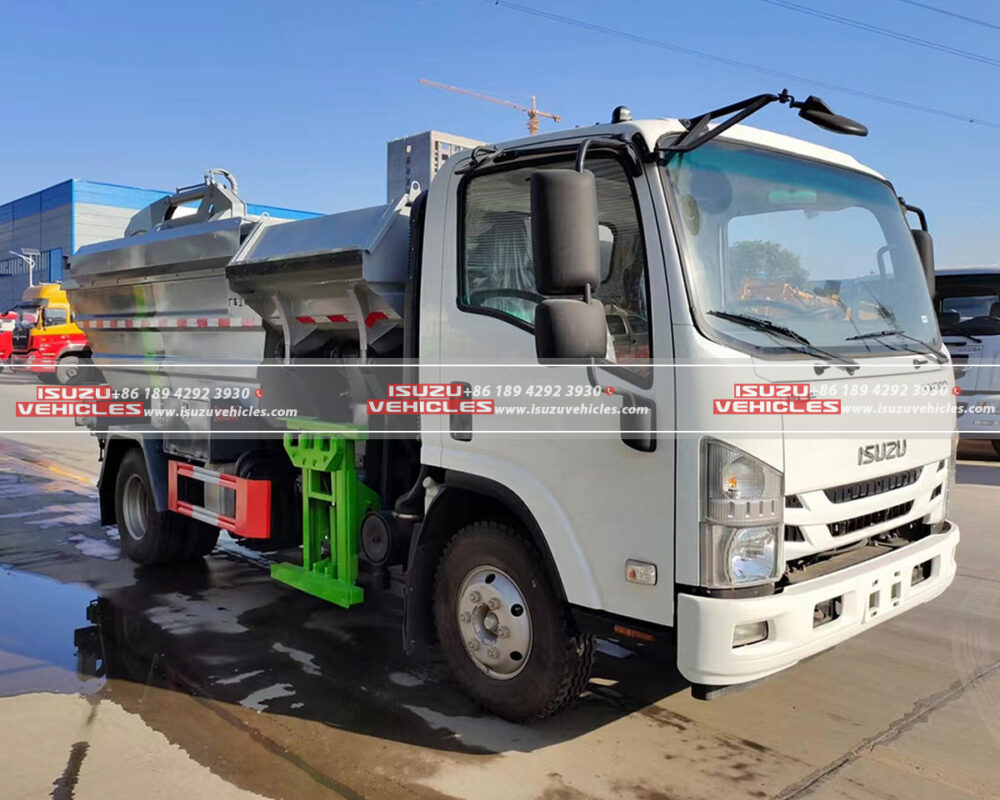
1. The Recycling Imperative: Smart Cities Confront the Sorting Crisis
As urban populations surge and consumption patterns intensify, smart cities face a paradoxical challenge: despite ambitious zero-waste targets, recycling rates often stagnate due to inefficient collection systems, contamination in waste streams, and a lack of real-time data to optimize resource recovery; conventional waste trucks, functioning merely as mobile dumpsters, collect mixed refuse without distinguishing between recyclables, organics, and landfill-bound materials, thereby transferring the sorting burden—and its significant costs and error rates—to overstretched processing facilities. Within this complex ecosystem, ISUZU garbage trucks have evolved from passive transporters into intelligent recycling accelerators, integrating sensor networks, data analytics, and adaptive compaction to transform the collection process itself into the first and most critical stage of high-fidelity resource recovery, fundamentally altering the economics and efficacy of urban circularity.
2. The Neural Network on Wheels: ISUZU’s Intelligent Collection Ecosystem
Sensor-Driven Waste Characterization
The core innovation lies in ISUZU’s deployment of embedded IoT sensors within hoppers and compaction units, which utilize near-infrared spectroscopy and weight-sensing technologies to analyze waste composition in real-time during loading; these systems instantly identify material types (e.g., PET plastics, aluminum cans, paper grades) and quantify contamination levels, transmitting data via 5G to municipal waste management platforms. This enables dynamic route adjustments—diverting trucks with high-purity recyclable loads directly to material recovery facilities (MRFs), while redirecting contaminated streams to preprocessing stations, thereby minimizing cross-pollution and maximizing feedstock quality for recyclers. Simultaneously, adaptive compaction algorithms adjust pressure based on detected materials, preventing glass shattering or plastic deformation that degrades recyclate value, ensuring that collected materials retain their marketability and reduce downstream processing losses by up to 30%.
Hybrid Efficiency as an Enabler
Critically, ISUZU’s parallel hybrid powertrain provides the necessary energy resilience for these data-intensive operations; the electric motor powers sensors, communications hardware, and compaction controls independently of the diesel engine, ensuring uninterrupted data flow even during engine-off phases at stops—a feat impossible for conventional trucks reliant on engine-driven alternators. This seamless energy management allows continuous operation of AI-driven optical sorters mounted on board, which visually tag and log recyclable items for granular waste stream analytics.
Water-Smart Synergies: The ISUZU Sprinkler Truck Connection
This intelligence extends to water resource management through integration with ISUZU sprinkler trucks; data from garbage trucks on organic waste moisture levels informs sprinkler systems for targeted street cleaning in high-spill zones (e.g., markets, restaurant districts), reducing overall water use while preventing putrescible waste from contaminating dry recyclables during collection, thus preserving material integrity upstream.
3. Closed-Loop Incentives: Bridging Citizen Engagement and Collection Efficiency
Gamified Recycling Feedback
Leveraging truck-collected data, ISUZU enables cities to deploy hyper-localized incentive programs; residents receive real-time SMS or app notifications detailing recycling performance—e.g., “Your Wednesday plastics achieved 92% purity—earn 15 reward points!”—based on actual sensor readings from their collected bins, replacing generic education campaigns with measurable, personalized feedback. In Seoul’s Mapo District, this approach boosted household recycling compliance by 41% within 18 months, as citizens adjusted sorting behaviors to maximize tangible benefits like tax rebates or transit credits.
Bin-Level Accountability
Furthermore, RFID-tagged smart bins communicate with ISUZU trucks upon lifting, assigning contamination scores to specific addresses; trucks equipped with selective compaction can isolate flagged contaminated loads into separate compartments, avoiding the spoilage of entire truckloads—a notorious issue that historically demotivated conscientious recyclers. This granular accountability transforms collection from a anonymous service into an auditable chain of custody, increasing resident trust and participation.
4. Fleet-Wide Integration: Amplifying Recycling Through Coordinated Operations
Liquid Waste Intelligence via ISUZU Vacuum Trucks
Recycling efficiency extends beyond solid waste; ISUZU vacuum trucks, integral to managing sewer sludge and liquid industrial waste, share data with garbage truck networks to identify synergistic opportunities. For instance, vacuum trucks servicing food processing plants capture organic slurry data, which routes compatible organic waste from municipal garbage trucks to co-digestion facilities rather than landfills, converting both streams into biogas and fertilizer. In Osaka, this cross-fleet coordination diverted 17,000 tons/year of organics toward energy recovery, enhancing overall resource productivity.
Dynamic Fleet Rebalancing
Centralized AI platforms (e.g., ISUZU’s Eco-Dashboard) analyze real-time inputs from garbage, sprinkler, and vacuum trucks, predicting recycling bin fill-rates and optimizing deployment; during festival periods, systems automatically reroute recycling-focused garbage trucks to commercial zones while dispatching ISUZU sprinkler trucks to clean adjacent streets, preventing litter windblown contamination. This holistic orchestration reduces collection vehicle kilometers by up to 25%, simultaneously lowering emissions and ensuring recyclables are captured before degradation or dispersal.
5. Economic Catalysis: Making Recycling Profitable for Cities
Smart ISUZU fleets convert waste data into monetizable urban intelligence: municipalities license anonymized material flow datasets to packaging manufacturers for circular design improvements, while MRFs pay premiums for high-purity, sensor-verified recyclables that slash their processing costs. Reduced contamination extends landfill lifespans, deferring $100M+ capital outlays for new sites—as demonstrated in Melbourne’s Northern Metro, where ISUZU-enabled source separation cut landfill-bound waste by 37%. Critically, lower fuel/maintenance costs from hybrid operations—coupled with extended component life due to adaptive compaction—free municipal budgets for reinvestment in community recycling hubs, creating a self-reinforcing investment loop where efficiency gains fund expanded circular economy infrastructure.
6. Global Blueprints: ISUZU’s Smart Recycling Pathways
Western Pilots: Data-Driven Policy Integration
European cities exemplify regulatory-data symbiosis; Amsterdam mandates RFID tagging for all commercial waste, with ISUZU trucks enforcing compliance by rejecting non-compliant bins and instantly notifying regulators—increasing commercial recycling to 78%. San Francisco correlates truck sensor data with demographic databases, targeting multilingual recycling education to low-participation neighborhoods, achieving unprecedented equity in recycling access.
ISUZU China: Scaling the Model for Megacity Realities
In China, where urbanization density strains conventional recycling, ISUZU China pioneers integrated waste-resource parks; garbage trucks pre-sort waste via onboard AI, directing streams to colocated recycling micro-factories within city limits—slashing transport emissions while enabling rapid material turnaround. In Shenzhen, garbage trucks communicate with underground pneumatic waste systems, activating suction only when sensors detect sufficient recyclable mass, optimizing energy use. Future roadmaps involve blockchain-tracked material passports initiated at truck-level scanning, transforming ISUZU fleets into the circulatory system of the urban metabolic engine—where every collected item is destined not for disposal, but for perpetual reinvention.