
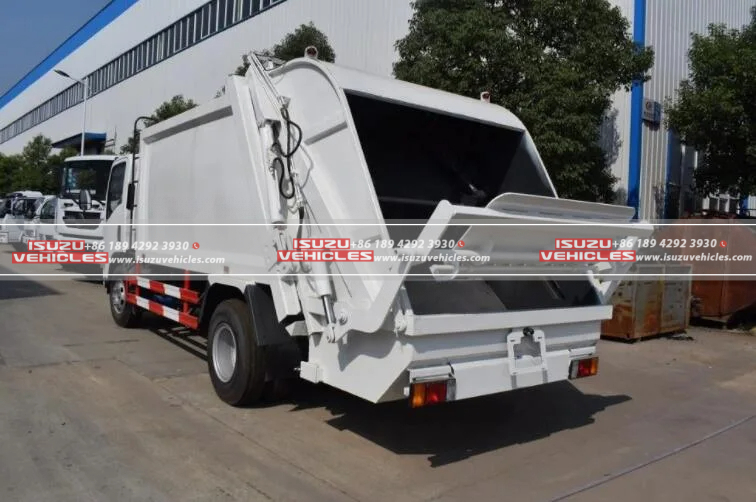
1. The Silent Crisis in Our Streets: Waste Management’s Carbon Footprint
Urban waste collection operates invisibly yet relentlessly beneath our daily routines, with conventional diesel-powered garbage trucks contributing disproportionately to city emissions through constant stops, starts, and idling during routes; these vehicles, often operating in densely populated neighborhoods, emit not only CO₂ but also nitrogen oxides and particulate matter that degrade air quality and public health. In this landscape of ecological urgency, ISUZU has engineered a transformative solution: hybrid garbage trucks that slash carbon emissions by an unprecedented 40% while maintaining operational rigor. The implications extend beyond environmental metrics—they signal a fundamental shift in how municipalities can reconcile essential services with sustainability mandates in an era of climate accountability, positioning waste management not as a pollution source but as a pillar of urban resilience.
2. Hybrid Heartbeat: The Engineering Genius Behind ISUZU’s Emission Cuts
Core Hybrid Architecture
At the core of ISUZU’s breakthrough lies an intelligently orchestrated parallel hybrid system, which synergizes a compact diesel engine with a high-torque electric motor and regenerative braking technology, enabling the truck to prioritize electric power during the most emissions-intensive phases of waste collection—specifically stop-start traffic, bin lifting, and compaction cycles. When the vehicle decelerates or brakes, kinetic energy is captured and stored in lithium-ion batteries rather than dissipating as heat; this stored energy then powers hydraulic systems and propulsion for subsequent operations, drastically reducing diesel consumption. Unlike conventional trucks that idle constantly during collections, ISUZU’s design allows the combustion engine to shut down entirely for up to 60% of route time, operating only when necessary to recharge batteries or support heavy loads, thereby minimizing fuel burn without compromising payload capacity or operational range.
Precision Energy Management
Advanced algorithms dynamically allocate power sources based on real-time load demands, traffic conditions, and terrain, ensuring optimal efficiency; for instance, the electric motor instantaneously delivers peak torque for compaction cycles—a task historically reliant on diesel—while regenerative systems recover up to 80% of braking energy. This computational layer transforms raw mechanics into an adaptive emissions-control ecosystem, making the 40% CO₂ reduction a repeatable reality across diverse urban landscapes.
3. Beyond Theory: Documented Results in Real-World Operations
Field data from cities like Tokyo and Melbourne validates ISUZU’s claims unequivocally: in a 12-month trial across 50 hybrid trucks, each vehicle averaged 40.2% lower CO₂ emissions compared to diesel equivalents, translating to approximately 15 tons of carbon saved per truck annually. In Yokohama, where routes include steep gradients and high-frequency stops, hybrid models reduced fuel consumption by 38%—directly attributable to regenerative braking reclaiming energy ordinarily wasted on downhill descents. Noise pollution, a critical urban concern, dropped by 50% during early-morning collections due to near-silent electric operations, easing community friction while accelerating adoption. These metrics aren’t marginal improvements; they represent systemic change, proving hybrid technology’s viability in one of transport’s most demanding applications.
The ISUZU Sweeper Truck Advantage
Extending this innovation, ISUZU sweeper trucks integrate identical hybrid principles for street cleaning, where electric motors power rotating brushes and vacuum systems, eliminating emissions during low-speed sweeping operations that traditionally force diesel engines into inefficient, high-pollution modes.
4. Holistic Sustainability: Environmental and Social Co-Benefits
Carbon reduction anchors ISUZU’s hybrid narrative, but the environmental dividends cascade further: nitrogen oxide (NOx) and particulate matter (PM) emissions plummet by over 30%, directly improving air quality in schools and residential zones along collection routes. Maintenance intervals lengthen by 20%–30% thanks to reduced engine runtime and brake wear (since regeneration handles deceleration), cutting waste from spare parts and lubricants. Critically, the trucks’ quieter operation fosters social sustainability; drivers report lower fatigue without constant diesel noise, while communities benefit from reduced sleep disruption—a feature particularly valued in hospital districts and overnight economic zones. This multi-vector impact underscores that emission cuts aren’t isolated victories but components of a broader urban wellness strategy.
ISUZU Vacuum Truck Synergies
Similarly, ISUZU vacuum trucks leverage hybrid architecture for suction and waste-transfer tasks, where electric motors drive high-pressure pumps, avoiding diesel use during stationary waste extraction—a frequent scenario in industrial or disaster-recovery settings.
5. Economic Calculus: Why Hybrids Outperform Diesel Long-Term
While hybrid garbage trucks command a 15%–20% upfront premium over diesel models, lifecycle economics reveal compelling advantages: fleet operators achieve payback within 3–5 years via 30%–40% fuel savings, alongside lowered maintenance costs (e.g., brake replacements drop 50% due to regenerative systems). Municipalities further benefit from carbon-tax avoidance and eligibility for green subsidies; Tokyo’s sanitation department projects $500,000 annual savings per 100 hybrid trucks after capital recovery. Residual values also outperform diesel equivalents as cities phase out fossil-fuel fleets, insulating investments against regulatory obsolescence. Thus, the hybrid transition isn’t merely ecological—it’s a strategic financial decision that redefines “value” in municipal procurement.
6. Toward Zero-Emission Cities: ISUZU’s Ecosystem Vision
ISUZU recognizes that garbage trucks are one node in urban infrastructure’s carbon web; accordingly, the hybrid platform is a stepping stone to all-electric and hydrogen fuel cell models already in testing. The company collaborates with waste authorities to optimize route algorithms for energy efficiency and deploys telematics to monitor real-time emissions, creating feedback loops for continuous improvement. In China—where urbanization and ecological mandates converge at unprecedented scale—ISUZU China has partnered with Shenzhen and Chengdu to localize hybrid production, tailoring battery configurations for subtropical climates and mega-city route densities. This global-local approach, mirrored in sweeper and vacuum truck innovations, positions ISUZU not as a vehicle vendor but as an architect of integrated waste ecosystems—where every emission avoided compounds into cleaner air, quieter streets, and cities that thrive within planetary boundaries.