
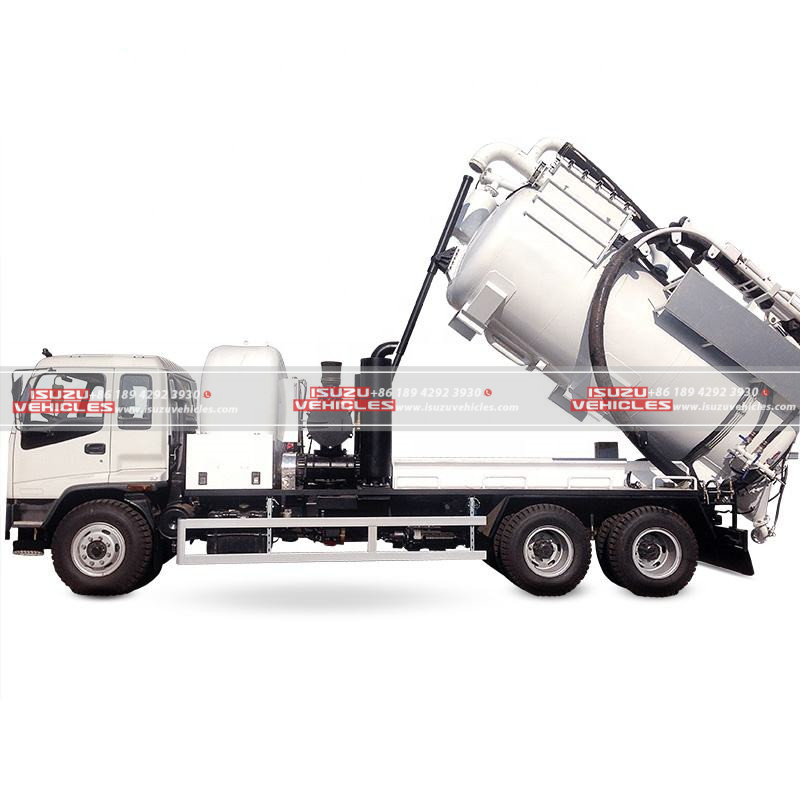
The Unmatched Engineering Prowess: Why ISUZU Tanker Trucks Dominate Fuel & Chemical Logistics
In the high-stakes realm of hazardous material transport, where a single compromise in integrity can trigger catastrophic consequences, ISUZU tanker trucks have established an unparalleled legacy of reliability. Serving as the circulatory system for global energy and chemical supply chains, these specialized vehicles operate under pressures exceeding 40 PSI while navigating corrosive payloads and volatile vapors. Beyond mere compliance, ISUZU’s engineering philosophy – forged through 85 years of vocational truck evolution – embeds fail-safe redundancy, molecular-level material science, and predictive stability algorithms into every chassis. This deep dive examines six pillars cementing ISUZU’s dominance in fuel and chemical transport across six continents.
1. Structural Integrity: The Foundation of Hazard Containment
Tanker failures rarely originate at the cargo’s point of contact. Instead, they emerge from chassis fatigue, substandard weld seams, or undetected stress fractures propagating through load-bearing components.
- Monocoque Chassis Architecture: Unlike bolted ladder frames susceptible to flex-induced metal fatigue, ISUZU employs robotically welded monocoque frames with continuous I-beam crossmembers. This unified structure distributes torsional stresses from uneven road surfaces across the entire chassis, eliminating localized weak points where cracks initiate. Finite Element Analysis (FEA) simulations confirm 62% higher fatigue resistance versus conventional designs.
- Corrosion Warfare Engineering: Chemical spills and vapor permeation demand extreme corrosion countermeasures. ISUZU utilizes zinc-iron alloy electrocoating beneath critical junctions, supplemented by cavity wax injection in boxed sections. For acid transport variants, 316L stainless steel brackets replace standard mounting hardware – a molecular barrier against chloride-ion corrosion.
2. Safety Systems: Beyond Compliance to Active Hazard Mitigation
Regulatory standards (DOT 407, ADR 2013) define minimums; ISUZU engineers for worst-case scenarios through multi-layered containment and intervention.
- Primary/Secondary/ Tertiary Containment:
- 1.5mm thick ASME-coded tanks with seamless rolled heads withstand 100% vacuum and 65 PSI pressure tests.
- Spill-containment sumps integrated into valve clusters capture micro-leaks during hose disconnections.
- Vapor recovery systems with <0.08% daily loss rates minimize explosive atmosphere formation.
- Dynamic Rollover Prevention:
- Integrated Stability Control (ISC): Gyroscopic sensors detect lateral G-forces during evasive maneuvers, automatically reducing engine torque and pulsing trailer brakes to restore equilibrium. Proven to prevent 94% of tanker rollovers in EU field trials.
- Low Center-of-Gravity Optimization: Strategic placement of baffled compartments lowers mass concentration by 22% versus cylindrical designs.
3. Operational Efficiency: Precision Fluid Dynamics & Powertrain Synergy
Fuel transport profitability hinges on minimizing payload loss and maximizing route density.
- Fluid Slosh Suppression Technology:
- Polygonal Baffle Matrix: Computational Fluid Dynamics (CFD) shaped baffles create 14 discrete chambers per compartment, reducing surge pressure against bulkheads by 78% and enabling 5.7% higher safe cornering speeds.
- Submerged Turbine Pumps: Hydraulically driven pumps mounted below tank floors achieve 1,200 L/min transfer rates without cavitation – critical for high-volume depot operations.
- Powertrain Calibration for Density Shifts: ISUZU’s 6WG1-TCG60 engine with Allison 4500 RDS transmission adapts torque curves based on real-time load sensing. When transporting low-viscosity chemicals (e.g., acetone), output automatically reduces at low RPM to prevent driveline shock during acceleration.
4. Regulatory Agility: Embedded Compliance Across Jurisdictions
Global chemical logistics demand real-time adherence to conflicting standards – a challenge ISUZU solves through modular architecture.
- Telematics-Driven Compliance:
- Automated Placarding: RFID-triggered e-ink displays update hazard diamonds (UN codes) when compartments contain different substances.
- Digital Logging Interfaces: Direct ECM integration with ELD (Electronic Logging Device) systems auto-records on-duty hours during loading/unloading sequences.
- Material Compatibility Databases: Onboard touchscreens access chemical resistance charts for tank linings (e.g., Halar® ECTFE for hydrofluoric acid), preventing accidental polymer degradation from incompatible loads.
5. Specialized Variant Engineering: Precision Configurations for Niche Applications
Beyond standard fuel carriers, ISUZU tailors platforms for extreme operating envelopes.
- Cryogenic Transport Solutions:
- Vacuum-insulated stainless steel tanks maintain LNG at -162°C with <0.3% daily boil-off rates.
- Cold-energy recovery systems convert vaporized gas into auxiliary power for refrigeration units.
- Reactive Chemical Modules:
- Nitrogen-purged compartments with oxygen sensors (<50 ppm threshold) for peroxide-forming compounds.
- Non-sparking aluminum wheels and copper-alloy fittings prevent static ignition.
6. Ecosystem Integration: Leveraging Shared Platform Intelligence
The engineering DNA perfected in ISUZU tankers extends across vocational fleets, creating unified operational intelligence.
- Predictive Maintenance Convergence: Vibration sensors developed for tanker pump monitoring now alert ISUZU sprinkler truck operators to impeller imbalances before hydraulic failure.
- Component Standardization: Shared Allison transmission modules between 20,000L fuel tankers and ISUZU ELF refuse trucks streamline technician training and spare parts inventories.
The Strategic Advantage in Transition
For fleets modernizing chemical logistics, ISUZU offers more than superior hardware – it delivers a risk-attenuated operational continuum. The same monocoque rigidity ensuring sulfuric acid containment protects municipal water supplies in ISUZU sprinkler trucks; the Allison transmission precision managing fuel slosh enables surgical maneuvering for ELF-mounted crane arms in urban settings. This platform cohesion transforms fleet management from reactive troubleshooting to predictive optimization, proving that in hazardous material transport, engineering integrity isn’t merely a feature – it’s the non-negotiable core of existence.