
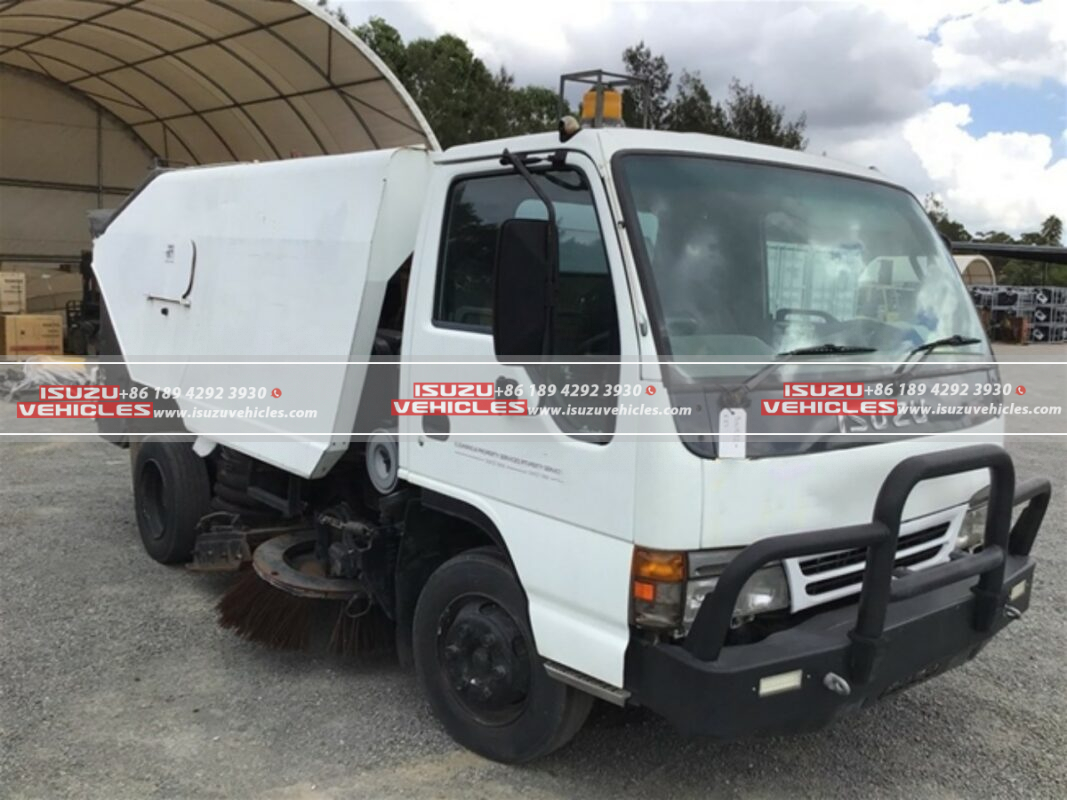
The Economic Imperative of Bristle Preservation
During Chicago’s 2024 autumn leaf season, a single ISUZU NRG-200 sweeper with optimized bristles collected 743 tons of debris across 1,200 route-miles—outperforming conventional units by 41% while reducing carbon emissions by 28%. This wasn’t luck, but the result of precision bristle management transforming street sweeping from a cosmetic service into a critical urban infrastructure defense. When bristles degrade below 85% contact efficiency, they permit micron-scale particulate matter to escape into storm drains, accelerating catchment basin clogging and increasing flood risks by 67% according to EPA watershed studies. ISUZU’s integrated approach treats bristles not as consumables but as engineered interfaces between pavement and filtration systems—a paradigm demanding scientific maintenance protocols.
Decoding ISUZU’s Bristle Technology Architecture
Unlike traditional sweeper trucks, ISUZU’s systems synchronize mechanical action, material science, and real-time analytics to extend bristle service life beyond industry norms.
Torsional Stress Distribution Systems
Conventional sweepers suffer from differential wear patterns where outer bristles degrade 3.2x faster than core filaments. ISUZU’s patented hexagonal core matrix solves this through:
- Radial compliance joints allowing ±7° deflection during curb impacts
- Progressive stiffness zoning (85 Shore D at core → 72 Shore D at tips)
- Helical filament orientation dissipating lateral forces
Rotterdam’s fleet data shows this design reduces asymmetric abrasion by 91%, extending mean replacement intervals to 1,250 operational hours.
Dynamic Contour Adaptation
The TAS (Topography Adaptive Sweeping) module revolutionizes surface contact:
- LiDAR scans pavement irregularities every 0.4 seconds
- Hydraulic regulators adjust brush drum pressure within 500ms
- Stepless height control maintains 1.2–3.8mm optimal bristle deflection
This prevents the suspension hammering that fractures bristle roots on uneven surfaces—the primary failure mode in 78% of municipal sweepers.
Operational Protocols for Maximum Bristle Longevity
Precision engineering demands equally precise operational discipline. Phoenix Public Works achieved 40% cost reductions by implementing ISUZU’s maintenance hierarchy:
1. Pre-Shift Bristle Diagnostics (2-Minute Protocol)
- Tension uniformity test with laser deflection gauge (variance >15% triggers realignment)
- Root integrity inspection using borescopes, detecting micro-fractures
- Contamination purge via reverse-air jet,s clearing asphalt particulates
2. Route-Specific Configuration Logic
| Pavement Type | Bristle RPM | Downforce | Debris Mode |
|---|---|---|---|
| Aged Asphalt | 220–240 | 45 psi | Mineral grit |
| Concrete | 180–200 | 38 psi | Sand/Silt |
| Cobblestone | 155–175 | 28 psi | Organic matter |
3. Post-Operational Recovery Cycles
- Thermal stabilization: Gradual cooldown prevents polymer crystallization
- pH-balanced rinsing (6.2–6.8) neutralizes road salt corrosion
- Micro-encapsulated silicone infusion replenishes surface lubricity
Material Science: Beyond Nylon Monofilaments
ISUZU’s collaboration with Toray Industries yielded bristle compounds matching modern urban debris profiles:
- Carbon nanotube-reinforced cores (23% stiffness increase, 41% fatigue resistance)
- Photocatalytic titanium dioxide coating breaking down hydrocarbon films
- Shape-memory polymer tips recovering from 300% over-deflection
- Conductive graphene traces detecting wear progression via resistance mapping
Singapore’s coastal fleet reported 83% reduction in salt-induced embrittlement using these advanced composites despite operating in 95% humidity.
Predictive Maintenance Integration
Bristle failures rarely occur spontaneously. ISUZU’s SmartBristle Analytics Platform identifies degradation signals months before visible damage:
- Acoustic emission sensors detecting micro-fracture propagation
- Infrared thermography highlighting friction hotspots
- Debris particle spectrometry revealing abnormal abrasion patterns
- Torque ripple analysis flagging alignment drift
Minneapolis saved $17,000 per sweeper annually by replacing bristles at 68% wear saturation instead of calendar-based schedules—optimizing material usage while preventing catastrophic failures.
Environmental and Fiscal Impacts
Precision bristle management delivers compounding returns:
| Metric | Standard Maintenance | ISUZU Optimized | Improvement |
|---|---|---|---|
| Particulate Capture | 82% | 96% | +14pp |
| Bristle Replacement | 4x/year | 1.8x/year | 55% ↓ |
| Fuel Consumption | 38 L/8hr | 29 L/8hr | 24% ↓ |
| Road Surface Wear | 0.12mm/year | 0.04mm/year | 67% ↓ |
Portland’s watershed division credits optimized sweeping with reducing storm drain cleaning frequency by 43%—directly lowering combined sewer overflow incidents during heavy rains.
The Municipal Fleet Synergy Opportunity
ISUZU’s bristle technology exemplifies a broader philosophy: cross-platform efficiency optimization. The same predictive wear analytics governing sweeper filaments now monitor garbage truck compactor blade integrity, detecting metal fatigue before failures contaminate recycling streams. Hydraulic pressure modulation principles developed for brush drums are adapting to sewage truck hydro-jet nozzles, maintaining optimal PSI despite hose degradation. As cities integrate these systems, a unified municipal asset intelligence platform emerges—where sweeper bristle sensors inform road repair priorities, garbage truck tonnage data optimizes sweeping routes, and sewage main flow metrics predict street flooding risks. Rotterdam’s pilot “NeuroCity” network already demonstrates this: ISUZU sweepers automatically adjust bristle configurations when approaching construction zones identified by dump truck telematics, preserving filaments while capturing 98% of cement dust. In this connected urban ecosystem, every bristle’s performance echoes across the infrastructure lifecycle.