
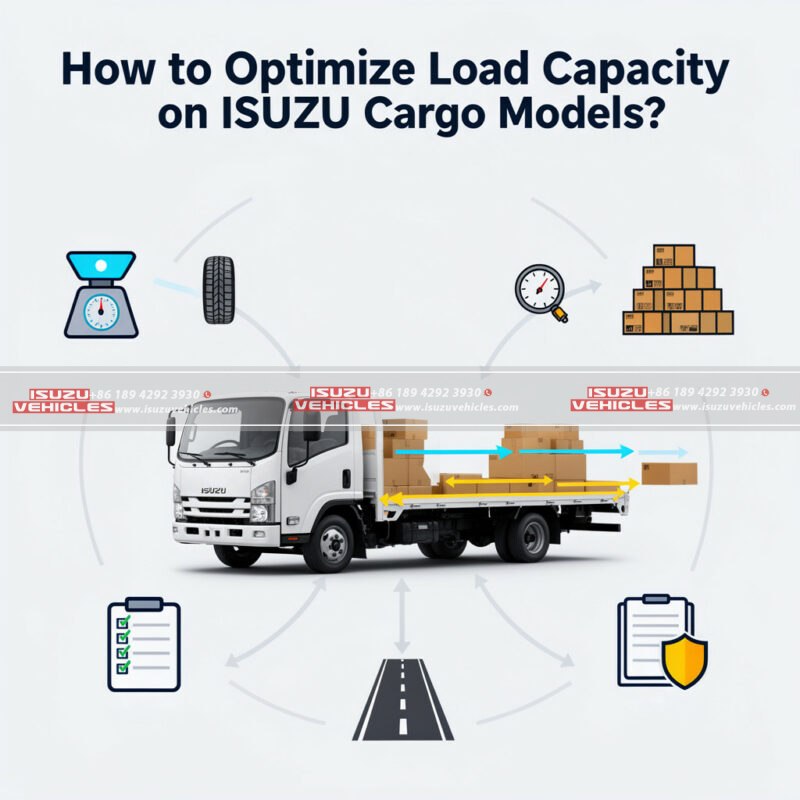
Engineering Efficiency, Operational Discipline, and Smarter Payload Management
Optimizing load capacity is not simply about carrying more weight; it is about achieving the most efficient balance between payload, vehicle durability, safety compliance, fuel economy, and long-term operating cost. For fleet operators, logistics companies, and owner-drivers who rely on ISUZU cargo models, understanding how to maximize usable load capacity without compromising vehicle integrity is both a technical challenge and a strategic advantage. ISUZU has long been recognized for building cargo trucks with exceptional structural balance, yet even the best-designed vehicle requires proper configuration, disciplined operation, and informed decision-making to truly perform at its peak. The following sections explore how load capacity optimization can be achieved through engineering awareness, body design choices, weight distribution strategies, suspension tuning, and daily operational habits.
Understanding Rated Load Capacity Versus Real-World Payload
Before any optimization can begin, it is essential to clearly distinguish between the figures printed on a specification sheet and the actual payload a truck can efficiently and safely carry in daily operations. Many load-related inefficiencies originate from misunderstanding these fundamental concepts.
Gross Vehicle Weight and Legal Boundaries
Every ISUZU cargo model is engineered around a specific Gross Vehicle Weight (GVW), which represents the maximum allowable weight of the fully loaded truck, including the chassis, cargo body, driver, fuel, tools, and cargo itself. Exceeding this limit may appear to increase short-term productivity, but it accelerates mechanical fatigue, increases braking distances, and exposes operators to legal penalties and insurance risks. Optimization, therefore, does not mean exceeding GVW, but rather ensuring that as much of the allowable weight as possible is used for revenue-generating cargo instead of unnecessary structural or accessory mass.
Curb Weight and Payload Efficiency
Curb weight refers to the weight of the truck as delivered from the factory, without cargo but with standard equipment and fluids. By understanding how curb weight interacts with GVW, operators can calculate the true available payload. ISUZU designs its cargo platforms with lightweight yet high-strength frames, which provides an inherent advantage, but the final payload efficiency heavily depends on body selection, auxiliary equipment, and aftermarket modifications introduced after delivery.
Selecting the Right Cargo Body for Maximum Efficiency
One of the most overlooked aspects of load optimization lies in cargo body design, where poor choices can silently reduce payload capacity by hundreds of kilograms over the life of a vehicle.
Material Selection and Structural Design
Cargo bodies constructed with overly thick steel panels, excessive reinforcement, or decorative but non-functional components often add unnecessary mass. Modern ISUZU-compatible cargo bodies increasingly utilize aluminum alloys, high-tensile steel, or composite sandwich panels, which maintain rigidity while significantly reducing dead weight. By selecting a body that aligns with the truck’s structural design philosophy, operators preserve more payload capacity for actual goods rather than carrying their own structure.
Internal Dimensions and Volume Utilization
Payload optimization is not purely about weight; volume efficiency plays an equally critical role. A cargo box that is poorly proportioned or internally obstructed by ill-placed reinforcement beams limits how cargo can be stacked and distributed. Carefully planned internal layouts, smooth wall surfaces, and optimized door openings allow operators to fully use cubic space without resorting to unsafe stacking practices that compromise stability.
Weight Distribution as a Core Optimization Strategy
Even when total payload remains within legal limits, poor weight distribution can severely impact handling, axle loads, and long-term vehicle health.
Axle Load Balance
ISUZU cargo models are designed with precise front-to-rear axle load ratios, ensuring predictable steering response and braking performance. Improper cargo placement, especially loading heavy items too far rearward or forward, can overload individual axles even if total weight is acceptable. Operators should prioritize placing the heaviest items low and close to the longitudinal center of the cargo bed, maintaining balance across both axles.
Center of Gravity Control
A high or uneven center of gravity reduces stability, particularly during cornering or emergency maneuvers. Long-term optimization involves training loading personnel to consistently position dense cargo at floor level and avoid stacking heavy pallets near the cargo box walls. Over time, this practice not only improves safety but also reduces suspension wear and tire degradation.
Suspension, Tires, and Chassis Configuration
The chassis system plays a decisive role in how effectively a truck manages its designed load capacity, and optimization often requires fine-tuning rather than structural alteration.
Suspension Matching and Maintenance
ISUZU trucks are equipped with suspension systems calibrated for specific load classes, but real-world usage patterns may differ from factory assumptions. Regular inspection of leaf springs, bushings, and shock absorbers ensures that load-bearing components maintain their designed characteristics. Worn suspension elements cause uneven load transfer, reducing effective capacity and increasing driver fatigue.
Tire Selection and Inflation Discipline
Tires are the only contact point between the truck and the road, and their load ratings directly influence operational payload limits. Selecting tires with appropriate load indices and maintaining correct inflation pressure allows the chassis to operate within its engineered envelope. Underinflated tires increase rolling resistance and heat buildup, while overinflation reduces contact patch stability, both of which undermine efficient load management.
Operational Habits That Unlock Hidden Load Capacity
Beyond hardware and specifications, daily operational practices have a profound impact on how effectively load capacity is utilized over time.
Eliminating Non-Essential Weight
Many cargo trucks gradually accumulate unnecessary items such as unused tools, redundant spare parts, and outdated accessories, all of which consume payload capacity without adding value. Periodic audits of vehicle contents help reclaim lost capacity and improve fuel efficiency simultaneously. This disciplined approach aligns well with ISUZU’s philosophy of functional minimalism in commercial vehicle design.
Route Planning and Driving Behavior
Optimized load capacity must be supported by intelligent route selection and consistent driving habits. Avoiding roads with severe gradients or poor surfaces reduces stress on the drivetrain and suspension, allowing trucks to operate closer to their optimal payload thresholds with less mechanical risk. Smooth acceleration, anticipatory braking, and controlled cornering further protect load integrity and vehicle balance.
Integrating Optimization into Long-Term Fleet Strategy
Load capacity optimization delivers the greatest value when it becomes part of a broader operational mindset rather than a one-time adjustment.
Data Tracking and Continuous Improvement
Fleet operators increasingly rely on telematics and maintenance data to monitor vehicle performance under load. Tracking fuel consumption, brake wear, and suspension service intervals reveals patterns that indicate whether trucks are operating near their optimal load capacity or suffering from chronic inefficiencies. Over time, these insights inform better body specifications, loading procedures, and replacement cycles.
Aligning Truck Models with Cargo Profiles
No single cargo truck configuration is ideal for every application, and matching vehicle specifications to cargo characteristics remains a cornerstone of optimization. For urban distribution, shorter wheelbases and lighter bodies may yield higher usable payload ratios, while regional transport may benefit from longer frames and reinforced suspensions. ISUZU’s diverse cargo lineup allows operators to fine-tune this alignment, ensuring that each truck works within its most efficient load window rather than being forced into unsuitable roles.
In practice, the optimization principles discussed above converge most effectively when operators view the truck as an integrated system rather than a simple load carrier. Whether configuring a new ISUZU box truck for city logistics or refining loading practices on an established fleet, attention to weight discipline, balance, and component harmony consistently yields measurable gains. Even within compact and versatile platforms such as the ISUZU ELF, thoughtful load management transforms everyday operations into a more efficient, safer, and economically sustainable transport solution, proving that true capacity optimization is as much about intelligence and consistency as it is about raw specifications.