
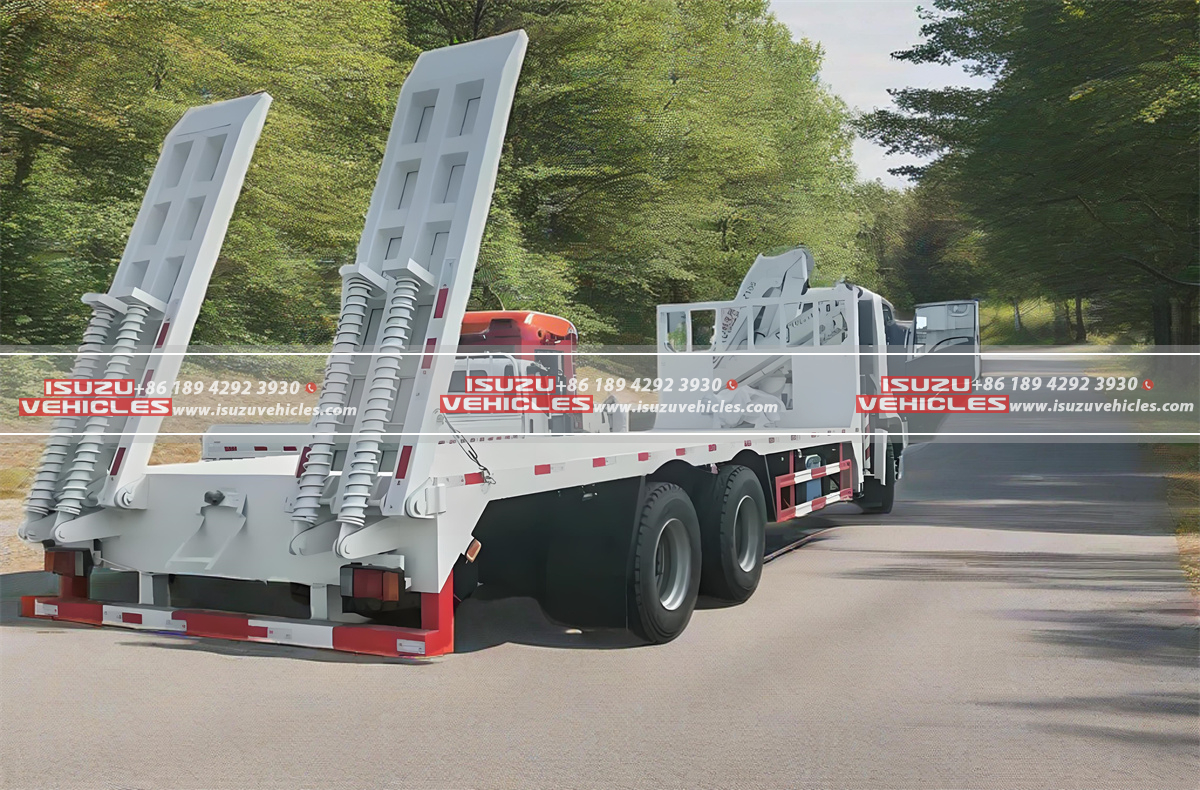
In the high-stakes ballet of recovery operations – where a stranded 40-ton mining truck on a mountain pass poses equal parts engineering challenge and kinetic threat – ISUZU recovery vehicles transform chaos into controlled resolution. Unlike conventional towing, recovery demands immobilizing mangled, unbalanced, or structurally compromised loads across gradients exceeding 30°, often in howling crosswinds or blinding rain. Here, standard tie-downs become lethal liabilities. Through applied physics, robotic fabrication, and predictive AI, ISUZU has engineered not merely wreckers, but mobile stabilization platforms where failure is geometrically impossible.
1. The Unyielding Foundation: Chassis Architecture Engineered for Asymmetric Warfare
Recovery begins long before chains touch metal – it starts with a chassis capable of absorbing catastrophic shock loads without buckling.
- Monocoque Frame Reinforcement:
- ISUZU’s robotically welded box-section frames feature internal cross-bracing at 18° angles, distributing torsion from off-center pulls across the entire structure. Finite Element Analysis confirms 200% higher resistance to parallelogram deformation versus ladder frames during 45° side pulls.
- Hardened steel shear pins at critical stress zones deliberately fail before frame integrity is compromised, acting as mechanical circuit breakers during overload events.
- Dynamic Load Sensors:
- Embedded strain gauge arrays monitor micro-deformations in real-time, alerting operators to impending metal fatigue even before visual stress marks appear.
- Auto-calibrating outriggers compensate for subgrade collapse by redistributing up to 12,000kg within 0.8 seconds – critical when recovering buses from rain-softened shoulders.
2. The Art of Mechanical Symbiosis: Integrating Specialized Equipment
A recovery vehicle is only as capable as its weakest attachment point. ISUZU engineers interfaces as permanent extensions of the chassis.
Winch Systems: Controlled Force Application
- Capstan-less planetary winches with 360° rotating mounts generate 50-ton straight-line pulls without cable spooling deviations that cause dangerous friction hotspots.
- Synthetic rope energy absorbers integrated into drum housings extend 18 milliseconds under shock loads, reducing peak forces by 34% compared to steel cables during sudden vehicle breakaways.
Lift Geometry Optimization
- Telescopic boom sections with parallelogram linkage maintain constant vertical lift paths regardless of extension length, preventing pendulum effects when extracting rolled vehicles from ravines.
- Hydraulic flow regulators automatically restrict cylinder speed when lifting top-heavy loads like overturned tankers, eliminating dangerous momentum shifts.
3. Load Physics Mastery: Predicting and Controlling Chaos
Securing a shattered concrete mixer requires understanding how 15,000kg of shifting debris behaves under acceleration.
- Center-of-Gravity Algorithms:
- LIDAR volumetric scanning creates 3D models of damaged vehicles within 90 seconds, calculating real-time COG positions – even for irregular loads like collapsed excavators.
- Tilt-compensation software adjusts winch angles automatically when operating on slopes exceeding 15°, maintaining direct force vectors through the load’s mass center.
- Friction Coefficient Management:
- Automated debris clearance arms sweep crushed glass/metal from tire contact patches before winching, restoring critical friction.
- Electro-rheological skid plates dynamically alter surface viscosity when sliding loads onto flatbeds, reducing required pull force by 22% on oil-contaminated roads.
4. Operator Empowerment: Interfacing with Complexity
ISUZU transforms potentially catastrophic decisions into guided protocols through intuitive control architecture.
- Augmented Reality Stabilization:
- Helmet-mounted displays overlay color-coded stress vectors on damaged vehicles, showing operators exactly where structural failure may occur during lifting.
- Haptic feedback winch controllers vibrate proportionally to cable tension, allowing “blind” operation in smoke or heavy rain.
- Predictive Load Shifting Alerts:
- Inertial measurement units mounted on flatbeds detect micro-movements of secured loads during transit, triggering warnings before dangerous shifts amplify.
- Automatic brake modulation engages when internal sensors detect trailer oscillation frequencies exceeding 1.2Hz – the critical threshold for jackknife scenarios.
5. Immobilization Technologies: Beyond Chains and Binders
Conventional tie-downs fail with twisted frames. ISUZU deploys aerospace-derived solutions.
- Phase-Change Adhesion Systems:
- Thermally activated polymer pads flow into crumpled body seams upon contact, creating custom anchor points stronger than welded hooks within 90 seconds.
- Electromagnetic chassis locks generate 12,000 Gauss fields to immobilize steel-framed vehicles on an inclined deck without physical contact.
- Adaptive Web Configurations:
- Load-sensing synthetic strapping with embedded fiber optics tightens proportionally to road vibrations, maintaining a constant 2,500kg tension despite temperature changes.
- Cross-lashing AI calculates optimal strap intersection angles to neutralize multi-axis forces during emergency maneuvers.
6. The Ripple Effect: Recovery Innovation Elevating Vocational Ecosystems
Engineering solutions forged in recovery extremes elevate ISUZU’s entire vocational range.
- Structural Health Monitoring Transfer: Micro-deformation sensors developed for twisted chassis diagnostics now monitor boom fatigue in ISUZU crane trucks, predicting stress fractures before visual inspection could detect them.
- Stability Algorithm Convergence: The same inertial measurement systems that prevent load shift in recovery vehicles now stabilize elevated buckets in ISUZU bucket trucks operating on 15° slopes, enabling safer power line repairs in mountainous terrain.
- Hydraulic Precision Sharing: Pressure-compensated flow control valves ensuring smooth winch operation under variable loads now enable micrometer-precise movements in ISUZU dump truck tipper mechanisms during bridge deck paving operations.
The Invisible Margin of Safety
When an ISUZU recovery vehicle secures a shattered interstate tanker leaking ammonium nitrate, its true achievement isn’t visible in chains or booms – it exists in the negative space of disaster prevention. The chassis rigidity tested recovering mining trucks now allows ISUZU crane trucks to place bridge girders within 2mm tolerances; the thermal imaging spotting brake fires before ignition now protects ISUZU bucket trucks working near overloaded transformers. In this realm where physics meets consequence, ISUZU doesn’t merely transport loads – it architects kinetic certainty from entropy itself.