
The Lifelines in the Sky Demand Uncompromising Access
The Andes Mountains, a breathtaking spine of South America, present one of the planet’s most challenging environments for maintaining the high-voltage transmission corridors that are the literal lifeblood of modern economies. These arteries of energy snake through altitudes exceeding 4,000 meters (13,000 ft), traverse unstable slopes prone to landslides, and endure weather extremes from scorching sun to freezing winds and torrential rains. When a fault occurs – whether from seismic activity, extreme weather, insulator failure, or wildlife contact – restoring power swiftly is not just about convenience; it’s critical for safety, economic stability, and community well-being. Achieving this in the Andes demands specialized equipment capable of conquering the trifecta of extreme altitude, treacherous terrain, and unpredictable conditions. This is where purpose-engineered ISUZU bucket trucks have become indispensable partners for utility crews, transforming the daunting task of high-altitude grid repair into manageable, efficient operations.
The Andean Crucible – Unique Demands on Grid Maintenance Fleets
Maintaining high-voltage power lines anywhere is complex, but the Andes amplify every challenge exponentially. The rarefied air at altitude drastically reduces engine combustion efficiency, leading to significant power derating – a standard truck engine can lose 30% or more of its sea-level horsepower and torque at 4,000 meters. This directly impacts the ability to climb steep grades, power hydraulic systems, and operate booms efficiently. Furthermore, the unstable, uneven terrain often lacks proper roads, requiring vehicles with exceptional off-road capability and stability to safely position crews near fault points, which may be perched on steep inclines or accessed via narrow, crumbling tracks. The sheer verticality of the landscape necessitates aerial devices with impressive working height and horizontal reach to access conductors suspended over deep ravines or far from any potential vehicle staging area. Add to this the corrosive effects of high UV radiation, temperature swings causing material fatigue, and abrasive dust, and the requirement for robust engineering and premium corrosion protection becomes non-negotiable for equipment longevity and crew safety.
ISUZU Engineering – Built for the Mountain Mission
ISUZU’s reputation for durability and reliability finds its ultimate test in the Andes, and specific engineering choices make their bucket trucks uniquely suited to this mission. The foundation lies in the reinforced chassis, designed to handle the immense torsional stresses encountered off-road while supporting the weight of the aerial device and its payload. Crucially, ISUZU offers high-altitude optimized engines; these are not merely standard diesels but powerplants calibrated or specifically configured with turbocharging systems designed to mitigate altitude-induced power loss as much as technologically possible, ensuring sufficient grunt remains for climbing and hydraulic operation.
Heavy-duty suspension systems, often featuring parabolic leaf springs or robust air suspension options, are essential for absorbing the punishment of rough tracks while maintaining stability crucial for safe boom operation. The integration of all-wheel drive (AWD) or four-wheel drive (4WD) systems provides the necessary traction on loose gravel, muddy inclines, and unstable surfaces, enabling crews to reach sites inaccessible to conventional 2WD bucket trucks. Underbody protection for critical components like fuel tanks, drivelines, and hydraulic lines is also paramount against rock strikes and deep ruts.
The Aerial Advantage – Specialized Buckets Conquering Vertical Challenges
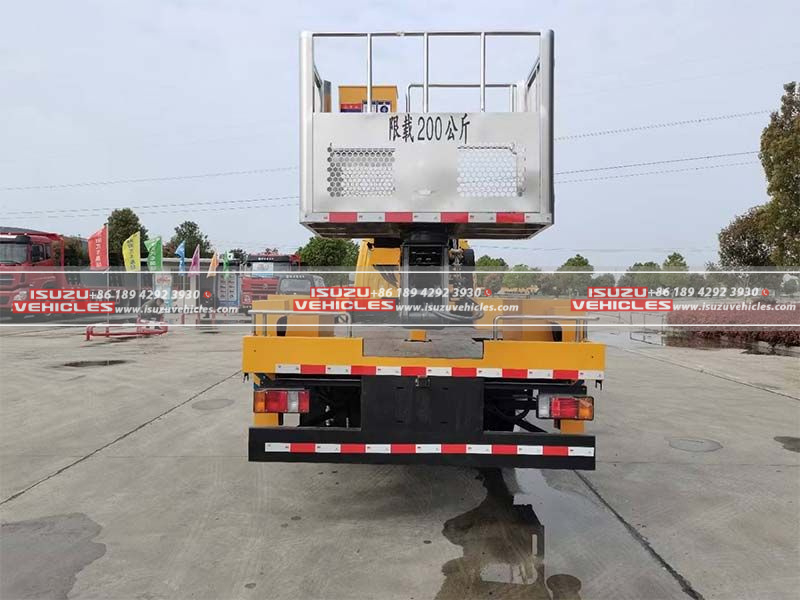
The heart of the operation is the aerial device mounted on the ISUZU platform. Specifying the right boom is critical for Andean success. High-reach capability is paramount; articulating booms offering significant up-and-over capability are often preferred over telescopic units for navigating around obstacles like rock faces or dense vegetation common in the mountains. Insulated booms meeting stringent international standards (e.g., IEC 61472) are mandatory for live-line work, which is frequently employed to minimize widespread outages, requiring precise dielectric protection for linemen working on energized high-voltage lines.
Stability is non-negotiable on slopes. Sophisticated auto-leveling outrigger systems, capable of compensating for severe side-to-side and front-to-rear inclinations (often exceeding 15 degrees), provide a stable, level platform for the bucket regardless of the truck’s position on uneven ground. Platform load sensing and interlock systems prevent overloading or unsafe maneuvers. Furthermore, the hydraulic systems powering these booms must deliver smooth, precise control even in the thin air, demanding high-quality components and efficient PTO-driven hydraulic pumps matched to the truck’s power output at altitude. Durability against UV degradation and corrosion is built-in through premium materials and finishes.
Operational Excellence – Enabling Efficient, Safe Repairs in Thin Air
The combination of ISUZU’s robust chassis and a properly specified aerial device translates directly into tangible operational benefits for utility crews facing Andean grid emergencies. The most significant advantage is faster response times. The ability to traverse difficult terrain and position the truck close to fault points drastically reduces the time-consuming setup often required with less capable equipment or manual methods. Enhanced crew safety is inherent in the design: the stable platform provided by the outriggers on slopes, the protection of the insulated boom during live work, and the secure bucket environment significantly reduce the risks associated with working at height on unstable ground near high-voltage conductors. Increased work efficiency stems from the boom’s reach and maneuverability, allowing linemen to access multiple points or conduct complex repairs from a single setup, minimizing repositioning. The reliability of the ISUZU platform also minimizes downtime due to mechanical failure in these remote locations, where breakdowns can lead to hours or days of delay waiting for parts or recovery. This overall efficiency is crucial for minimizing outage duration, reducing economic losses, and restoring power to vulnerable communities reliant on consistent electricity for heating, communication, and essential services.
Beyond Bucket Trucks – The ISUZU Ecosystem Supporting Andean Infrastructure
While bucket trucks are the stars of grid repair, maintaining the vast Andean transmission corridors requires a supporting cast of specialized vehicles. ISUZU’s versatility across its chassis range allows utilities to build a cohesive, reliable fleet. Material transport is a constant need. ISUZU dump trucks, built on equally rugged platforms, are indispensable for hauling gravel to repair access roads washed out by rains, delivering ballast for tower foundations, or transporting heavy equipment like transformers and switchgear to remote substation sites. Their payload capacity and off-road prowess ensure materials reach locations inaccessible to standard haulers. Similarly, tasks requiring heavy lifting beyond the scope of a bucket truck boom – such as replacing entire transformer units, setting large poles, or handling major structural components during tower repair – demand specialized lifting solutions. ISUZU crane trucks, equipped with robust hydraulic cranes offering significant lifting capacity and reach, provide the necessary muscle for these critical infrastructure tasks.
The inherent chassis commonality across the ISUZU range (dump trucks, crane trucks, bucket trucks) offers significant logistical advantages for fleet managers operating in remote regions. Shared engine platforms simplify mechanic training and spare parts inventory. Proven component reliability reduces the risk of cascading failures. Familiar operator interfaces enhance safety and efficiency as crews transition between different vehicle types. This integrated approach, leveraging the strengths of different specialized bodies on reliable ISUZU chassis, provides utilities with a comprehensive toolkit for not only reacting to grid failures but also proactively maintaining and upgrading the vital high-voltage corridors that power progress across the Andean peaks. The resilience of the grid, therefore, is intrinsically linked to the resilience and capability of the vehicles tasked with its upkeep.