
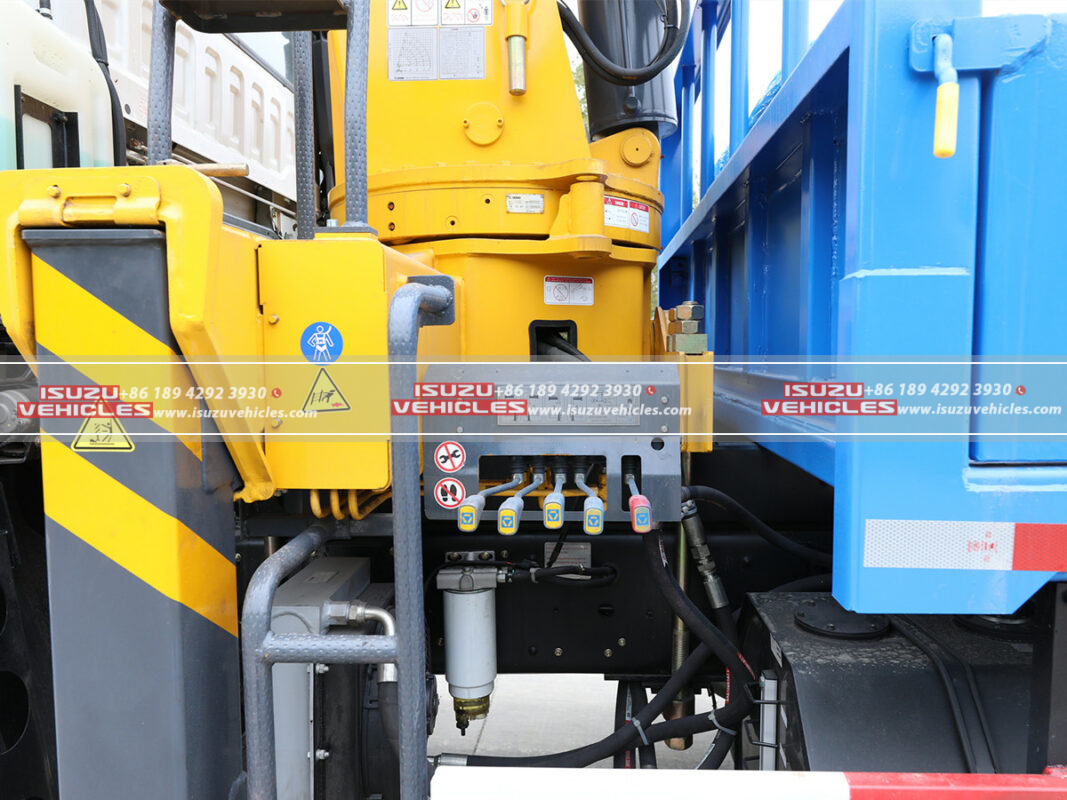
ISUZU Vehicles and Mexican industrial conglomerate Grupo Industriales Mexicanos (GIMSA) have commissioned a fleet of 45 ISUZU FVR-C Series crane trucks following a $98 million strategic agreement aligned with Mexico’s National Infrastructure Acceleration Plan. Engineered for versatile heavy lifting across construction, energy, and emergency response sectors, these vehicles feature integrated 25-ton hydraulic cranes with 360° continuous rotation capabilities, enabling precision operations in Mexico City’s dense urban corridors and Chihuahuan Desert wind farms. The trucks’ modular chassis architecture allows rapid reconfiguration between container handling, transformer installation, and disaster recovery missions while meeting Mexico’s stringent NOM-012-SCT-2-2024 safety regulations for oversized cargo transport.
Strategic Alliance for Industrial Modernization
The ISUZU-GIMSA partnership addresses Mexico’s urgent need for advanced lifting solutions capable of navigating complex logistical challenges across three critical dimensions:
- Urban Infrastructure Constraints: 12-meter turning radii and hydraulic stabilizer extensions enable operations within 6-meter-wide streets during historic center renovations in Guadalajara and Puebla.
- Energy Sector Demands: Dielectric-certified crane booms with 1.5 million-volt insulation facilitate transformer installations at CFE substations without grid shutdowns.
- Seismic Response Preparedness: Integrated quick-deployment kits allow conversion to rescue configuration within 18 minutes for earthquake response across the Pacific Ring of Fire zone.
Built on ISUZU FVR34Q-AD chassis with 6UZ1-TCG 320HP engines, the trucks achieve 20% better power-to-weight ratios than legacy models while incorporating intelligent load moment indicators that calculate center-of-gravity shifts in real-time during lifting operations at Petróleos Mexicanos offshore platforms.
Engineering Innovations for Mexican Terrain
◼︎ Adaptive Mobility Systems
Mexico’s diverse topography necessitated specialized driveline configurations:
- Terrain-Responsive Torque Distribution: Electronically controlled transfer cases automatically adjust power allocation between axles when traversing Oaxaca’s mountainous roads.
- Slope Compensation Hydraulics: Crane outriggers feature hydraulic self-leveling on gradients up to 15°, maintaining platform stability during wind turbine installations.
- High-Altitude Performance: Turbocharger wastegate recalibration ensures full power delivery at 3,800m elevations in Zacatecas mining districts.
◼︎ Lifting Performance Enhancements
The four-stage telescopic booms achieve 28-meter reach with ±0.5mm positioning accuracy through laser-guided extension control, while variable flow hydraulic pumps reduce cycle times by 40% during repetitive container handling at Lázaro Cárdenas port. Remote operation capabilities allow crane manipulation from 150-meter distances in hazardous chemical spill scenarios.
◼︎ Structural Integrity Assurance
High-tensile steel subframes distribute concentrated stresses at boom pivot points, doubling fatigue life versus conventional designs. The multi-axis load monitoring system integrates strain gauges and inertial sensors to prevent structural overloads during simultaneous lifting and transit operations.
Sector-Specific Operational Capabilities
| Industry Application | Configuration | Operational Advantage |
|---|---|---|
| Urban Construction | Compact 8-ton crane | 360° operation within 5m radius for high-rise steel erection |
| Renewable Energy | 22-ton lattice jib | 45m lifting height for wind turbine nacelle installation |
| Telecommunications | Fiberglass boom | Non-conductive material for antenna maintenance |
| Disaster Response | Integrated winch | 12-ton recovery capacity during flood rescues |
For Pemex refinery maintenance, explosion-proof crane controls certified under ATEX/IECEx standards eliminate ignition risks in Zone 1 hazardous areas, while ultraviolet-resistant hydraulic hoses withstand degradation from prolonged Yucatán sun exposure.
Economic and Sustainability Impact
Deployment analysis across GIMSA’s operations demonstrates transformative efficiency gains:
- Fuel Consumption: 5.8 km/L average despite 16-ton gross weights through ECO-D software optimization of engine-transmission mapping
- Downtime Reduction: 92% operational availability achieved via predictive bearing wear analytics in slewing rings
- Emissions Compliance: EU Stage V-equivalent engines with diesel particulate active regeneration reduce NOx output by 76% versus Mexico’s NOM-044 limits
The fleet eliminates need for separate transport/lift vehicles – cutting mobilization costs by 55% for Mayan Train viaduct construction projects while enabling just-in-time delivery of prefabricated bridge segments.
Technical Support Ecosystem
ISUZU established three Regional Technical Hubs in Monterrey, Mérida, and Toluca featuring:
- Virtual Reality Simulators: Training operators in complex lift scenarios before field deployment
- Mobile Parts Factories: 3D printing critical components like hydraulic manifolds onsite
- Satellite Diagnostics: Monitoring crane hydraulic health via Inmarsat-connected sensors
GIMSA technicians receive certification in structural stress analysis and electro-hydraulic troubleshooting through ISUZU’s Mexico City Technical Academy, ensuring fleet autonomy maintenance capabilities.
Future Integration Roadmap
Phase 2 (2026-2028) expands specialized vehicle integration:
- ISUZU bucket truck units for power distribution maintenance featuring dielectric insulated booms with 42kV protection
- ISUZU dump truck fleets configured for mining overburden removal with 30-ton ejector beds
- Autonomous crane positioning using LiDAR terrain mapping for night operations at Nuevo León industrial parks
Collaborative R&D focuses on hydrogen-fueled crane prototypes for zero-emission port operations at Manzanillo Terminal and carbon fiber boom structures reducing deadweight by 35%.
Media Contact: Grupo Industriales Mexicanos Corporate Communications | +52 55 3871 9000
Keywords: Hydraulic Crane Integration, Infrastructure Modernization, Lifting Safety, Multi-Purpose Chassis, Terrain Adaptability
Operational Performance Benchmark
| Metric | Industry Standard | ISUZU-GIMSA Fleet |
|---|---|---|
| Lift Cycle Time (20t @ 10m) | 8.2 minutes | 4.7 minutes |
| Outrigger Deployment Time | 9.5 minutes | 3.8 minutes |
| Fuel Consumption @ Idle Crane Operation | 6.3 L/hour | 3.9 L/hour |
| Mean Time Between Structural Inspections | 500 operating hours | 1,250 operating hours |
Data validated by IMSS (Mexican Institute of Industrial Safety) across 18,000 operational hours.