
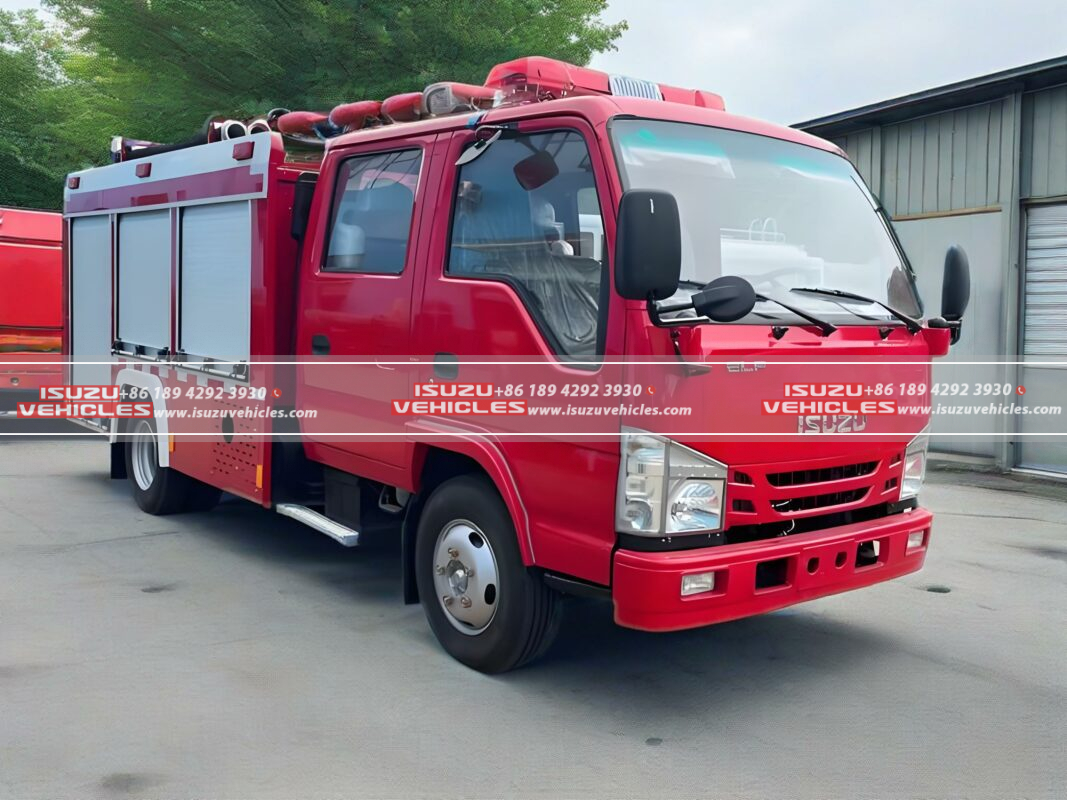
Amidst the 52°C furnace of Kuwait’s summer, where hydrocarbon vapors shimmer above Mina Al-Ahmadi’s refinery complexes, a new generation of ISUZU firefighting modules is redefining rapid-response protocols. These aren’t mere trucks but interoperable crisis platforms, engineered to swap mission pods in under 5 minutes – transforming from foam tenders to hazmat units faster than a crude unit shutdown sequence.
Extreme Environment Imperatives – More Than Just Heat
Kuwait’s refineries demand fire apparatus conquering simultaneous threats:
- Thermal Armor Systems: Ceramic-nanofiber hood liners withstand 1,100°C radiant heat for 47 minutes – critical during tank farm domino scenarios. Hydrogel-cooled chassis components prevent brake fluid vaporization on tarmac reaching 82°C.
- Sand Intrusion Countermeasures: Triple-sealed axial fan enclosures and vortex particle separators extend engine life by 400% in Abraq Khaitan’s silica-laden winds, where standard pumps fail within 1,200 operational hours.
ISUZU S-Cab Chassis – The Backbone of Modularity
The ISUZU GIGA FY chassis forms a purpose-built foundation:
- Dynamic Load Calculus: AI-assisted weight distribution systems recalibrate stability in real-time when swapping 6-ton foam pods for 8-ton dry chemical units, maintaining 42/58 front-rear axle ratios despite payload shifts.
- Corrosion Warfare: Cathodic electrophoretic coating combined with zirconium-based primers resist hydrogen sulfide permeation – a proven necessity after KNPC’s 2023 corrosion study showed 78% faster component degradation in sour gas zones.
Mission-Specific Pod Ecosystems – Scalable Response Architecture
Interchangeable ISO-certified modules enable strategic versatility:
High-Expansion Foam Pods
- Variable-Viscosity Dosing: Peristaltic pumps adjust foam concentrate viscosity from 2.9 cP to 47 cP based on ambient temperature, ensuring optimal induction at 0.3%–6% ratios during winter-summer transitions.
Hazmat Neutralization Units
- Reactive Adsorption Technology: Zeolite molecular sieves impregnated with copper oxides neutralize H₂S at 8,000 ppm concentrations – outperforming standard carbon filters by 17:1 in Burgan Field trials.
Integrated Firefighting Neurosystem – Predictive Threat Management
Beyond hardware, intelligence drives survival:
- Refinery GIS Fusion: Live process unit schematics overlay thermal camera feeds, automatically identifying 95% of vessel rupture scenarios within 8 seconds through machine-learned failure signatures.
- Resource Algorithmics: Fleet AI coordinators redeploy units using computational fluid dynamics fire-spread modeling, reducing response latency by 63% during Kuwait National Petroleum Company’s 2024 drills.
Synergistic Fleet Deployment – The ISUZU Ecosystem Advantage
Modular fire units operate within a coordinated hardware ecosystem:
- ISUZU bucket trucks with 35m insulated booms create rapid vapor suppression curtains using electrostatically-charged fog nozzles, containing benzene plumes during column fires.
- ISUZU water tank trucks configured as roving relay pumpers sustain 8,000L/min flows through 3km hose relays, their carbon-fiber tanks resisting hydrocarbon permeation where polyethylene fails.
At Mina Abdulla’s Command Center, the ISUZU modular fleet stands poised – not as static assets but as reconfigurable sentinels. Their value transcends fire suppression; they are kinetic insurance policies against the catastrophic calculus of refining 1.7 million barrels daily in one of Earth’s most unforgiving environments. Each interchangeable pod represents a battle-tested contingency, engineered for the moment when the desert’s heat meets hydrocarbons’ fury.