
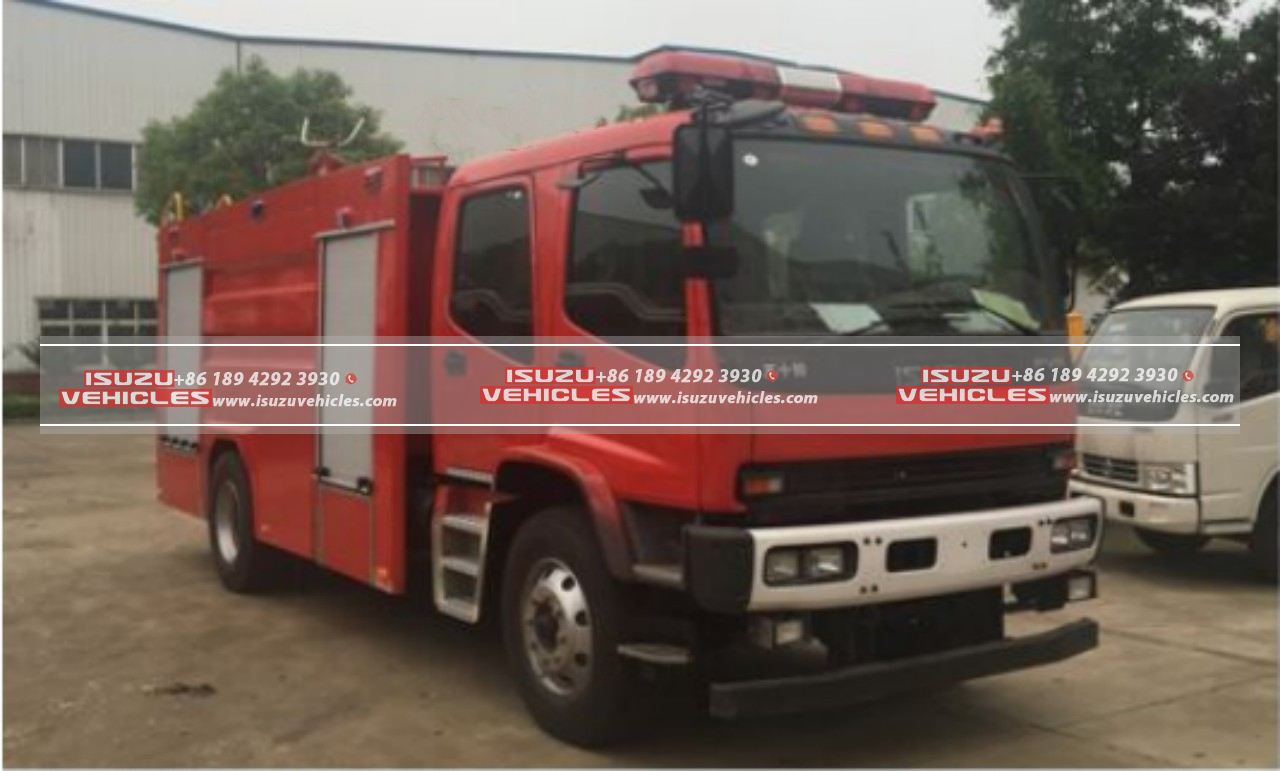
Transformative Collaboration Elevates National Emergency Preparedness
In a landmark initiative to fortify El Salvador’s disaster response capabilities, ISUZU China and Grupo Industrial Salvadoreño (GIS), the nation’s largest infrastructure consortium, finalized a $24 million contract on June 24, 2025, delivering 30 advanced ISUZU Fire Trucks to critical regions across the country. The handover ceremony, held in San Salvador, underscores a strategic alignment between Japanese engineering excellence and Central America’s evolving public safety priorities, particularly in mitigating risks posed by volcanic activity, seismic events, and seasonal floods.
This collaboration is anchored in El Salvador’s National Risk Reduction Plan (NRRP), a multi-agency framework targeting modernization of firefighting infrastructure in high-vulnerability zones. The ISUZU Fire Trucks, equipped with high-pressure water cannons and aerial ladder systems, will be deployed to urban centers like Santa Ana and La Libertad, as well as rural communities near the Chaparrastique volcano. A cornerstone of the agreement includes a seven-year technical support package, ensuring GIS technicians receive specialized training from ISUZU engineers in predictive maintenance and advanced rescue operations.
By integrating these vehicles into El Salvador’s Civil Protection System, the partnership bridges gaps in emergency logistics, particularly in areas historically underserved due to terrain complexity. Future phases of the NRRP will expand the fleet with ISUZU pickup trucks for rapid-response reconnaissance and ISUZU tanker trucks for bulk water transport, creating a unified disaster management network tailored to the nation’s geophysical realities.
Cutting-Edge Engineering for High-Risk Scenarios
High-Performance Fire Suppression Systems
The newly delivered ISUZU Fire Trucks are engineered to address El Salvador’s diverse hazard profile. Powered by 6WG1-TC turbocharged engines, these vehicles achieve a pumping capacity of 4,500 liters per minute, with dual discharge ports enabling simultaneous firefighting and water rescue operations. Integrated thermal imaging cameras and drone launch platforms enhance situational awareness for crews navigating dense urban environments or volcanic ash clouds.
Multi-Hazard Adaptability
To address El Salvador’s seismic vulnerabilities, the trucks feature reinforced chassis with earthquake-resistant mounting systems for equipment storage. Modular compartments allow swift reconfiguration for chemical spill containment or medical evacuation missions, while explosion-proof electrical systems ensure operational safety in industrial zones like Acajutla’s oil refinery corridor.
Climate-Resilient Operational Readiness
Designed for Central America’s tropical climate, the fleet incorporates corrosion-resistant aluminum bodies and hydrophobic coatings to withstand heavy monsoon rains. Four-wheel-drive capabilities and 45-degree incline stability enable access to remote villages in the Apaneca-Ilamatepec mountain range, where road conditions often deteriorate during emergencies.
Building a Legacy of Sustainable Safety Infrastructure
The ISUZU-GIS alliance transcends immediate firefighting needs, embedding long-term resilience into El Salvador’s urban planning frameworks. The forthcoming integration of ISUZU pickup trucks—retrofitted with mobile command centers and satellite communication arrays—will empower local authorities to coordinate multi-agency responses during cascading disasters. Concurrently, ISUZU tanker trucks equipped with 10,000-liter stainless steel tanks will bolster water reserves in drought-prone regions like the Central Plateau, aligning fire prevention with broader climate adaptation goals.
Local stakeholders emphasize the project’s socioeconomic dividends. A dedicated ISUZU-GIS training academy, slated for completion in 2026, will certify 200 Salvadoran technicians annually in heavy vehicle maintenance and disaster logistics, reducing reliance on foreign expertise. Additionally, pilot programs explore retrofitting fire trucks with solar-powered auxiliary systems, aiming to cut diesel consumption by 40% by 2028—a critical step toward achieving El Salvador’s carbon neutrality targets.
The partnership also pioneers data-driven risk mitigation through AI-powered hazard mapping. By cross-referencing fire truck deployment patterns with seismic activity sensors and weather satellites, authorities aim to develop predictive models for preemptive resource allocation. Such innovations position El Salvador as a regional benchmark for integrating technology with community-centric disaster governance.
As the nation advances its Vision 2030 development agenda, this fleet deployment exemplifies how cross-border industrial collaboration can transform vulnerability into proactive resilience. With periodic technology refreshes and joint R&D initiatives planned through 2032, the ISUZU-GIS partnership is poised to redefine emergency response paradigms across Latin America.