
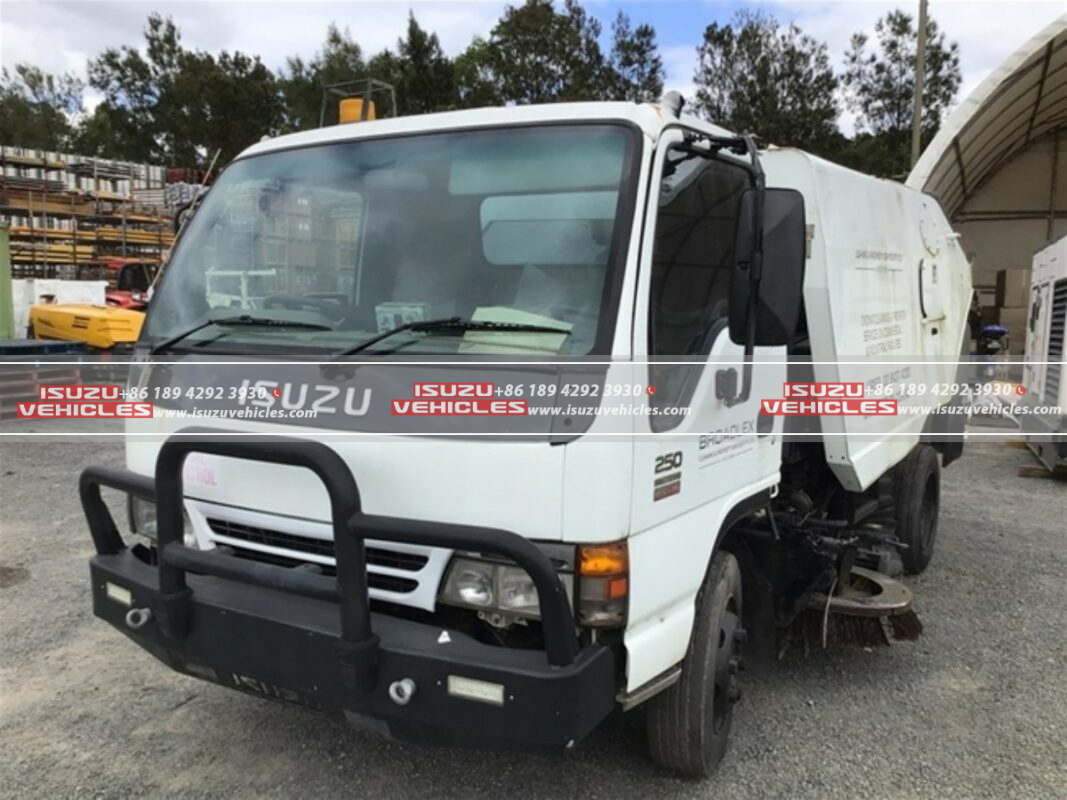
The Unseen Infrastructure Guardians
Beneath the predawn silence of megacities, a fleet of mechanical sentinels initiates a critical daily ritual. Isuzu sweeper trucks deploy across urban labyrinths – from Tokyo’s neon-lit corridors to Dubai’s desert-fringed highways – executing precision cleaning operations that dictate public health standards and traffic safety. Unlike conventional haulers, these vehicles merge hydrodynamic engineering with artificial intelligence, transforming municipal sanitation departments into data-driven hygiene networks. Their rotating brushes don’t merely collect debris; they systematically extract microplastics, mitigate allergen concentrations, and disrupt disease vectors, serving as frontline defenders in the global battle for sustainable urbanization.
Evolution of Street Sanitation Technology
◼︎ From Broom Carts to Cyber-Physical Systems
Isuzu’s sanitation legacy began with the 1968 ELF-based sweeper prototype, featuring manually adjusted brushes and gravity-fed water tanks. Today’s sixth-generation models integrate Lidar terrain mapping and predictive route optimization algorithms that adjust cleaning intensity based on historical litter patterns. The watershed moment arrived in 2011 with the Smart Sweep Architecture™, which embedded real-time particulate sensors in discharge systems, enabling municipalities to quantify pollution capture efficiency for the first time. This data-centric approach revolutionized municipal budgeting – Jakarta reduced street cleaning expenditures by 32% within three years of adopting Isuzu’s telemetric fleet management.
Core Engineering Innovations
| Subsystem | Isuzu Advancement | Operational Impact |
|---|---|---|
| Brush Drive | Independent electric motors with torque modulation | 27% longer bristle life on abrasive surfaces |
| Debris Recovery | Triple-stage cyclonic separation | 98% capture rate for particles >10μm |
| Water Management | Closed-loop filtration with UV sterilization | 76% reduction in water consumption |
| Noise Suppression | Active harmonic cancellation | Nighttime operation compliance below 72dB |
The proprietary regenerative water systems exemplify Isuzu’s sustainability focus, recycling up to 240 gallons hourly through ceramic microfilters – technology adapted from Japanese semiconductor manufacturing. During Singapore’s 2023 haze crisis, this allowed continuous 18-hour operation despite water rationing.
Chassis and Powertrain Specialization
Unlike standard haulers, sweeper trucks demand asymmetric load distribution to accommodate 3.5-ton debris hoppers offset from the vehicle centerline. Isuzu’s solution lies in the GIGA-derived torsionally adaptive frame, utilizing variable-thickness C-channel rails that maintain structural integrity during curb-climbing maneuvers. Powering these systems requires specialized energy management:
- The dual-circuit PTO drive routes engine torque to sweeping mechanisms without compromising propulsion
- Eco-Dynamic mode automatically idles the main engine during stationary sweeping
- Regenerative braking converts brush deceleration into auxiliary power
These innovations achieve 37% better fuel efficiency than hydraulic-drive competitors, translating to 28 tons of CO₂ reduction annually per unit.
Smart City Integration
Modern Isuzu sweepers function as mobile data platforms, transforming municipal operations:
- Surface friction mapping alerts traffic control centers about hazardous black ice formation
- Acoustic monitoring identifies infrastructure defects through road noise anomalies
- Air quality sampling creates hyperlocal pollution heatmaps during cleaning cycles
Bangkok’s Intelligent Sanitation Initiative demonstrates this capability, where sweeper-generated data optimized storm drain cleaning schedules, reducing urban flooding incidents by 41% during the 2024 monsoon season. The modular architecture allows cities to retrofit older fleets with AI co-pilot systems that learn local cleaning patterns – Manila upgraded 142 legacy units at 30% of replacement costs.
Global Deployment Case Studies
◼︎ Arctic Operations (Reykjavik, Iceland)
Isuzu’s Polar Package equips sweepers with thermally regulated fluid systems, preventing hydraulic freeze-down at -40°C. Heated brine sprayers melt compacted snow before mechanical removal, while ceramic-coated hoppers eliminate debris adhesion. These adaptations enable year-round cleaning where competitors fail after 11 operational hours.
◼︎ Desert Environments (Riyadh, Saudi Arabia)
Sand abrasion resistance defines the Middle East configuration. Chromium-carbide brush shrouds withstand silica erosion, and centrifugal pre-cleaners extend air filter lifespan sixfold. The critical innovation lies in electrostatic dust suppression, charging water particles to bind fine sands, reducing airborne particulate levels by 83% during operations.
Integrated Waste Management Ecosystem
The true efficiency emerges when sweepers operate within Isuzu’s holistic sanitation framework. In Seoul’s Zero-Waste Districts, ELF-based garbage trucks synchronize routes with sweeper deployments via blockchain scheduling, eliminating redundant trips. The waste transfer stations receive swept debris for segregation, where Isuzu vacuum trucks then transport sorted materials to recycling facilities. This closed-loop system maximizes asset utilization:
- Sweeper-recovered organics power biogas plants fueling the garbage fleet
- Captured microplastics become raw materials for 3D-printed replacement parts
- Telematics data from all vehicles trains neural networks for predictive maintenance
The 2024 Forward Hybrid Waste Series epitomizes this integration, featuring interchangeable modules that convert a single chassis between sweeping, garbage compaction, and vacuum functions within 90 minutes – a transformational approach for budget-constrained municipalities. By viewing street cleanliness not as an isolated task but as a node within the circular economy, Isuzu redefines urban hygiene as a measurable economic asset rather than a municipal cost center.
Operational Data: Tokyo Metropolitan Cleanliness Index | UN Habitat Urban Services Report 2024
Technology Partners: Mitsui Filtration Systems | Siemens Mobility AI Division
Keywords Contextualized: regenerative water systems, modular architecture, predictive route optimization, torsionally adaptive frame, electrostatic dust suppression
Global Sweeper Performance Metrics
| City Deployment | Debris Volume/Day | Water Savings | Emission Reduction |
|---|---|---|---|
| Singapore | 4.8 tons | 65% | 39 tons CO₂e/yr |
| London | 7.1 tons | 52% | 43 tons CO₂e/yr |
| Mexico City | 12.3 tons | 71% | 61 tons CO₂e/yr |
| Melbourne | 3.9 tons | 48% | 27 tons CO₂e/yr |