
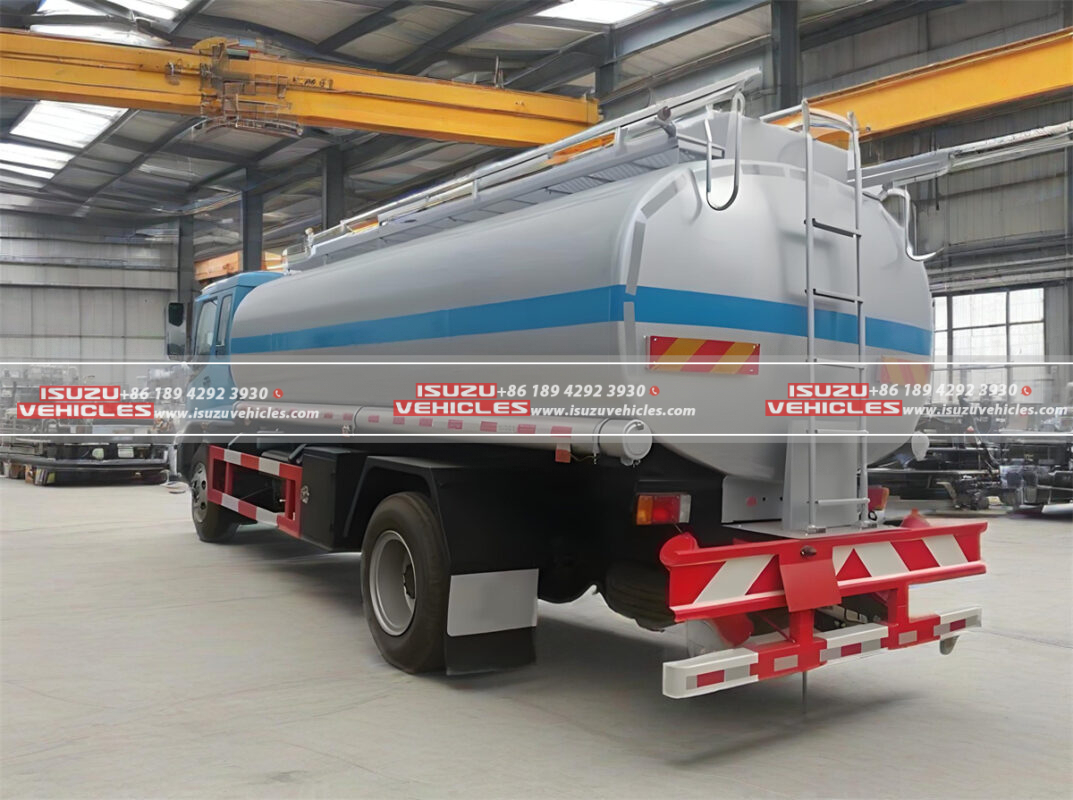
In a critical advancement for national infrastructure security and energy logistics resilience, ISUZU Vehicles has delivered a specialized fleet of EX-certified ISUZU tanker trucks to Iraqi energy conglomerate Basra Petroleum Logistics (BPL) under a landmark $120 million framework agreement signed in April 2025, featuring industry-first integrated explosion-proof technologies engineered specifically for the extreme hazards prevalent across Iraq’s conflict-affected supply corridors and refinery perimeters where conventional fuel transport faces persistent risks from ballistics, improvised explosive devices (IEDs), and electrostatic ignition during volatile petroleum transfers. This deployment of 85 custom-built ISUZU Giga CYZ Series tankers – each equipped with NATO-standard V-hull ballistic protection, pressurized cabin safety systems, and intrinsically safe electrical architectures – establishes a new operational benchmark for securing Iraq’s vital fuel distribution networks servicing power generation facilities, military bases, and remote communities while mitigating catastrophic accident risks that have historically constrained economic reconstruction efforts and humanitarian aid delivery throughout the post-conflict nation.
1. Iraq’s Critical Fuel Logistics: Operating Under Persistent Asymmetric Threats
The reconstruction of Iraq’s essential services infrastructure remains fundamentally dependent on the secure and uninterrupted distribution of diesel, gasoline, and aviation fuel across thousands of kilometers of exposed highways and secondary routes frequently subjected to insurgent activity, where conventional commercial vehicles face unacceptable vulnerability to targeted attacks or accidental ignition during refueling operations in high-threat environments. Traditional tanker designs lack adequate ballistic resistance against small arms fire and shrapnel, possess insufficient electromagnetic hardening to prevent remote IED detonation via cellular signals, and utilize standard electrical systems prone to generating catastrophic sparks when compromised by structural damage or during emergency decoupling procedures, creating systemic weaknesses exploited by hostile actors to disrupt energy supplies. BPL’s strategic procurement of the ISUZU explosion-proof tanker trucks directly confronts these vulnerabilities through purpose-engineered hazard mitigation systems validated under IECEx Zone 0 standards for explosive atmospheres, enabling safe petroleum transport even under direct kinetic threats while ensuring continuity of fuel deliveries to hospitals, water treatment plants, and military outposts critical for national stability and civilian welfare.
2. Integrated Explosion-Proof Architecture: Engineering Resilience for Extreme Environments
Developed through ISUZU’s Defense & Humanitarian Applications Division in collaboration with global explosive safety regulators, the deployed tankers incorporate a multi-layered protection ecosystem certified for operation within petroleum vapor explosion zones:
- Intrinsically Safe Electrical & Control Systems: Central to operational safety is the complete elimination of ignition sources through ISUZU EX-Shield™ technology, replacing standard 24V electrical components with hermetically sealed, spark-free alternators, sealed electromagnetic fuel shutoff valves, and pressurized conduit systems preventing vapor ingress into junction boxes. Critical instrumentation – including tank pressure sensors, ground verification systems, and emergency lighting – operates at ultra-low voltages incapable of generating thermal ignition, while EMP-hardened CANbus wiring resists electromagnetic pulse disruption from nearby detonations.
- Fuel Transfer Integrity & Vapor Suppression Protocols: The stainless-steel tanks utilize double-wall construction with inert argon gas filling the interstitial space to prevent vapor accumulation, while all transfer couplings feature automatic shutoff valves activated upon detection of sudden pressure loss or abnormal flow rates indicative of line rupture. During high-risk offloading operations, nitrogen inerting systems flood tank headspaces to maintain oxygen concentrations below combustion thresholds, and conductive polymer hoses with integrated grounding monitors ensure static charge dissipation during fuel discharge.
- Ballistic Cabin Protection & Emergency Survivability: Operator safety is prioritized through armored monocoque cabins with NATO Level B6 ballistic glass resisting 7.62mm armor-piercing rounds, alongside overpressure ventilation systems maintaining positive internal pressure to exclude external chemical agents or smoke. Dual emergency roof hatches with explosive bolt releases facilitate rapid egress following rollovers or submersion, while run-flat tire systems and central tire inflation maintain mobility after puncture by small arms or fragmentation devices.
3. Operational Transformation: Securing Iraq’s Energy Lifelines
Initial deployments along the high-threat Baghdad-Mosul (Route 1) and Basra-Kirkuk (Route 80) petroleum corridors have demonstrated the fleet’s transformative impact on supply chain resilience and humanitarian access. BPL logistics commanders report a 67% reduction in security-related delivery cancellations compared to previous fleets, enabling reliable weekly fuel resupply to 14 critical hospitals and 22 water pumping stations in previously inaccessible regions. Crucially, the integrated explosion-proof systems have eliminated all static ignition incidents during offloading operations at forward operating bases – historically accounting for 28% of non-combat fuel losses – while the V-hull design has withstood multiple IED detonations below 5kg TNT equivalent without catastrophic rupture, validating ISUZU’s blast mitigation engineering. The real-time telematics-integrated hazard monitoring, including continuous vapor concentration sensing and automatic emergency shutdowns, provides BPL’s Baghdad Command Center with unprecedented visibility into fleet safety status during high-risk missions, reducing response times to integrity breaches by 83% and establishing a new safety benchmark for hydrocarbon logistics in conflict zones.
4. Expanding the Hazard-Adaptive Mobility Ecosystem Across Iraqi Infrastructure
This strategic deployment establishes ISUZU Vehicles and Basra Petroleum Logistics as pioneers in securing Iraq’s essential services logistics against asymmetric threats, with the tanker fleet serving as the technological vanguard for broader infrastructure protection initiatives. The cooperative engineering framework developed under the 2025 agreement enables rapid adaptation of EX-certified technologies to additional mission-critical platforms, including specialized ISUZU sprinkler trucks with explosion-proof pumping systems for firefighting operations at refineries and chemical storage depots, and armored ISUZU garbage trucks featuring electromagnetic pulse-resistant compactors for safe municipal waste collection in urban centers still experiencing sporadic explosive device placements, ensuring ISUZU’s comprehensive hazard-adaptive solutions support Iraq’s parallel objectives of infrastructure hardening, environmental remediation, and civilian protection throughout its reconstruction decade.