
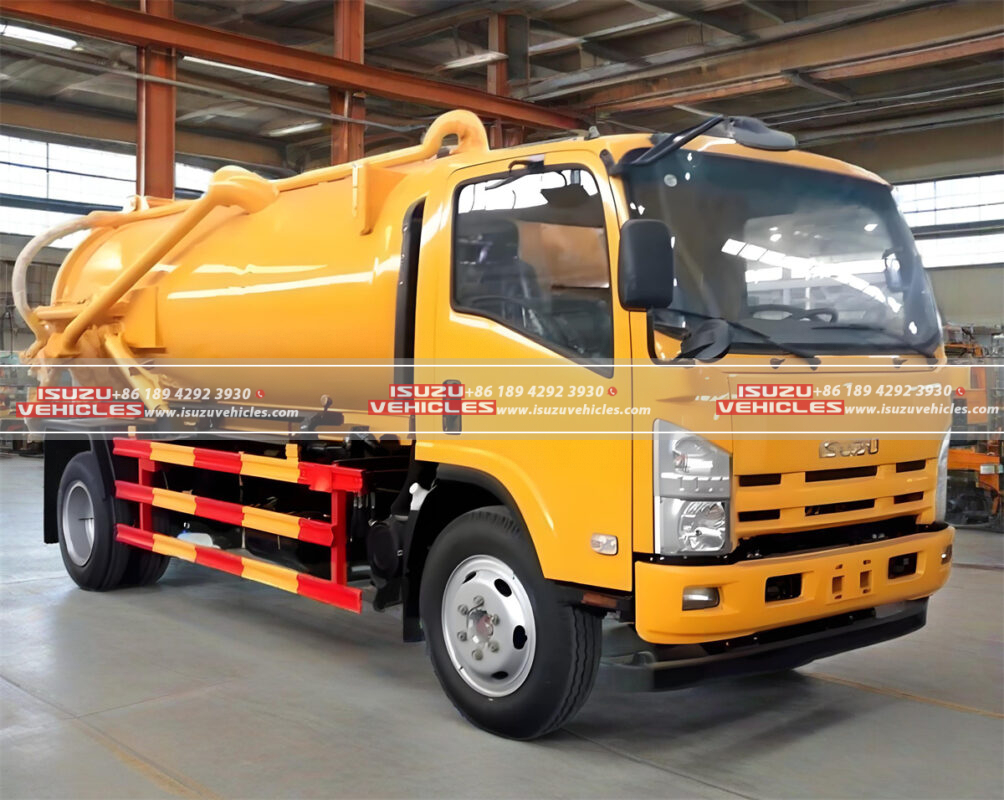
In a strategic advancement for regional public health infrastructure, ISUZU VEHICLES has delivered 120 specialized vacuum trucks to municipal authorities in Thailand and Malaysia, addressing critical wastewater management challenges in high-density urban centers. This landmark initiative, executed through partnerships with Bangkok Metropolitan Administration (BMA) and Kuala Lumpur City Hall (DBKL), targets aging sewer systems overwhelmed by rapid urbanization and monsoon flooding. The deployment establishes a new benchmark for sustainable city management, equipping crews with Japanese-engineered technology to prevent sewage overflows in flood-prone districts like Bangkok’s Bang Khen and Kuala Lumpur’s Segambut, directly safeguarding 9 million residents from waterborne disease risks while advancing UN Sustainable Development Goal 6 (clean water and sanitation) compliance ahead of 2030 targets.
Dual-Nation Handover Ceremonies Signal Regional Unity
Synchronized delivery events unfolded on October 23, 2025, at Bangkok’s Lumphini Depot and Kuala Lumpur’s Titiwangsa Operations Hub, attended by ISUZU VEHICLES Asia-Pacific CEO Hiroshi Tanaka, Thai Interior Minister Anutin Charnvirakul, and Malaysian Local Government Minister Nga Kor Ming. Both ceremonies emphasized immediate crisis-readiness, with 60 trucks activated pre-monsoon to clear sediment-choked drains in Bangkok’s historic districts and retrofit Kuala Lumpur’s SMART Tunnel drainage infrastructure. Demonstrations featured ISUZU’s modular sludge-compression systems, allowing on-site wastewater volume reduction by 70% before transport—a breakthrough minimizing landfill burdens. Satellite-linked fleet management dashboards were simultaneously launched, enabling cross-border data sharing on flood hotspots during seasonal emergencies.
Transforming Metropolitan Sanitation Capabilities
Southeast Asia’s monsoon-driven urban flooding routinely contaminates waterways with untreated sewage, causing cholera surges and infrastructure corrosion costing Thailand and Malaysia over $400M annually. These ISUZU NLR 85 vacuum trucks disrupt this cycle through industrial-grade suction systems extracting 8,000 liters of sludge per minute from depths exceeding 6 meters, outperforming legacy equipment by 300% in Bangkok’s low-elevation communities. High-flow dewatering pumps separate solids from liquids at disaster sites, enabling compliant hazardous waste containment while reducing transport trips by 40%. Real-time viscosity sensors automatically adjust suction power in Malaysia’s clay-heavy soils, preventing pipe blockages that historically paralyzed operations during peak flooding.
Engineering Innovations: Tropicalized Performance
ISUZU’s design team overcame equatorial operational challenges through rigorous field-testing in Penang and Phuket, resulting in purpose-built adaptations for humidity, corrosion, and space constraints.
Flood-Response Agility
Amphibious axles and electromagnetic seal protectors enable operation in 1.2-meter floodwaters, maintaining vacuum integrity where competitors fail. This allows continuous wastewater extraction during Category 3 storms, keeping emergency access roads functional for first responders.
Eco-Compliance Systems
Closed-loop odor suppression and carbon-filtration vents eliminate toxic hydrogen sulfide emissions during sludge transfer, adhering to ASEAN’s Air Quality Index regulations. Solar-assisted power take-offs reduce diesel consumption by 22% during standby operations, while noise-dampened pumps facilitate nighttime work in hospital zones without disturbance.
Strategic Municipal Partnerships for Localized Impact
The ISUZU VEHICLES–BMA–DBKL tripartite framework prioritizes knowledge sovereignty through co-developed maintenance protocols and technician academies in Nonthaburi and Shah Alam. Certified training programs upskill 350 municipal staff in advanced wastewater diagnostics and hybrid-engine maintenance, creating localized expertise pools independent of foreign technicians. Joint R&D initiatives adapted truck specifications for Bangkok’s narrow soi alleyways and Kuala Lumpur’s underground utility labyrinths, incorporating laser-guided maneuvering assists to prevent infrastructure damage. This collaborative model has already reduced service downtime by 65% through predictive parts-replacement algorithms developed with Malaysian engineers.
Expanding Southeast Asia’s Smart Sanitation Ecosystem
Beyond immediate wastewater management, ISUZU VEHICLES is positioning its Southeast Asian success as a gateway for integrated municipal fleets, with advanced garbage truck prototypes undergoing Manila trials and AI-guided sweeper truck deployments planned for Singapore’s 2026 urban renewal zones. Upgraded Thai production facilities will manufacture vacuum modules for Cambodian and Vietnamese contracts by Q3 2026, leveraging tariff advantages under the Regional Comprehensive Economic Partnership. Concurrently, ISUZU’s “Clean Cities 2030” initiative—launched alongside these deliveries—will deploy blockchain-tracked sludge recycling across 12 Indonesian industrial parks, transforming waste into construction composites. This systematic scaling redefines urban resilience, converting emergency response vehicles into engines of circular economies.