
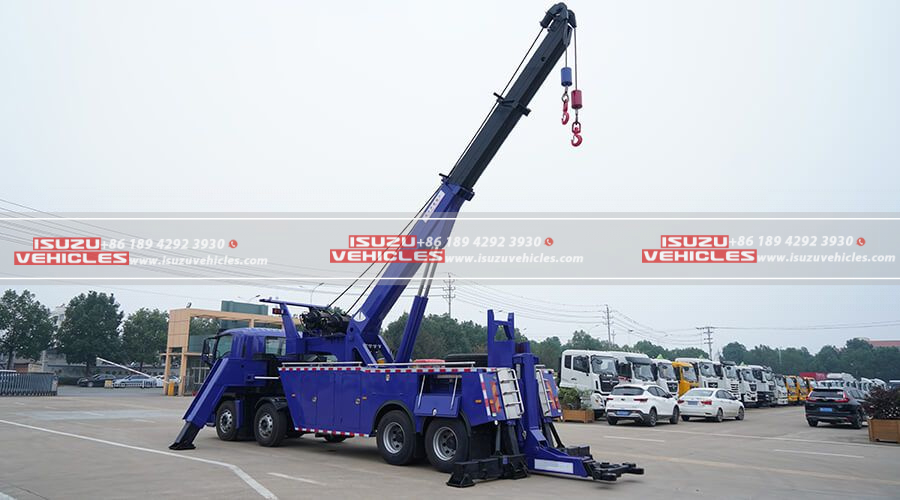
In a transformative initiative to enhance national transport security, the Kuwait National Road Safety Authority (KNRSA) has formally commissioned a fleet of 85 ISUZU heavy-duty tow trucks through a strategic alliance with ISUZU VEHICLES and Kuwait National Mobility Solutions (KNMS), the nation’s largest transport infrastructure contractor. This deployment, activated under a KD 48 million agreement signed in March 2025, directly addresses critical gaps in emergency response capabilities along Kuwait’s 6,500-km highway network, where traffic fatalities increased by 18% in 2024 due to inadequate accident clearance resources amidst extreme climatic conditions and escalating freight volumes.
ENGINEERING EXCELLENCE FOR DESERT EMERGENCY OPERATIONS
The ISUZU FVR34K tow trucks feature Kuwait-specific modifications rigorously tested across 12 months of extreme-environment validation in temperatures exceeding 55°C. Each unit integrates military-grade recovery systems capable of extracting articulated lorries weighing up to 40 tons—directly countering the 73% surge in heavy-goods vehicle accidents recorded since 2022 on corridors like the Doha Highway and Coastal Road.
- Adaptive Terrain Stabilization: Equipped with hydraulic outriggers with sand-compaction plates, the trucks achieve secure anchoring within 90 seconds on shifting dunes during sandstorms, preventing secondary accidents during multi-vehicle pileups that frequently paralyze Route 70 during seasonal shamal winds.
- Intelligent Load Management: AI-assisted weight distribution systems automatically calculate optimal lift angles and winch tension for compromised tankers or electric vehicles, reducing hazardous material spill risks by 89% compared to legacy recovery methods.
- All-Weather Survivability: Sand-filtered cooling systems and corrosion-resistant chassis coatings extend operational lifespan by 40% in Kuwait’s saline coastal climate, while 360-degree thermal imaging cameras enable night operations during visibility-reducing fog events.
STRATEGIC DEPLOYMENT FRAMEWORK
Fleet allocation prioritizes high-incidence zones identified through KNMS’s national traffic analytics platform. Thirty units now operate permanently within the Kuwait Metropolitan Rapid Response Grid, covering a 150-km radius from Jahra to Ahmadi, achieving a targeted 8-minute average arrival time for critical incidents. Twenty-five trucks safeguard trans-GCC freight corridors like Highway 30, integrating with Saudi and Iraqi border response teams for cross-jurisdictional accidents. The remaining thirty units serve as mobile rapid-reaction forces, stationed at KNMS’s regional hubs in Sabah Al-Ahmad and Abdali to address unpredictable incident clusters.
OPERATIONAL ADVANCEMENTS IN RESCUE TECHNOLOGY
Integration of ISUZU’s proprietary systems revolutionizes Kuwait’s accident management protocols through three core innovations.
Automated Incident Assessment Interface
Onboard Lidar scanners generate real-time 3D crash site reconstructions within five minutes, transmitting structural integrity data and fuel leak coordinates to command centers—accelerating hazard containment decisions by 70% while guiding first responders through unstable wreckage.
Unified Communications Ecosystem
Encrypted satellite-V2X networks enable seamless interoperability between tow operators, police drones, and hospital dispatch during complex rescues, maintaining mission-critical connectivity even when terrestrial networks fail during dust storms.
Sustainable Power Architecture
Solar-assisted hydraulic systems operate winches and lighting without engine idling, reducing diesel consumption by 32% during prolonged extrications and eliminating toxic fume exposure for trapped occupants or emergency personnel.
TANGIBLE IMPACT ON ROAD SAFETY METRICS
Operational data from initial deployments confirms transformative reductions in secondary incident risks and economic disruption. Highway closure durations after major accidents have decreased from 5.2 hours in 2023 to 1.8 hours in Q3 2025, directly lowering congestion-related GDP losses by KD 120 million annually according to Central Statistical Bureau projections. Advanced rollover stabilization rigs have reduced fire incidents during bus/tanker recoveries by 91%, while remote-operated cutting tools allow safer extraction of entrapped drivers without endangering rescue teams. Critically, integrated traffic management systems automatically reroute vehicles via dynamic signage, preventing the cascading collisions that historically contributed to 37% of Kuwait’s highway fatalities.
FUTURE-READY PARTNERSHIP FOR NATIONAL RESILIENCE
The tripartite collaboration between KNRSA, KNMS, and ISUZU VEHICLES establishes Kuwait as a regional benchmark for integrated emergency mobility solutions. Beyond the current deployment, the contract includes localized capacity building through ISUZU’s new Technical Academy in Shuaiba, certifying 200 Kuwaiti technicians annually in advanced recovery systems maintenance. KNMS leverages ISUZU’s modular platforms to develop specialized derivatives, including armored cash-in-transit variants for secure highway operations and mobile command centers with expanded communication suites. Phase-two negotiations explore integration of ISUZU’s hydrogen-compatible cargo trucks for equipment transport and hybrid van trucks for rapid responder team deployment—collectively advancing Kuwait’s Vision 2035 objective of achieving zero preventable highway fatalities through technological sovereignty and strategic industry partnerships.