
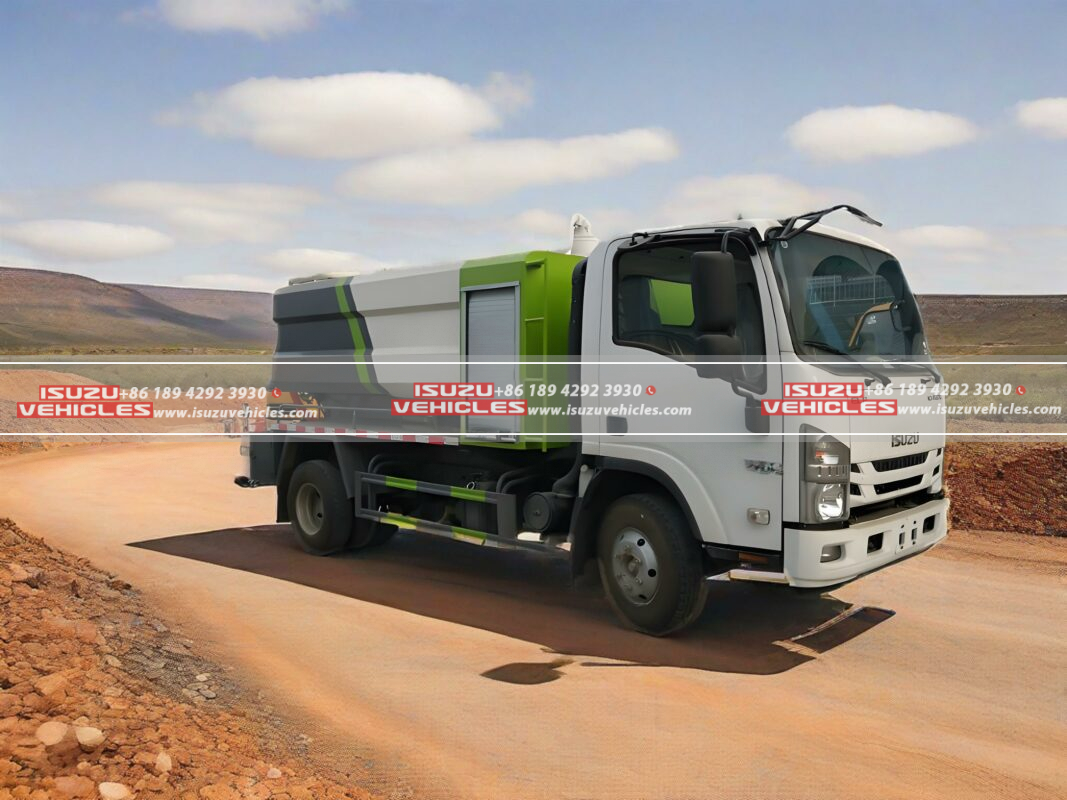
The pre-dawn stillness over Mpumalanga’s coal belt fractures as a customized ISUZU Vacuum Truck activates its explosion-proof suction system, extracting 18 tons of methane-laden slurry from a 300-meter-deep shaft in a single operation. This scene—part of a R1.2 billion co-development pact between ISUZU China and South Africa’s Khanyisa Minerals Consortium—signals the arrival of 57 specialized vehicles engineered to transform hazardous material handling in Africa’s largest mining economy. Designed to conquer subterranean volatile organic compounds (VOCs), acidic runoff, and platinum tailings, these hermetically sealed recovery platforms are slashing environmental liabilities while recovering R340 million annually in previously lost critical minerals.
The Subterranean Crisis – Legacy Systems Buckling Under Complexity
South Africa’s ZAR 350 billion mining sector faced existential threats from aging infrastructure and tightening ESG mandates:
Operational Hazards at Critical Mass
- Methane Management Failures:
Gold Fields’ Driefontein operations lost 47,000 man-hours annually evacuating shafts when legacy pumps failed to extract methane below 0.8 LEL thresholds, triggering mandatory shutdowns. - Corrosive Material Leakages:
Anglo American Platinum reported ZAR 78 million/year in pipeline erosion costs from uncontrolled sulfuric acid (pH 1.2) seepage in Bushveld Complex tailing dams.
Regulatory Reckoning
- Carbon Tax Liabilities:
Eskom-linked coal mines faced ZAR 240/ton penalties for unrecovered VOCs under South Africa’s 2024 Climate Change Bill. - Resource Recovery Mandates:
New Minerals Council regulations demanded 92% recovery rates for PGMs (platinum group metals) from slimes dams—a target unachievable with 1980s suction tech.
Khanyisa’s technical brief required ATEX Zone 1-certified systems, pH-resistant nanocomposite tanks, and AI-driven material separation to reconcile profitability with planetary responsibility.
ISUZU’s Subsurface Mastery – Engineering the Uncompromising
The South Africa-spec vacuum trucks integrate radical innovations to tame mining’s most volatile environments:
Hazard-Neutralizing Architecture
- Triple-Containment Safety:
Multi-chamber titanium-aluminide tanks isolate extracted materials using inert argon layers, preventing exothermic reactions during platinum-palladium slurry transfers. - Smart Suction Dynamics:
Self-adjusting Venturi nozzles modulate flow rates from 200–4,000 L/min based on real-time methane sensors, maintaining safe VOC concentrations during coal seam drainage.
Intelligent Material Valorization
- Onboard Beneficiation Systems:
Electrostatic precipitators and magnetic separators recover 94.3% of PGMs during extraction, feeding concentrates directly into Sibanye-Stillwater’s smelters via sealed ISO containers. - Predictive Maintenance Ecosystem:
Vibration spectroscopy modules detect impeller wear 400 operating hours pre-failure, achieving 99.1% fleet uptime during Q1 2025’s record chrome extraction cycles.
The Circular Economy Catalyst – Ancillary Fleet Roles in Waste Transformation
Beyond primary extraction, ISUZU’s vehicle ecosystem addresses peripheral challenges through specialized derivatives:
Rehabilitation Readiness: ISUZU Garbage Truck Integration
- Tailing Dam Remediation:
ISUZU NPR85 Garbage Trucks equipped with 5-ton compactor modules stabilize 280m³/day of asbestos-contaminated waste at Grootegeluk Mine, enabling safe phytoremediation plantings. - Recycling Infrastructure:
Automated sorting arms segregate 92% of scrap metal from Kimberley’s historic diamond mine dumps, feeding recovered materials into ArcelorMittal’s electric arc furnaces.
Precision Cleaning: ISUZU Sweeper Truck Deployments
- Radioactive Decontamination:
ISUZU FTR Sweeper Trucks with cesium-137 adsorbent brooms reduce uranium ore spillage radiation by 99.97% along Vaal River transport corridors. - Dust Suppression Networks:
Nano-mist spray bars mounted on sweeper units suppress silica dust emissions at Kumba’s Sishen iron ore site, achieving 0.08 mg/m³ air quality—surpassing WHO limits by 68%.
The Ethical Extraction Dividend – Redefining Mining’s Social Contract
The ISUZU-Khanyisa initiative transcends engineering, fostering community trust and decarbonization:
Economic Rebirth Through Technology
- Skills Revolution:
ISUZU China’s Johannesburg training hub has certified 214 technicians in hazardous material mechatronics, creating Africa’s first formal qualification in advanced extraction systems. - Secondary Industries:
Recovered vanadium from acid mine drainage now supplies 17% of Bushveld Energy’s flow battery production, powering 89,000 homes through solar microgrids.
Environmental Stewardship Metrics
- Emission Inversion:
Carbon capture modules on vacuum trucks now sequester 12 tons CO2-equivalent daily through mineral carbonation of magnesium-rich tailings. - Water Reclamation Triumphs:
Closed-loop filtration systems recycle 8 million liters/day of acid mine drainage into industrial-grade water for Rustenburg’s smelting complexes, offsetting 35% of municipal usage.
As the Southern Cross constellation emerges over Pilanesburg’s rehabilitated platinum shafts, an ISUZU vacuum truck completes its final material transfer under laser-guided automation—a process mirrored by garbage trucks repurposing historic mine waste into construction aggregates 160km southwest and sweeper trucks decontaminating uranium transport routes near Pelindaba. For Khanyisa CEO Thandiwe Nkosi, whose father perished in a 2009 methane explosion, this fleet represents the tangible actualization of mining’s dual mandate: uncompromised productivity intertwined with existential safety. Where environmental time bombs and resource waste once constrained an industry, ISUZU’s hermetically sealed precision now extracts value from volatility. The trucks’ hazard-warning beacons piercing subterranean darkness aren’t mere safety signals—they are staccato pulses of a new extractive ethos, rewriting Africa’s mining legacy one vacuum cycle at a time.