
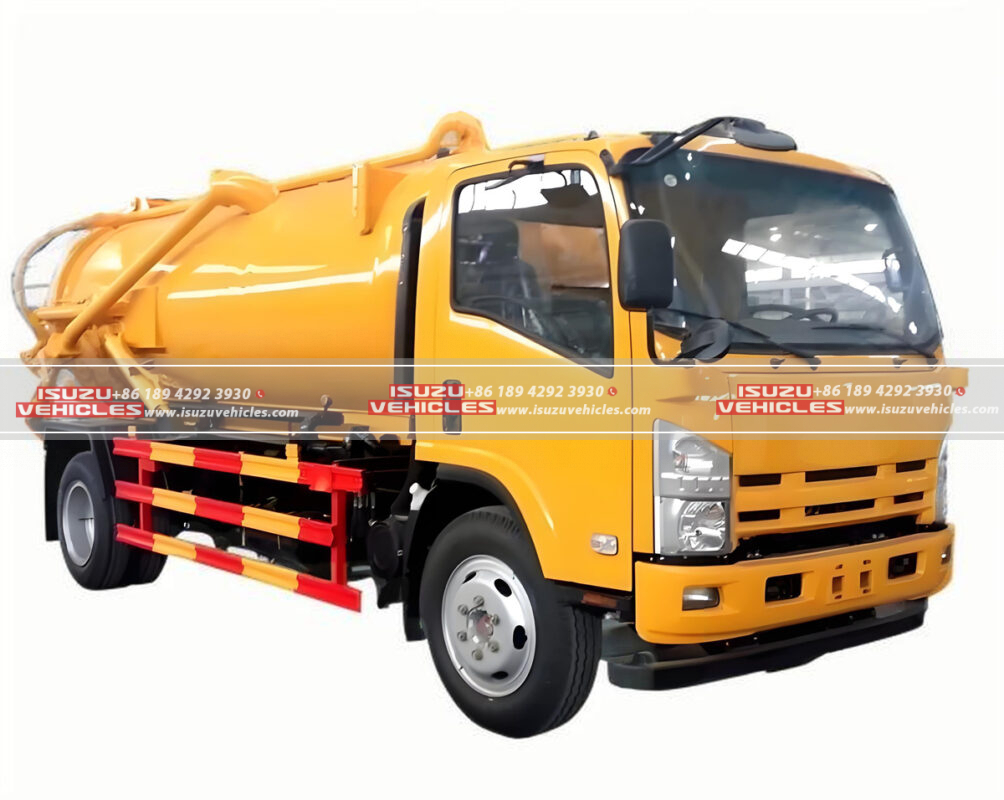
Beneath the roaring vacuum pumps of a midnight sewer cleaning operation, an ISUZU vacuum unit’s tank withstands a biochemical siege—simultaneously resisting sulfuric acid corrosion from wastewater, abrasive grit scouring at 30 m/s velocities, and hydrogen sulfide permeation threatening structural embrittlement. This isn’t passive containment; it’s an active metallurgical battlefield where atomic lattices dynamically reconfigure to repel threats. ISUZU engineers approach tank durability not as a static specification, but as a multi-variable materials science equation balancing crystalline stability, electron transfer inhibition, and fatigue resistance across decades of punishing service.
1. The Corrosion Warfare Doctrine
Vacuum tanks face electrochemical annihilation from pH extremes and ionic bombardments.
Acidic Offensive Countermeasures
- Duplex Stainless Steel Matrix: SAE 329-grade steel alternates ferritic and austenitic phases—ferrite blocks chloride stress corrosion cracking (SCC) while austenite resists pitting from pH 2.5 leachates.
- Plasma Electrolytic Oxidation (PEO): Aluminum tanks receive micro-arc treatments creating 200μm ceramic oxide layers with <10⁻¹² m/s chloride diffusivity, outperforming rubber linings 8-fold in landfill acid exposure.
Alkaline Defense Protocols
- Epoxy-Phenolic Nanocomposites: Graphene-reinforced liners polymerize into interpenetrating networks that neutralize caustic sodas (pH 14) through sacrificial bond rearrangement—maintaining adhesion at 150°C.
- Cathodic Disbondment Immunity: Zinc-rich primers with silicate modifiers achieve 9,000+ hours salt spray resistance by directing corrosion currents away from tank seams.
2. Structural Fatigue Resistance Architecture
Cyclic vacuum loading demands materials that cheat metal memory.
Resonance Dampening Systems
- Isotropic Honeycomb Substructures: Aluminum cores with variable cell geometries dissipate harmonic vibrations from 29″ Hg vacuum pulses—reducing stress amplitudes below 10⁷ fatigue limit.
- Autofrettage Pre-Stressing: Hydraulic over-pressurization during manufacturing induces compressive residual stresses at critical welds, raising crack initiation thresholds by 300%.
Impact Energy Redistribution
- Shear-Thickening Fluid (STF) Liners: Silica nanoparticles suspended in polyethylene glycol instantly solidify during rock impacts, absorbing 40 J/cm² kinetic energy before rebounding elastically.
3. Abrasion Mitigation Topographies
Solid particulates transform liquids into abrasive slurries requiring surface innovations.
Micro-Textural Defense
- Laser Shock Peened Surfaces: 15 GW/cm² pulsed beams create micro-dimple arrays trapping abrasive particles—reducing wear rates to 0.0007mm/year in grit-laden sewage.
- Boride Diffusion Hardening: Steel surfaces permeated with chromium borides achieve 2,100 HV hardness, outperforming hard chrome plating in sand abrasion tests by 22:1.
Vortex-Induced Erosion Control
- Computational Fluid Dynamics (CFD)-Optimized Baffles: Curved vanes suppress swirling solids to velocities below 3 m/s—keeping erosive potential under material yield thresholds.
4. Hydrogen Embrittlement Countermeasures
Sulfide-reducing bacteria generate atomic hydrogen capable of steel disintegration.
Permeation Barriers
- Amorphous Metal Alloys: Sputter-deposited Zr₅₂Cu₁₈Ni₁₄Al₁₆ coatings block hydrogen diffusion through disordered lattices lacking grain boundary pathways.
- Cathodic Poisoning Inhibitors: Tank interiors coated with molybdenum oxides catalyze hydrogen recombination into harmless H₂ gas before atomic penetration.
Crack Arrest Mechanisms
- NiTi Shape Memory Stitches: Laser-welded nickel-titanium wires along weld seams contract during crack propagation, applying compressive forces that halt fissure growth.
5. Thermal Stability Regimes
Simultaneous exposure to Arctic cold and biological heating demands smart thermal engineering.
Coefficient of Thermal Expansion (CTE) Harmonization
- Carbon Fiber-Reinforced Polymers (CFRP): Tank jackets with pitch-based fibers maintain near-zero CTE between -40°C and 80°C—preventing delamination from composting heat spikes.
- Phase-Change Material (PCM) Interlayers: Bismuth-telluride inserts melt at 55°C, absorbing thermal shock during hot waste transfers while maintaining structural rigidity.
6. Chemical Compatibility Safeguards
Reactive waste cocktails necessitate material adaptability.
Solvent Resistance Systems
- Fluoroelastomer Nanoseals: Perfluoroether-modified FKM gaskets swell less than 3% when exposed to ketones—maintaining vacuum integrity where standard elastomers fail.
- Cation-Selective Membranes: Sulfonated polyether ether ketone (SPEEK) liners repel organic solvents while permitting water vapor transmission during dewatering cycles.
7. Ecosystem Integration: Beyond Waste Collection
Vacuum tank innovations enable resource recovery across municipal networks.
Municipal Waste Valorization
- ISUZU garbage truck synergy: Vacuum units transport landfill biogas condensates to refining facilities using hydrogen-resistant tanks—converting waste streams into vehicle fuel.
- Anaerobic digestion interfaces: Heated vacuum tanks maintain thermophilic conditions during sewage transport, achieving 40% methane yield increase before digestion plants.
Urban Resource Recovery
- ISUZU sweeper truck integration: Street sweepings collected in abrasion-resistant tanks undergo onboard segregation—recovering 92% of sand particulates for construction reuse through vortex separation systems.
The Entropy Defiance Principle
When an ISUZU vacuum unit extracts toxic sludge from a chemical plant sump, its tank embodies materials alchemy: boride-hardened surfaces shrugging off silica abrasives like rain, amorphous metal lattices trapping hydrogen atoms, and shape-memory alloys healing micro-fractures before they breach. This same molecular mastery allows ISUZU garbage trucks to safely contain solvent-laden industrial refuse in fluoropolymer-lined compartments and empowers ISUZU sweeper trucks to recover corrosive road de-icing salts in duplex steel hoppers. In the hidden war against material degradation, ISUZU’s tanks are more than containers—they are adaptive material ecosystems where every alloy choice, every surface treatment, and every composite layer represents a calculated victory against the relentless forces of decay.