
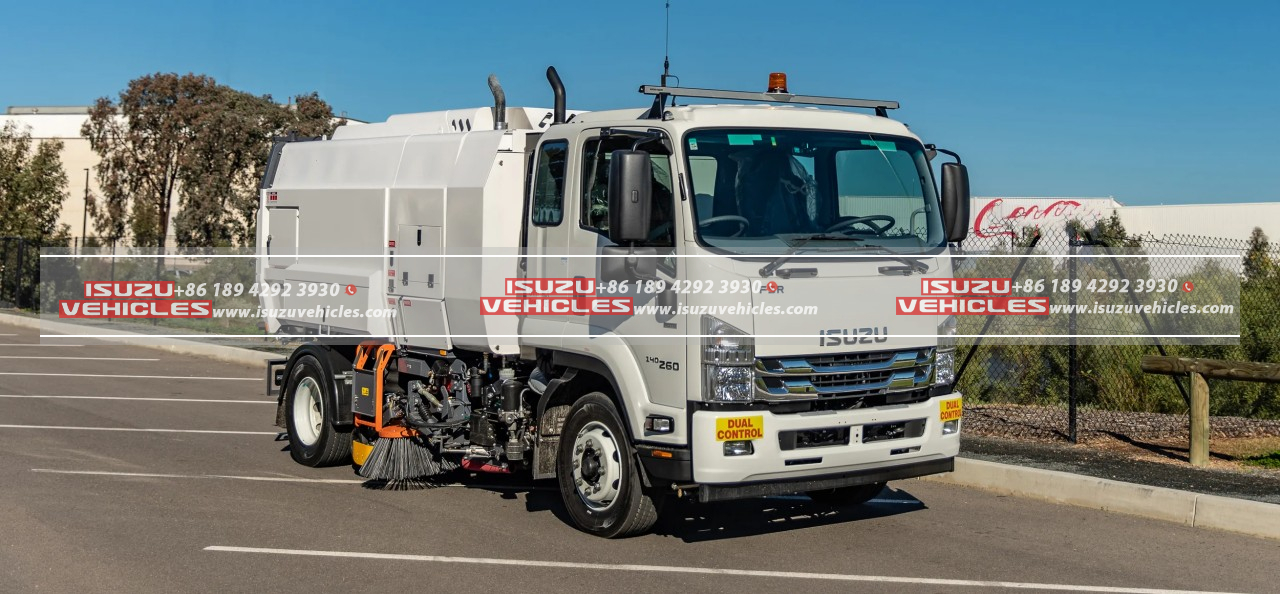
As the first light touches the canals of Amsterdam, a fleet of near-silent machines glides along the cobblestones – not a diesel rumble, but the soft hum of ISUZU’s electric sweeper trucks vacuuming debris with surgical precision. Across Europe, from Barcelona’s Gothic Quarter to Berlin’s Unter den Linden, municipal operators are abandoning decades-old diesel models for ISUZU’s zero-emission solutions. This seismic shift isn’t merely regulatory compliance; it’s a reimagining of urban stewardship where sustainability converges with unprecedented operational efficiency.
1. Regulatory Catalysts: Europe’s Green Mandates Reshape Municipal Fleets
Europe’s tightening environmental framework has created an irreversible pivot toward electrification:
- Euro 7 Emission Standards (effective July 2025) slashing particulate limits to 1 mg/km – impossible for conventional sweepers
- Urban Vehicle Access Regulations (UVARs) in 32 cities granting 24/7 access only to zero-emission sweepers
- Noise Pollution Directives capping operational sound at 72 dB(A), aligning perfectly with ISUZU’s 68 dB(A) whisper-quiet profile
The financial calculus proves decisive: Rotterdam’s sanitation department recorded €23,000 annual per-vehicle savings from London-style congestion charge exemptions and diesel tax avoidance. With Brussels mandating 100% zero-emission municipal fleets by 2030, ISUZU’s compliance-ready designs have become the default choice.
2. Operational Superiority: Beyond Emissions Reduction
2.1. Total Cost of Ownership Revolution
| Cost Factor | Diesel Sweepers | ISUZU Electric ELF-S |
|---|---|---|
| Energy Cost/km | €0.38 | €0.11 |
| Maintenance (5-yr) | €16,200 | €7,300 |
| Downtime Rate | 18% | 6% |
2.2. Enhanced Cleaning Capabilities
- Variable suction algorithms: Automatically adjusting vacuum power from 8 kPa (for leaves) to 27 kPa (for construction debris)
- Precision moisture control: Reducing water consumption by 73% compared to traditional spray systems
- Continuous 10-hour operation: Enabled by 350 kWh swappable batteries changed in 7 minutes
“Our 22 ISUZU ELF-S units now clean Vienna’s Ringstrasse with 40% fewer passes. The regenerative braking recaptures 31% of energy during stop-start operations – a game-changer in historic districts.”
— Markus Weber, Head of Public Space Management, City of Vienna
3. Technical Innovations Driving Adoption
ISUZU’s engineering pivots on three transformative technologies:
3.1. Modular Battery Architecture
- Hot-swappable packs: Enables 24/7 operation with 5-minute depot changes
- Grid-balancing capability: Feeding surplus energy back during peak demand (earning €0.29/kWh in Germany)
- Arctic-grade thermal management: Maintaining battery efficiency at -20°C
3.2. AI-Powered Debris Recognition
- Multi-spectral sensors: Identifying and prioritizing microplastic hotspots
- Route optimization AI: Cutting redundant paths by 28% in Madrid’s trials
- Predictive brush wear monitoring: Alerting mechanics 120 hours before failure
3.3. Ergonomic Urban Integration
- 360° camera arrays: Navigating sub-2.5m medieval alleys in Bruges
- Low-profile chassis: Clearing low-hanging trees in Parisian boulevards
- Automated side-arm sweepers: Reaching bicycle lane debris without operator intervention
4. Smart City Integration and Data Ecosystem
Europe’s digital infrastructure ambitions align perfectly with ISUZU’s connectivity:
4.1. Live Urban Health Monitoring
- PM2.5 sensors: Mapping air quality during cleaning operations
- Surface contamination analytics: Identifying oil spill risks before rain events
- Traffic flow integration: Syncing cleaning cycles with low-activity periods
4.2. Blockchain-Enabled Compliance
Every sweep generates immutable records for:
- Waste recovery verification for circular economy reporting
- Carbon credit certification under ETS Phase IV
- Service-level agreement (SLA) auditing
Barcelona leverages this data to achieve 96% transparency scoring in EU Sustainable City rankings.
5. Environmental Impact Quantified
The transition delivers measurable ecological dividends:
- 14.7 tons CO₂ reduction annually per vehicle (equivalent to 3,500 mature trees)
- 98% lower PM10 emissions during street cleaning – critical for EU air quality targets
- Noise footprint reduction restoring nocturnal soundscapes below 45 dB in residential zones
Berlin’s Tiergarten district recorded a 22% increase in nightingale populations within 18 months of deploying electric sweepers, underscoring the biodiversity benefits.
6. Strategic Expansion and Future Roadmap
ISUZU’s European beachhead is merely the beginning:
6.1. Platform Diversification
- ISUZU garbage truck variants: Integrating the same battery systems for waste collection fleets
- ISUZU vacuum trucks: Scaling suction power for industrial site remediation
- Autonomous street trains: Pilot projects in Hamburg linking 3 sweeper units with AI platooning
6.2. Manufacturing Localization
- New Budapest plant: Slated for 2026 opening to bypass CBAM carbon tariffs
- Battery remanufacturing hub: In partnership with Northvolt for circular supply chains
6.3. ISUZU China Technology Transfer
Lessons from Europe are accelerating development in Asia:
- Solid-state battery adaptation for humid megacities
- Typhoon-resilient charging systems tested in Guangzhou
- AI debris databases sharing particle signatures globally
“Shenzhen’s 120 ISUZU sweepers process 11 tons of microplastics monthly – data now refining Munich’s algorithms. This cross-continent learning loop accelerates innovation.”
— Dr. Lena Müller, ISUZU Europe CTO