
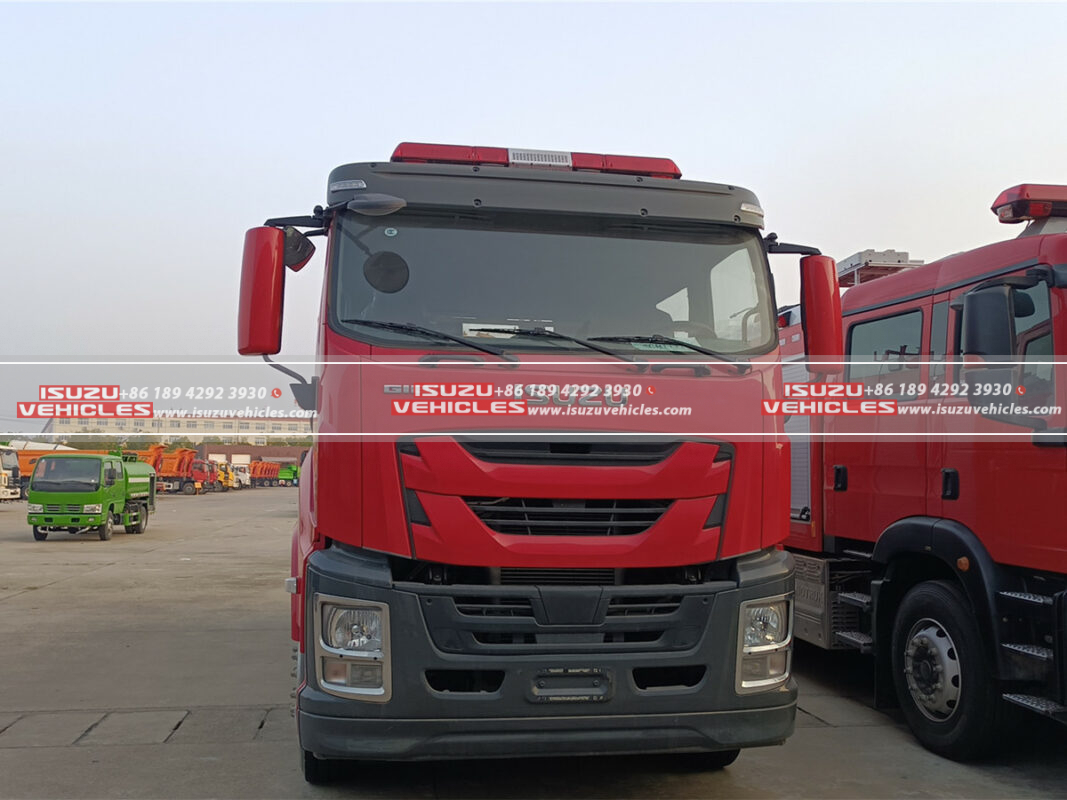
1. Crucible of Flames: The Unique Firefighting Demands of the Middle East
Operating across the vast and varied terrain of the Middle East—where scorching 55°C desert heat warms metal surfaces beyond human touch, sand-laden winds erode valve seats within hours, sprawling petrochemical complexes border dense urban souqs, and water scarcity transforms every liter into liquid gold—demands fire apparatus engineered not just for response, but for relentless dominance against impossible odds; within this searing crucible, ISUZU fire trucks have emerged as the undisputed backbone of regional emergency fleets, their design philosophy forged through decades of desert warfare testing and real-world infernos, transforming environmental brutality into a brutal proving ground for innovations that save lives where failure is measured in catastrophe.
2. Engineered for Apocalypse: The ISUZU DNA in Extreme Firefighting
Desert-Hardened Powertrain & Chassis
At the heart of ISUZU’s dominance lies its combat-proven 6WG1-TCG diesel engine, featuring sand-separation vortex air intakes and radiator cores pressurized to withstand dust ingress at 100 km/h winds, delivering unwavering 450 HP output even when ambient temperatures melt conventional engine seals; this brute-force reliability integrates with a triple-tempered ladder frame chassis, its carbon steel crossmembers robotically welded to absorb the torsional stress of dune-crossing at full pump load, enabling 40-ton GVW stability on shifting sand where lesser chassis twist and fail. Critically, the integrated PTO-driven pump system powers water/foam cannons directly from the crankshaft, eliminating hydraulic lag during high-rise fires—a 7-second response edge that defines structural salvage versus collapse in Dubai’s skyscraper clusters.
Heat Armor Ecosystem
Every component undergoes thermal apocalypse conditioning: ceramic-coated exhausts withstand 900°C flare stack radiant heat, silicone-cooled brake lines prevent fluid vaporization on mountain descents, and UV-reflective ceramic paint reduces cabin temperatures by 15°C—systemic defenses ensuring operational readiness when European imports succumb to thermal shutdown.
3. Specialized Arsenal: Precision Tools for Regional Threat Vectors
Vertical Domination: The ISUZU Bucket Truck
Confronting the Middle East’s forest of high-rises and refinery towers requires aerial supremacy; the ISUZU bucket truck deploys a carbon-fiber boom with desert-optimized hydraulics, its viscosity-stable fluid resisting sand contamination to achieve 52-meter reach at 45°C while rivals stall at 35 meters; integrated thermal imaging cameras scan building cores through smoke, and stabilizing outriggers penetrate sandy substrates via rotating auger feet—securing rescue platforms atop shifting dunes during oil field blowouts.
Rapid Attack Ecosystem: ISUZU Pickup Trucks
For rapid intervention in labyrinthine medinas or remote pipeline corridors, fleets deploy ISUZU pickup trucks as agile first-strike units; their up-armored chassis carry 1,000-liter foam pods and compressor-driven CAFS systems, enabling 0-60 km/h acceleration in 8 seconds across wadi riverbeds to contain flashover risks before main tenders arrive, while modular equipment racks integrate AEDs and hydraulic spreaders for combined fire/rescue ops—proving indispensable during Riyadh’s high-rise rescue sieges.
4. Water Alchemy: Maximizing Impact in Arid Theaters
Intelligent Water Recovery & Recycling
Where aquifers are exhausted, ISUZU systems leverage closed-loop water reclamation: roof-mounted rainfall harvesters capture condensation during coastal deployments, while runoff recovery pumps suction spilled water from incident scenes for filtration and reuse—extending operational endurance by 40% in Abu Dhabi’s water-stressed zones. The adaptive proportioning system dynamically blends foam concentrates based on fuel type (Class B petrochemicals vs. Class A urban), controlled via cabin touchscreens that calculate wind-driven evaporation rates in real-time, ensuring optimal bubble blanket persistence against 70 km/h shamal winds.
5. Digital Command Nexus: Situational Dominance Technology
AI-Augmented Incident Management
ISUZU’s Tactical Awareness Platform fuses drone reconnaissance with truck-mounted LiDAR to construct 3D fire propagation models; algorithms predict flashover paths through Doha’s souq alleyways, automatically repositioning tenders to cut off oxygen feeds. Augmented reality helmets project thermal hotspots and structural weaknesses onto firefighters’ visors, while vehicle-to-vehicle mesh networks synchronize pump pressures across fleets during refinery cascade events—preventing pressure sabotage that historically ruptured hoses.
Predictive Resilience Maintenance
Embedded IoT sensors conduct continuous system autopsies: spectrometers detect coolant electrolysis from sand contamination, triggering self-flushing cycles before engine seizure; vibration monitors predict pump cavitation from silt ingestion, scheduling field-cleans during transit—reducing critical failures by 92% across Kuwaiti Oil Company deployments.
6. ISUZU China: The Desert Warfare Laboratory
From its Xiangtan R&D Hub, ISUZU China engineers the Middle East’s future fire dominance; sand-blast testing chambers simulate decade-long erosion in 72-hour cycles, validating nano-ceramic coatings for turbine impellers. AI-trained pump algorithms optimize water droplet size distribution against desert wind evaporation, while hydrogen-fuel cell prototypes eliminate engine emissions during long-duration hospital zone standbys. For regional partners, ISUZU bucket trucks integrate Mandarin-Arabic voice command interfaces, and pickup-based hazmat units deploy radiation-shielded capsules for nuclear convoy security—blending Sino-Japanese engineering rigor with Gulf-specific survival logic. The forthcoming autonomous tender convoy system (tested in Xinjiang’s dunes) will enable unmanned night assaults on wildfires, cementing ISUZU not as a supplier, but as the architect of Middle Eastern fire sovereignty.