
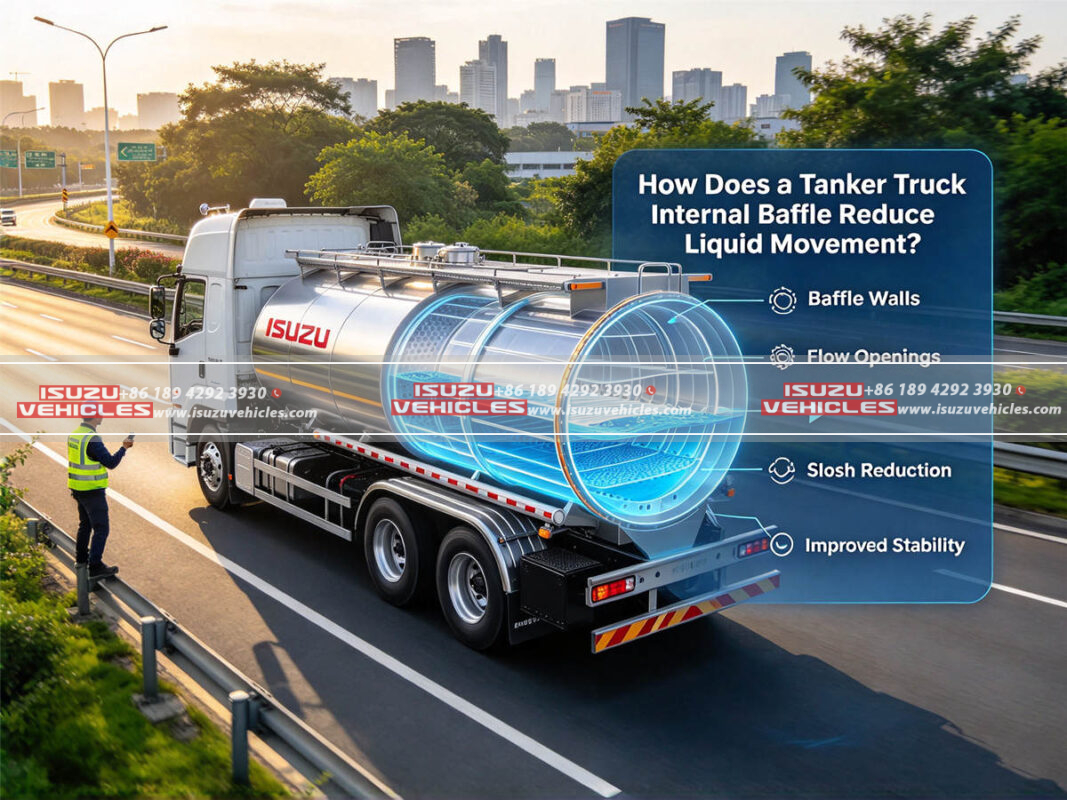
A tanker truck may look relatively simple from the outside, with a large tank mounted securely on a commercial vehicle chassis, but transporting liquid safely is considerably more complicated than transporting a solid load. Water, fuel, oil, and other liquids do not remain fixed in one position when a truck accelerates, brakes, turns, or travels across an uneven road. Instead, the liquid can move forward, backward, and sideways inside the tank, producing a phenomenon commonly known as liquid surge or sloshing. An internal baffle is one of the most important structures used to control this movement because it interrupts the free movement of the liquid and reduces the size and energy of the waves that can develop inside the tank.
For a professional tanker, controlling liquid movement is not simply about making the tank stronger. The tank, internal baffles, chassis, suspension, axles, braking system, and mounting structure must work together so that the vehicle remains predictable under changing load conditions. Current ISUZU Vehicles tanker information identifies internal baffles or anti-wave boards as an important method for reducing liquid surge, particularly when the tank is partially filled. The ISUZU 10 CBM Water Tanker Truck, for example, uses an anti-wave board inside its tank to help stabilize the water during transportation.
This is also why tank capacity alone should never be the only consideration when selecting a liquid transport vehicle. A large tank can carry more material per trip, but the larger liquid mass can also generate substantial dynamic forces when it moves. Understanding how an internal baffle controls these forces helps explain why properly engineered tanker bodies are so important for water transportation, fuel distribution, municipal services, and other specialized applications.
1. What Is Liquid Surge Inside a Tanker Truck?
Liquid surge is the movement of liquid inside a tank caused by changes in the vehicle’s motion. When a tanker accelerates, the liquid tends to move toward the rear of the tank because of inertia. When the driver applies the brakes, the liquid continues moving forward relative to the vehicle, while during a turn the liquid shifts toward the outside of the curve. The movement can become especially noticeable when the tank is only partially filled because the free space above the liquid gives the fluid more room to develop waves.
Unlike a solid load, liquid does not behave as a single rigid mass attached firmly to the chassis. Although the total weight of the liquid remains essentially the same, its internal distribution changes continuously as the truck moves. This changing distribution can influence the forces acting on the tank and the vehicle, which is why liquid transportation requires different engineering considerations from ordinary cargo transportation.
Why Is Liquid Surge a Problem?
Imagine a tanker carrying several thousand liters of water while traveling on a relatively level road. At constant speed, the water may appear relatively calm inside the tank, but if the driver suddenly brakes, the truck begins slowing down while the water’s inertia causes it to continue moving forward. The resulting wave can push strongly against the front section of the tank.
If the driver then accelerates again, the liquid moves in the opposite direction. During cornering, the movement changes from primarily front-to-back to side-to-side. When these movements occur repeatedly, the liquid can create dynamic forces that influence vehicle handling and place additional loads on the tank structure, mounting points, and chassis.
Current ISUZU technical guidance describes liquid surge as a factor that can influence vehicle stability and place additional forces on the tank and chassis, particularly when the tank is partially filled.
This does not mean that liquid movement can or should be completely eliminated. Instead, the objective is to control the movement so that it develops more gradually and produces smaller dynamic effects, allowing the vehicle to behave more predictably during acceleration, braking, and cornering.
2. What Is an Internal Baffle in a Tanker Truck?
An internal baffle is a reinforced plate or structural barrier installed inside a tanker body to restrict the movement of liquid. Depending on the tank’s design and intended application, baffles can divide the tank into sections, partially obstruct the flow of liquid, or use strategically positioned openings that allow controlled movement while preventing the entire liquid mass from traveling freely from one end of the tank to the other.
The exact arrangement varies according to the tank dimensions, liquid being transported, operating conditions, compartment configuration, and applicable engineering requirements. A water tanker may use anti-wave plates primarily to control the movement of water, while a fuel tanker may use more specialized internal structures and multiple compartments because fuel transportation introduces additional requirements related to safety, unloading, grounding, vapor management, and cargo separation.
How Does a Baffle Interrupt a Liquid Wave?
A simple way to understand the principle is to imagine carrying a bucket of water while walking. If the bucket is moved suddenly forward, the water develops a wave that travels toward the opposite side. In a large open container, the wave has a long distance over which it can develop and gather momentum. If a barrier is introduced into the container, the water can no longer move across the entire length as one uninterrupted mass.
The same basic principle applies inside a tanker, although the real engineering is much more sophisticated because the tank is moving at road speed and the liquid may weigh several tons. The baffle breaks up the large-scale movement of the liquid, reducing the distance over which a large wave can develop and limiting how much fluid can move together at one time.
Current ISUZU information describes internal baffles as reinforced plates that divide the liquid into smaller sections or interrupt its movement, thereby breaking large waves into smaller movements, reducing forward-and-backward fluid forces, limiting sideways displacement, and improving vehicle balance.
Therefore, an internal baffle should not be thought of as a wall that completely stops water. Instead, it is a carefully engineered flow-control structure that changes the way the liquid responds to vehicle movement.
3. How Does an Internal Baffle Reduce Forward and Backward Surge?
One of the most important jobs of an internal baffle is controlling longitudinal surge, which is the movement of liquid toward the front or rear of the tanker. This becomes particularly significant during acceleration and braking because both actions generate forces that encourage the liquid to move along the length of the tank.
Consider a tanker traveling at a steady speed with a partially filled tank. If the driver suddenly applies the brakes, the chassis decelerates, but the liquid continues moving forward because of inertia. Without an internal barrier, a substantial volume of liquid can travel toward the front of the tank, forming a large wave that places a concentrated dynamic load against the forward tank structure.
With a properly designed baffle system, the liquid is divided into smaller moving regions. Instead of allowing the entire liquid mass to develop one large wave from the rear of the tank to the front, the baffles interrupt the movement and reduce the effective travel distance of each wave.
Breaking One Large Wave Into Smaller Movements
This is the central operating principle of an anti-surge baffle. The liquid is still free to move to some extent, but its movement is interrupted before it can develop into one large, highly energetic wave. The resulting smaller movements are easier for the tank structure and vehicle chassis to manage.
During acceleration, the same principle works in the opposite direction. Instead of allowing the entire body of liquid to surge toward the rear, the baffles limit the amount of liquid that can move as one connected mass. During braking, they similarly reduce the scale of forward movement.
This is particularly valuable for partially filled tanks because partially filled conditions can provide more freedom for liquid movement than a completely full tank. ISUZU’s tanker guidance specifically notes that internal anti-wave structures are particularly useful under these conditions.
The benefit is therefore not simply that the tank experiences less movement, but that the movement becomes more controlled and less capable of producing sudden changes in the distribution of dynamic forces acting on the vehicle.
4. How Do Baffles Control Side-to-Side Liquid Movement?
Forward and backward surge is easy to imagine, but sideways liquid movement is equally important because a tanker truck must frequently negotiate intersections, roundabouts, curves, construction zones, and narrow urban roads. When the vehicle turns, the liquid tends to move toward the outside of the curve, and the resulting lateral shift can influence how the vehicle responds to steering input.
Internal baffles can restrict this sideways movement by limiting how much liquid can shift from one side of the tank to the other. Instead of allowing the entire liquid volume to move laterally as one large mass, the internal structure divides or interrupts the flow, reducing the scale of the movement.
Why Partial Loads Are Especially Important
A tanker does not necessarily carry the same liquid volume throughout an entire working route. A water tanker may begin the day with a full tank, deliver water at several construction sites, and continue traveling with a reduced load before returning for refilling. A fuel tanker may make several deliveries, causing the amount of fuel in each compartment to change throughout the route.
As the liquid level falls, the available free space inside the tank increases, which can allow the liquid surface to move more freely. Consequently, the internal baffle arrangement must be designed to provide useful control across practical loading conditions rather than only when the tank is completely full.
ISUZU’s tanker information specifically explains that the movement of liquid can affect stability when the tank is partially filled, which is why anti-wave structures are an important part of tanker design.
It is also important to remember that baffles do not replace proper driving practices. A tanker carrying a partial load still requires appropriate speed, braking, cornering, and load management because the liquid remains a moving mass even after surge-control structures have reduced its movement.
5. How Does the Baffle Work With the Tank and Chassis?
An internal baffle cannot be considered independently from the rest of the vehicle because the forces generated by moving liquid are transferred through the tank structure and its mounting system into the chassis. The tank shell must withstand the pressure and dynamic forces created by the liquid, the baffles must be securely connected to the tank, and the tank mounting points must transfer the combined load to the chassis without excessive structural stress.
This makes tanker design a system-level engineering problem. The tank capacity, tank geometry, baffle arrangement, material thickness, mounting structure, suspension, axle capacity, tire selection, braking system, and chassis configuration must all be compatible with one another.
Reducing Repeated Structural Loading
When liquid moves freely through a long tank, repeated waves can place changing loads on the tank ends, side walls, internal structures, fittings, and mounting points. By restricting the size and energy of these movements, baffles can help reduce the magnitude of repeated dynamic loading throughout the structure.
A current ISUZU 16 CBM Fuel Tanker Truck, for example, uses cross-braced internal baffles specifically described as reducing liquid surge and improving stability during transportation and unloading. This model also incorporates additional specialized fuel-transport safety equipment, illustrating how internal surge control forms only one part of a complete tanker design.
For water tankers, the requirements may be different, but the basic engineering principle remains the same. An ISUZU water tanker can use an anti-wave board to reduce movement inside the tank, while the chassis, suspension, and braking system are selected to carry the resulting gross vehicle weight safely.
Proper baffle construction is therefore important not only for vehicle handling but also for long-term durability. Repeated dynamic loads can contribute to fatigue if the tank and internal components are not properly designed, manufactured, mounted, and maintained.
6. Why Is Baffle Design Important for Different Tanker Applications?
Not every tanker truck carries the same material, and therefore not every internal tank arrangement can be treated as interchangeable. Water, diesel, gasoline, chemicals, wastewater, and other liquids can have different densities, viscosities, handling requirements, and safety considerations. The tank structure and internal baffles must consequently be matched to the specific application.
Water transportation is one of the most straightforward examples. The ISUZU 10 CBM Water Tanker Truck uses an internal anti-wave board to help stabilize water during transportation, making the configuration suitable for applications such as municipal water distribution, construction-site watering, landscaping, and road maintenance.
Fuel transportation introduces additional requirements. Current ISUZU tanker configurations include 6 CBM, 12 CBM, and 16 CBM fuel tankers as well as larger aircraft refueling vehicles, demonstrating that tank construction and equipment vary considerably according to the intended service.
The same broader principle of liquid management can be seen in other municipal vehicles. A sweeper truck, for example, can carry a dedicated water supply for road washing and dust suppression. Current ISUZU sweeper models include configurations with water tanks alongside sweeping brushes, suction systems, and debris collection equipment, meaning that the water-storage system is integrated into a much larger road-cleaning operation.
A vacuum truck presents a different liquid-handling challenge because its tank is primarily intended to collect and transport sewage, sludge, wastewater, and other liquid or semi-liquid materials. ISUZU vacuum configurations include dedicated sewage vacuum trucks, vacuum sewer trucks, combined jetting vacuum trucks, and high-pressure vacuum cleaner trucks, with tank and pumping systems designed around waste collection rather than simple liquid transportation.
This distinction matters because a tanker body should always be designed around the behavior of the material it is intended to carry. A water tank, fuel tank, and vacuum waste tank may all look like large containers from the outside, but their internal structures, equipment, materials, safety systems, and operating procedures can be very different.
For ISUZU Vehicles, internal baffles are therefore one part of a broader approach to tanker engineering. They do not eliminate liquid movement, but they interrupt and control it by dividing the moving liquid mass, breaking up large waves, reducing forward-and-backward surge, and limiting excessive lateral displacement. The result is a more predictable load behavior that complements the truck’s chassis, suspension, braking, and steering systems.
For fleet operators and truck buyers, this is why the internal structure of a tanker deserves as much attention as its advertised capacity, engine power, pump performance, or exterior dimensions. A properly engineered tanker should balance payload, tank volume, structural strength, liquid-control features, chassis capacity, and operational safety. When these elements are correctly matched, an ISUZU Vehicles tanker can provide a dependable solution for transporting water, fuel, and other suitable liquids, while related vehicles such as a sweeper truck or vacuum truck can be configured for their own specialized municipal and environmental applications.