
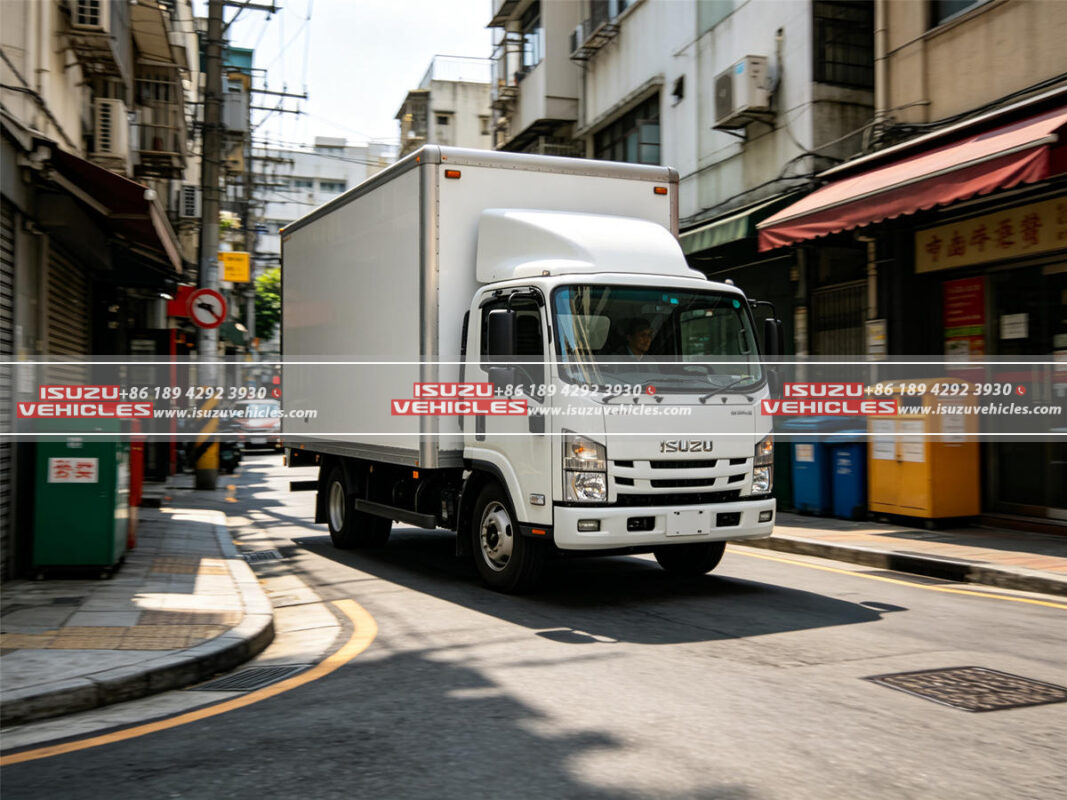
Urban delivery has become increasingly demanding as cities grow more crowded, customers expect shorter delivery windows, and businesses need to move products through narrow streets, busy commercial districts, residential neighborhoods, and industrial zones throughout the day. For this type of operation, the vehicle must do much more than carry goods from one location to another. It needs to combine practical cargo capacity, maneuverability, loading convenience, protection from weather, dependable operation, and reasonable operating costs, which is why an ISUZU van box truck is often considered a practical solution for urban logistics.
Unlike an open flatbed or conventional cargo truck, a box truck provides an enclosed cargo compartment that protects goods from rain, dust, sunlight, road debris, and unauthorized access while creating a clearly organized space for loading and unloading. This makes it particularly suitable for parcel delivery, retail distribution, food and beverage transportation, appliance delivery, furniture distribution, e-commerce logistics, and many other urban applications. The current ISUZU range includes compact ELF and N-Series box trucks as well as larger F-Series and GIGA configurations, allowing businesses to select a vehicle according to their required payload, cargo volume, and route conditions.
Why Is an ISUZU Box Truck Suitable for Urban Delivery?
The main advantage of a box truck in an urban environment is the balance between cargo protection and vehicle maneuverability. City delivery routes often involve frequent stops, narrow streets, crowded intersections, loading zones, shopping districts, and residential roads where a large heavy-duty truck can be inconvenient to operate. A suitably sized ISUZU box truck provides an enclosed cargo body while retaining the compact footprint and practical handling characteristics needed for repeated urban deliveries.
This is especially important for businesses that do not need the enormous payload capacity of a long-haul tractor-trailer but still require a dedicated enclosed cargo compartment. A smaller box truck can enter areas that are difficult for larger vehicles to access, stop closer to customers, and spend less time maneuvering during loading and unloading operations.
Compact Dimensions for Crowded Streets
Urban delivery is fundamentally different from highway transportation because the final few kilometers of a delivery route can be the most complicated part of the journey. A driver may need to navigate around parked vehicles, traffic islands, pedestrians, motorcycles, delivery vans, and narrow entrances before reaching a customer’s loading point.
The cab-over-engine layout used across many ISUZU light- and medium-duty platforms is particularly useful in this environment because it can provide good forward visibility while allowing the overall vehicle length to remain relatively compact. The current ISUZU N-Series range specifically highlights maneuverability and its suitability for multi-stop delivery operations, making it a natural platform for urban box-body applications.
How the Box Body Protects Urban Delivery Cargo
Urban delivery goods can vary dramatically, from packaged consumer products and clothing to electronics, household items, cartons, tools, and retail merchandise, but they share one common requirement: they need to arrive at the destination in good condition. An enclosed box body provides an important layer of protection between the cargo and the outside environment.
Rain is an obvious concern, but weather protection is only one advantage. Dust from busy roads, exhaust particles, direct sunlight, branches, road spray, and accidental contact with other vehicles can also affect exposed cargo. An enclosed body helps reduce these risks while providing a more professional and organized appearance when the truck arrives at a customer’s location.
Better Cargo Organization
A box body also gives operators a defined cargo compartment in which shelves, partitions, tie-down points, pallets, racks, or other internal equipment can be installed according to the business’s requirements. For a parcel company, the interior may be arranged for multiple delivery stops, while a furniture distributor may need an open interior with additional protection for large items.
This flexibility makes the ISUZU box truck suitable for businesses with very different delivery models. The vehicle itself provides the transportation platform, while the body interior can be adapted to the products being carried and the loading method used by the company.
Security During Multi-Stop Routes
Urban delivery often involves multiple stops during a single working shift, meaning the driver may open the cargo compartment dozens of times before returning to the depot. An enclosed body provides a more secure environment than an open cargo platform and can help keep remaining goods protected between delivery points.
This is particularly useful for businesses carrying relatively high-value products or mixed consignments where cargo must remain organized throughout a route. Good internal organization also helps reduce the time spent searching for individual packages, which can become a significant productivity issue when a driver completes many deliveries every day.
ISUZU Box Truck vs. Conventional Cargo Truck for City Delivery
Whether a box truck is better than an open cargo truck depends largely on what the business needs to transport. An open cargo body provides excellent loading flexibility and is particularly useful for bulky, irregularly shaped, or weather-resistant goods, while a box truck offers better protection and security for packaged products.
The current ISUZU Cargo Truck range includes multiple configurations, such as 600P, 700P, KV100, and GIGA cargo trucks, giving operators a broad choice for different payload and transportation requirements.
When a Box Truck Has the Advantage
A box truck is generally more attractive when cargo needs protection from weather or when the delivery business requires a clean, enclosed environment. Parcel distribution, retail products, electronics, clothing, household goods, packaged food, and many types of commercial merchandise can all benefit from an enclosed cargo compartment.
The box structure also provides a consistent external shape, which can make it easier to install company branding, delivery information, safety markings, and advertising graphics. For businesses whose trucks visit customers throughout the day, the vehicle effectively becomes a mobile representation of the company.
When an Open Cargo Body May Be Better
An open cargo truck can be preferable when the goods are oversized, unusually shaped, heavy, or loaded using cranes and forklifts from multiple directions. Construction materials, machinery, agricultural products, steel products, and other irregular cargo can sometimes be easier to handle on an open platform.
Therefore, the question is not whether a box truck is universally better than a cargo truck, but whether enclosed cargo protection is more important for the specific delivery operation. For a business focused on urban retail and parcel distribution, the box body can provide substantial practical advantages.
How ISUZU Box Trucks Support Multi-Stop Urban Logistics
One of the biggest challenges in city distribution is the number of stops completed during a working day. A truck may travel relatively few kilometers but still spend many hours driving, parking, loading, unloading, and navigating between customers. This makes vehicle accessibility and driver convenience extremely important.
A properly sized ISUZU box truck can support this operating pattern by providing sufficient cargo volume without unnecessarily increasing the overall dimensions of the vehicle. The driver can enter the cab, move through city traffic, reach designated loading areas, and repeatedly access the cargo compartment without the operational complexity associated with a much larger freight vehicle.
Loading and Unloading Efficiency
The configuration of the rear and side access points can have a significant effect on delivery productivity. Depending on the body design, businesses can specify rear doors, side doors, liftgates, shelving, ramps, or other equipment that matches the way products are handled.
For example, a parcel delivery company may benefit from a rear cargo door combined with organized shelving, while a business delivering appliances may require a larger access opening and a hydraulic tail lift. The flexibility of the box-body concept allows the same basic truck platform to be adapted to very different commercial operations.
Driver Visibility and Daily Comfort
Urban delivery drivers spend long periods entering and leaving the vehicle, navigating traffic, checking addresses, parking, and handling cargo. Driver comfort therefore becomes part of productivity rather than simply an optional feature.
A practical cab layout with good visibility can make it easier to judge tight corners and crowded intersections, while a suitable seating position and easy access can reduce the physical strain associated with repeated stops. For businesses operating several trucks every day, small improvements in driver usability can accumulate into meaningful operational benefits over an entire year.
Can an ISUZU Box Truck Handle Temperature-Sensitive Goods?
A standard box truck is designed primarily to provide enclosed cargo protection and should not automatically be treated as a temperature-controlled vehicle. However, the same ISUZU chassis platforms can be configured with insulated and refrigerated bodies when the cargo requires controlled temperatures.
This distinction is particularly important for food distributors, pharmaceutical logistics companies, supermarkets, restaurants, catering businesses, and fresh-produce suppliers. These businesses may need the cargo protection of an enclosed body while also requiring refrigeration or freezing equipment to maintain the required temperature throughout the delivery route.
From Box Truck to Refrigerated Delivery Truck
The current ISUZU refrigerated range includes multiple temperature-controlled configurations, including 4-meter refrigerated vans, 4.2-meter freezer box trucks, 16 CBM and 28 CBM refrigerator box trucks, and larger refrigerated box trucks.
For businesses transporting ordinary dry cargo, a standard box truck may provide the most economical solution because there is no need to operate refrigeration equipment. For businesses handling frozen meat, seafood, ice cream, frozen food, or other temperature-sensitive products, a freezer truck or refrigerated truck can provide the additional temperature-control capability required for the route.
This distinction also makes fleet planning easier. A logistics company may use standard box trucks for dry goods while operating dedicated freezer trucks for frozen products, allowing each vehicle to be configured around the actual needs of the cargo instead of trying to make one truck perform every task.
Choosing the Right ISUZU Box Truck for Urban Delivery
There is no single box truck configuration that is ideal for every urban delivery business because the correct vehicle depends on payload, cargo volume, road conditions, delivery frequency, parking limitations, and the type of goods being transported. A small retailer making local deliveries may need a compact light-duty vehicle, while a regional distribution company may require a medium-duty box truck with a significantly larger cargo body.
The ISUZU ELF and N-Series platforms are particularly relevant for lighter urban delivery work, with the current ELF range including models such as the ELF 3 Ton Van Box Truck and ELF Electric 4.2 Meter Box Truck. The F-Series, meanwhile, includes larger box configurations such as the FVR 7.1 Meter and FVR 12 Meter Van Box Trucks for applications requiring more cargo capacity.
Payload Should Match the Cargo
Choosing a truck based only on the physical size of the cargo body can lead to an inefficient fleet. The vehicle also needs to have sufficient payload capacity for the actual weight of the products, packaging, equipment, and any additional accessories installed inside the body.
At the same time, buying a significantly larger truck than necessary can increase acquisition and operating costs and make urban maneuvering more difficult. The ideal configuration is therefore one that provides enough payload and cargo volume for normal operations while remaining appropriately sized for the delivery environment.
Cargo Volume Matters Too
Weight is not always the limiting factor in urban delivery. Products such as clothing, household packaging, parcels, furniture components, and consumer goods can occupy considerable space before reaching the truck’s maximum payload. In these cases, cargo volume becomes just as important as rated carrying capacity.
A well-designed box body can maximize usable interior space while maintaining practical vehicle dimensions. Businesses should consider the dimensions of their typical packages, pallet sizes, stacking methods, loading equipment, and average daily delivery volume before selecting the body length and height.
Is an ISUZU Box Truck a Good Long-Term Urban Delivery Investment?
For many businesses, the value of a delivery truck should be measured over its entire working life rather than by its initial purchase price. A vehicle that is reliable, appropriately sized, easy to operate, and well matched to its cargo can reduce unnecessary downtime and help a business maintain predictable delivery schedules.
The ISUZU N-Series is specifically positioned as a versatile commercial platform for delivery and distribution work, while the F-Series provides additional capacity for heavier applications. The broader product range also allows companies to move from compact urban delivery vehicles to larger box trucks as their distribution requirements grow.
Maintenance planning is equally important. Urban delivery trucks may experience frequent starts and stops, repeated braking, tight turns, extensive idling, and constant loading and unloading, which can create a different wear pattern from a vehicle used primarily for highway transportation. Regular servicing, inspection of tires and brakes, attention to the cargo-body structure, and proper maintenance of doors and loading equipment can all help preserve operational reliability.
A successful urban delivery fleet may also combine several types of specialized vehicles instead of relying exclusively on one configuration. An ISUZU cargo truck can provide an open-body solution for bulky or irregular loads, while a box truck provides enclosed protection for general merchandise, and a freezer truck can handle frozen and temperature-sensitive products. This approach allows each vehicle to perform the type of delivery work for which it is best suited rather than forcing one truck to cover every requirement.
Ultimately, an ISUZU box truck can be an excellent choice for urban delivery because it combines enclosed cargo protection, practical cargo volume, maneuverability, and flexible body configurations in a vehicle designed for frequent commercial operation. It is particularly well suited to businesses that need to make multiple daily stops while keeping packaged goods protected and organized, while businesses carrying different types of cargo can expand their fleet with an ISUZU cargo truck for open-load applications or a freezer truck for temperature-sensitive distribution. By selecting the right body size, payload capacity, access configuration, and chassis for the route, ISUZU Vehicles can provide a practical foundation for modern urban logistics and help delivery operators balance productivity, cargo protection, maneuverability, and long-term operating efficiency.