
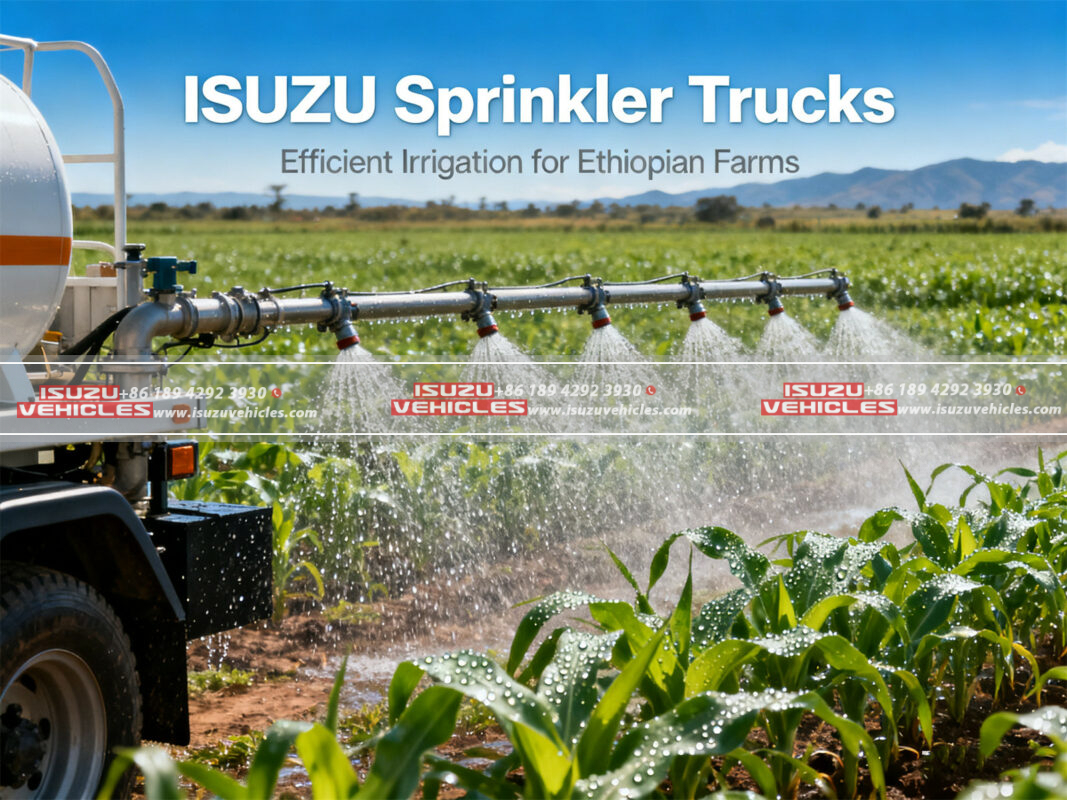
Ethiopia’s agricultural backbone – sustaining 80% of its 120 million people – faces an existential threat from erratic rainfall patterns amplified by climate change. With over 15 million smallholder farms scattered across the rugged highlands and Rift Valley, traditional canal irrigation reaches less than 5% of arable land, while drought-induced crop failures cost the economy $1.5 billion annually. Enter ISUZU’s purpose-engineered sprinkler trucks, featuring intelligent water mapping, gradient-compensated pressure systems, and ultra-efficient droplet control – delivering 40% more crop yield per liter of water while slashing diesel consumption by 30% compared to conventional irrigation rigs. This isn’t just about watering fields; it’s about securing food sovereignty across one of Africa’s most vulnerable agricultural landscapes.
1. Ethiopia’s Irrigation Imperative: Why Conventional Methods Fail
The nation’s complex topography and fragmented farmlands create unique barriers to efficient water distribution:
- Topographic Fragmentation: 62% of Ethiopia’s arable land lies on slopes exceeding 15 degrees, where gravity-fed canals cause massive runoff and soil erosion during irrigation cycles.
- Water Scarcity: Despite the Blue Nile’s flow, seasonal rivers dry up for 5-7 months annually, forcing farmers to rely on distant reservoirs with prohibitively high transport costs.
- Smallholder Limitations: Average plot sizes of 0.9 hectares make center-pivot systems economically unviable, while manual watering wastes 60% of water through evaporation and uneven coverage.
ISUZU’s mobile sprinkler platforms overcome these constraints by transforming standard water trucks into precision irrigation assets, reaching terraced fields inaccessible to fixed infrastructure while cutting water waste to under 15%.
2. ISUZU Sprinkler Truck Engineering: Intelligence in Every Droplet
Terrain-Adaptive Spray Systems
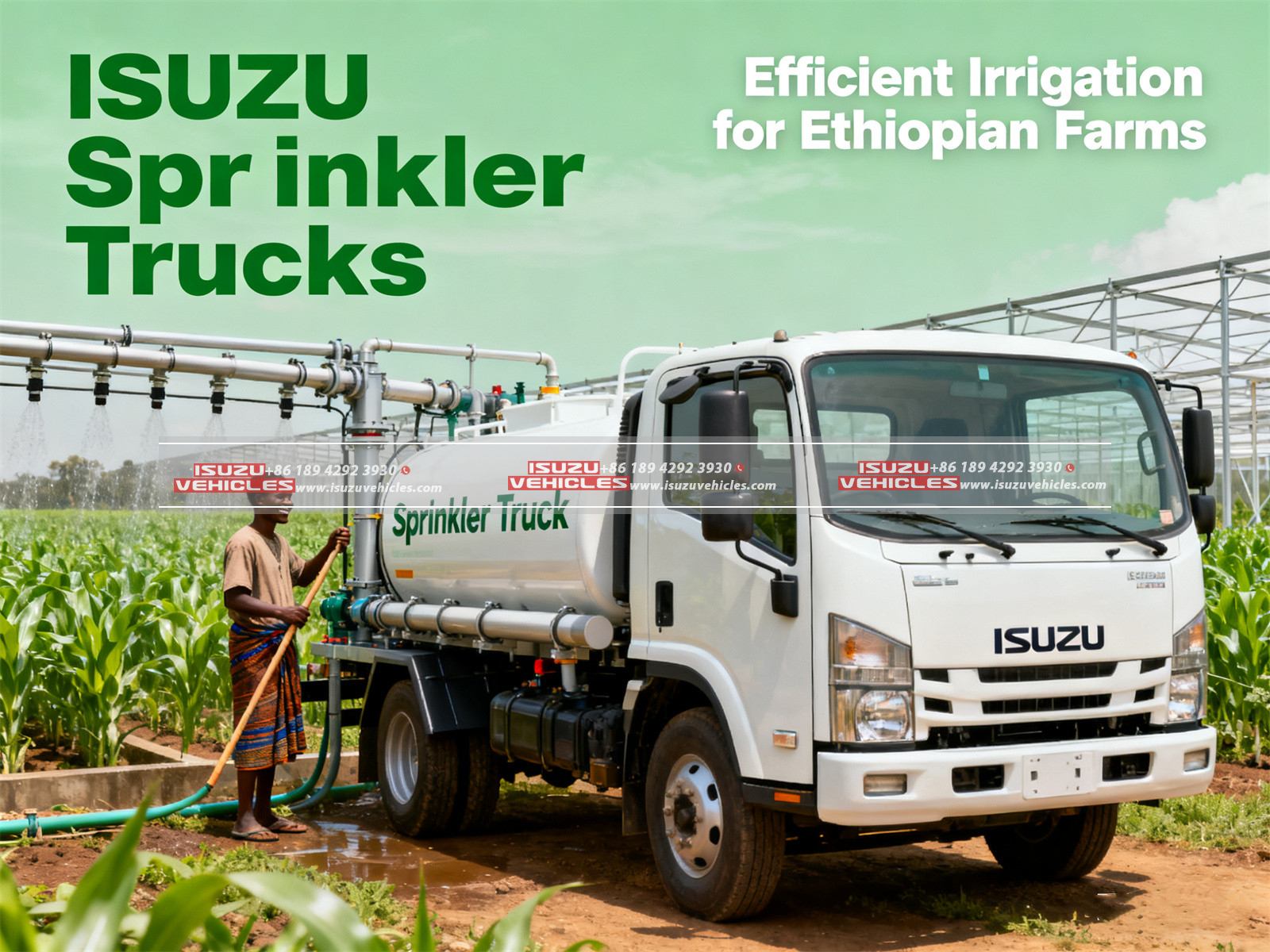
The core innovation lies in the HydroSync™ nozzle array, which dynamically adjusts water delivery based on real-time terrain data:
- Inclinometer-Guided Pressure: Laser-leveling sensors detect slope angles up to 25 degrees, modulating pump pressure from 2.5 to 8 bar to maintain uniform droplet distribution on steep gradients.
- Wind-Correction Algorithms: Ultrasonic anemometers trigger automatic spray pattern narrowing when crosswinds exceed 15 km/h, reducing drift loss by 74% in Ethiopia’s highland gusts.
- Variable-Radius Coverage: Telescopic booms extend from 4m to 18m, enabling U-shaped irrigation around irregular plots without overspray onto adjacent properties.
Water-Efficient Powertrain Integration
ISUZU’s 6HK1-CR engine with Eco-Drive PTO optimizes energy use:
- Demand-Responsive Pumping: Hydraulic flow adjusts automatically based on nozzle deployment count, saving 22% fuel during partial-load operations.
- Regenerative Braking: Captures kinetic energy during mountain descents to charge the 48V auxiliary system powering sensors and control modules.
3. Operational Economics: Quantifying the Water-Food-Cost Nexus
A 2025 pilot across 120 farms in Amhara Region documented transformative results:
| Metric | Diesel Pump + Hose | ISUZU FVR Sprinkler | Improvement |
|---|---|---|---|
| Water Use/Ton of Teff | 1,840 m³ | 1,050 m³ | 43% ↓ |
| Fuel Cost/Hectare | $87 | $61 | 30% ↓ |
| Labor Hours/Hectare/Season | 210 | 45 | 79% ↓ |
| Crop Yield Increase | Baseline | 39% ↑ | – |
Remote nozzle diagnostics and 1,000-hour service intervals further reduced downtime costs by 68% versus retrofitted water trucks.
4. Climate Resilience Engineering: Built for Ethiopian Extremes
Every component is hardened against local environmental stressors:
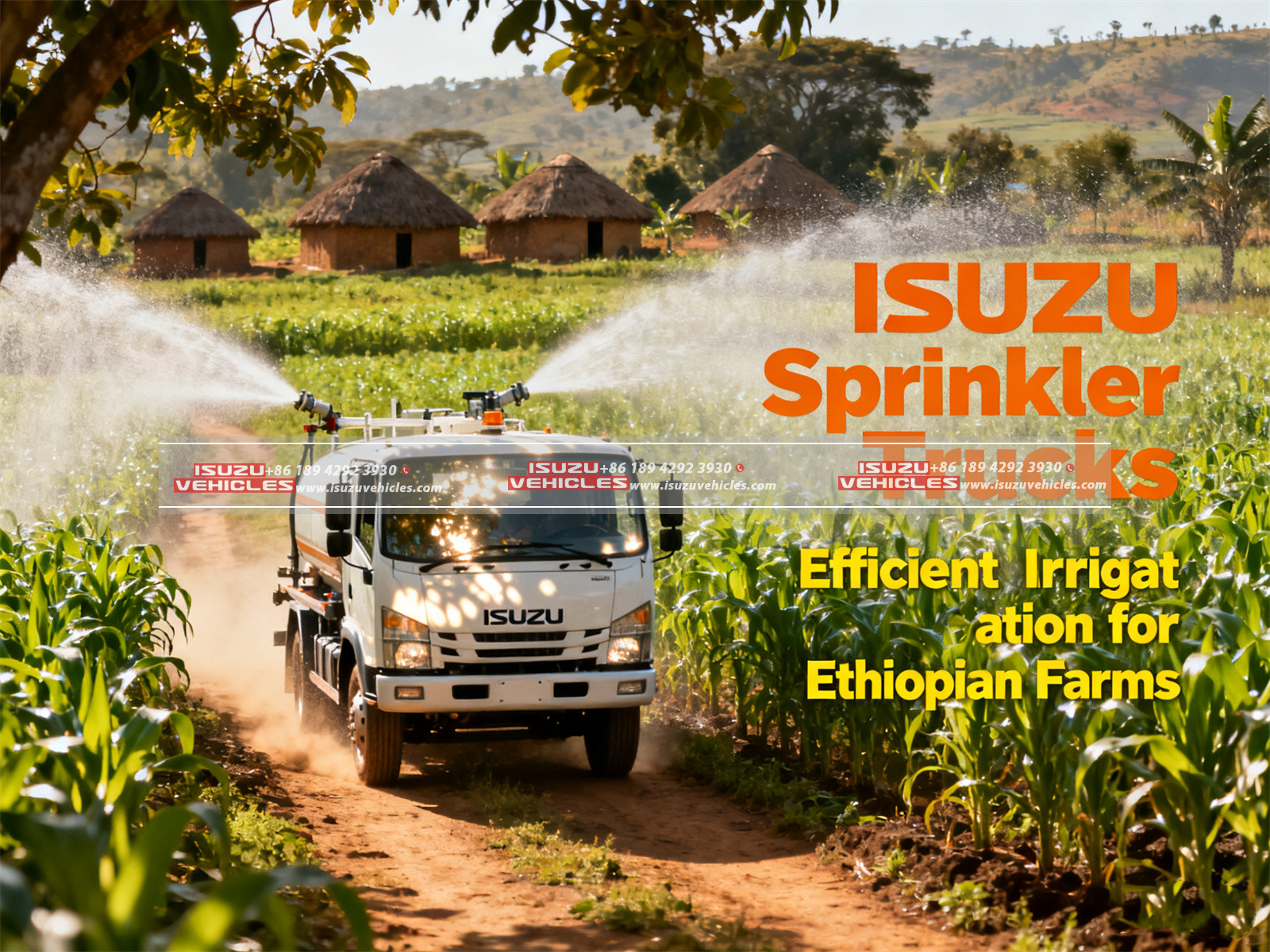
- Dust Warfare: Radial-sealed bearings and cyclonic air pre-cleaners protect pumps from silica-rich soil prevalent in Tigray’s farmlands, extending filter life to 600 hours.
- Altitude Compensation: Turbochargers with adaptive vane geometry maintain 100% pump power at 3,000m altitudes where standard engines lose 35% output.
- Corrosion Defense: Zinc-iron phosphate coated chassis and ceramic-exhaust wraps resist corrosion from fertilizer-laden runoff water and acidic soils.
Field testing in the Afar Depression demonstrated 98% operational availability during 45°C heatwaves that crippled conventional rigs.
5. National Impact: Aligning with Ethiopia’s Agricultural Transformation
ISUZU’s technology directly enables Ethiopia’s key food security initiatives:
- Climate-Resilient Green Economy (CRGE): 30% lower CO₂ emissions per irrigated hectare support Ethiopia’s net-zero pledge while precision moisture sensors prevent water table depletion.
- Yelemat Tirufat Campaign: Mobile irrigation boosts dairy fodder production by 200% on small plots, enabling year-round cattle nutrition for landless pastoralists.
- Digital Agriculture: FarmSpace™ telematics generate irrigation maps integrated with national soil databases, allowing agencies to optimize reservoir allocations during droughts.
The Ethiopian Water Ministry reports 17,500 hectares brought under efficient irrigation using ISUZU trucks since 2024.
6. Integrated Fleet Solutions: Beyond Irrigation
For regional governments managing multiple municipal and agricultural assets, standardization on ISUZU platforms multiplies returns:
- Shared Telematics: The ISUZU CONNECT™ hub monitors sprinkler water pressure alongside sweeper truck broom RPM and garbage truck compaction cycles via unified dashboards.
- Modular Chassis Utilization: Common F-series frames enable quick reconfiguration – a sprinkler truck’s pump module can be swapped for vacuum tanks during dry seasons to serve as emergency water transporters.
- Maintenance Synergy: Mechanics trained on garbage truck hydraulic systems can service 80% of sprinkler truck components using identical diagnostic protocols, slashing training costs.
Oromia Region’s integration of 32 ISUZU vehicles (18 sprinklers, 9 sweeper trucks, 5 garbage trucks) reduced spare parts inventory by $290,000 annually while achieving 92% fleet utilization.
The rhythmic pulse of ISUZU sprinklers across Ethiopia’s highlands represents more than agricultural innovation—it embodies water sovereignty in action. By transforming rigid infrastructure into agile, data-driven water distribution systems, these mobile platforms turn every reservoir into a strategic asset and every hillside into productive farmland. For communities where rain is memory and hope is a growing season away, this technology isn’t irrigation—it’s life orchestrated drop by deliberate drop.