
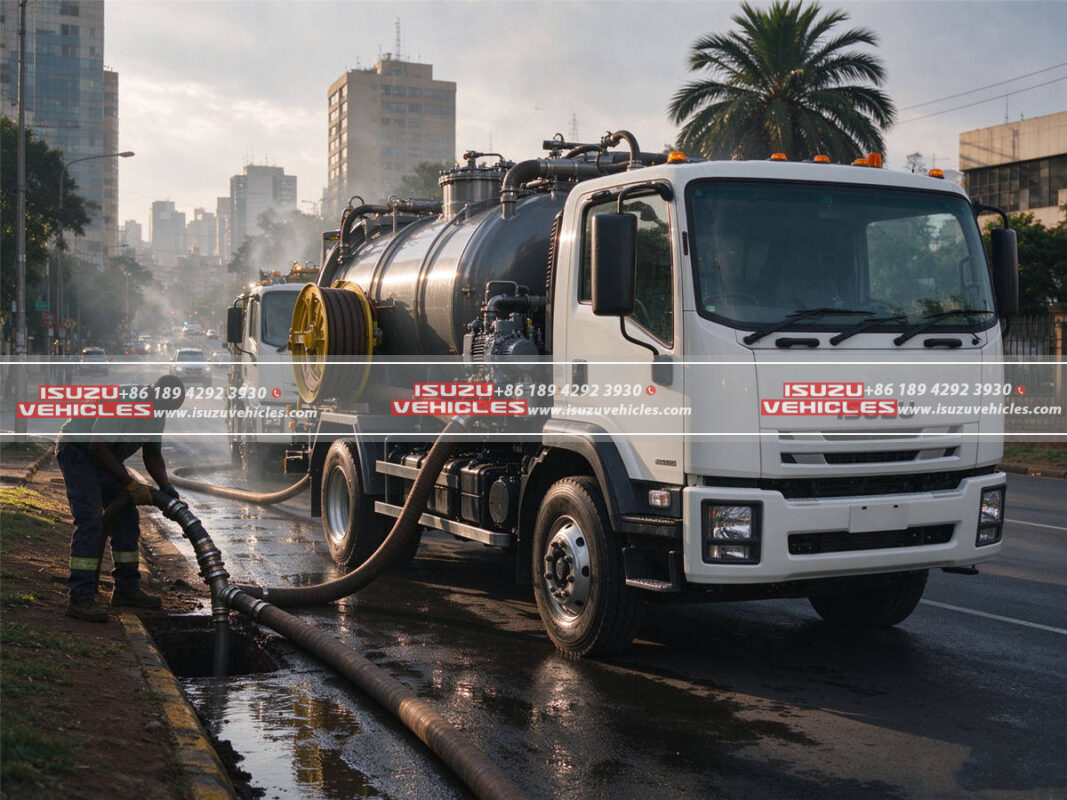
ISUZU Vehicles has completed a specialized commercial vehicle contract with a major local company in Kenya, supplying a fleet of ISUZU Vacuum Trucks developed for sewer cleaning, wastewater removal, drainage maintenance, and other demanding sanitation operations. The delivery provides the customer with purpose-built equipment capable of handling liquid waste and accumulated sludge in underground drainage systems, septic facilities, industrial wastewater areas, and municipal sanitation networks, where dependable suction performance and efficient waste transportation are essential for maintaining clean and functional infrastructure.
Unlike conventional cargo vehicles that are primarily designed for transporting solid materials, vacuum sewer trucks combine a dedicated vacuum pumping system, a sealed collection tank, hydraulic controls, and a heavy-duty truck chassis into one specialized working platform. This integrated configuration allows operators to reach service locations, collect wastewater and sludge, transport the material securely, and discharge it at an approved treatment or disposal facility, helping professional crews complete multiple stages of a sanitation operation with a single vehicle.
Powerful Vacuum Equipment for Efficient Sewer Maintenance
The delivered vacuum truck fleet is designed around the practical requirements of sewer and drainage maintenance, where strong suction capability, reliable pumping performance, and a durable tank structure are particularly important. During cleaning operations, the vacuum system creates negative pressure inside the collection tank, allowing liquid waste, sludge, sediment, and other accumulated materials to be drawn through the suction hose and transferred into the tank for safe transportation.
Built for Demanding Sanitation Applications
The sealed tank helps contain collected wastewater and sludge during transportation, while hydraulic and pneumatic components are arranged to support convenient loading and unloading operations. For field crews, this means that a single vehicle can move between different service locations without requiring separate pumping and transportation equipment, improving the organization of sewer maintenance projects and reducing unnecessary handling of contaminated materials.
The robust ISUZU chassis also provides a dependable road-going platform for sanitation contractors that frequently operate between urban districts, industrial facilities, residential areas, and wastewater treatment locations. Strong maneuverability is especially valuable when operators need to position a large specialized vehicle near manholes, drainage channels, narrow access roads, or crowded municipal service areas, while the dedicated superstructure gives the truck the functionality required for intensive cleaning work.
Supporting a Complete Municipal Sanitation System
Effective sanitation management rarely depends on one type of specialized vehicle alone, because sewer cleaning, road maintenance, waste collection, and environmental services are closely connected in modern urban infrastructure management. Alongside vacuum equipment, a road-cleaning vehicle can remove dust, sand, leaves, and debris from public roads, helping prevent solid waste from entering drainage systems and reducing the burden placed on sewer networks.
Similarly, a refuse collection truck can provide systematic household and commercial waste collection, helping keep communities cleaner while reducing the possibility of improperly discarded waste entering stormwater channels. ISUZU Vehicles offers multiple configurations for these applications, allowing municipal contractors and private sanitation companies to develop complementary fleets that address solid waste, street cleaning, wastewater, and drainage requirements through purpose-built equipment. :contentReference[oaicite:0]{index=0}
For example, the available sweeping range includes vehicles with dedicated brushing, suction, water spraying, and debris collection systems, while the waste collection range includes compactor, hooklift, skip-loader, and other configurations designed for different refuse-handling requirements. This combination can help Kenyan service providers establish a more coordinated sanitation operation in which each vehicle performs a clearly defined role while contributing to the same broader environmental objective. :contentReference[oaicite:1]{index=1}
Strengthening Sewer and Environmental Services in Kenya
The cooperation between ISUZU Vehicles and the major Kenyan company demonstrates the growing importance of specialized commercial vehicles in professional infrastructure maintenance, because reliable sewer cleaning equipment can directly support public health, environmental protection, and the long-term performance of urban drainage networks. When accumulated sludge, wastewater, and sediment are removed efficiently, drainage systems can operate more effectively, service teams can respond to maintenance requirements with greater flexibility, and sanitation contractors can organize their field operations around dependable mobile equipment.
The new fleet also represents an investment in practical working capability rather than simply an increase in vehicle numbers. With purpose-built vacuum equipment available for demanding sewer and wastewater applications, operators can approach cleaning projects with a more systematic workflow, from locating the service point and positioning the vehicle to suctioning waste, transporting collected material, and completing controlled discharge operations. This can help reduce reliance on labor-intensive manual methods while improving the consistency of professional sanitation services.
As Kenya continues to require reliable solutions for urban sanitation, drainage maintenance, wastewater management, and environmental protection, ISUZU Vacuum Trucks provide a strong foundation for companies seeking efficient and durable equipment for specialized field operations. Combined with municipal sweeping equipment and solid-waste transport solutions, these vehicles can form part of a comprehensive sanitation fleet that helps communities maintain cleaner streets, healthier drainage networks, and more reliable public infrastructure.