
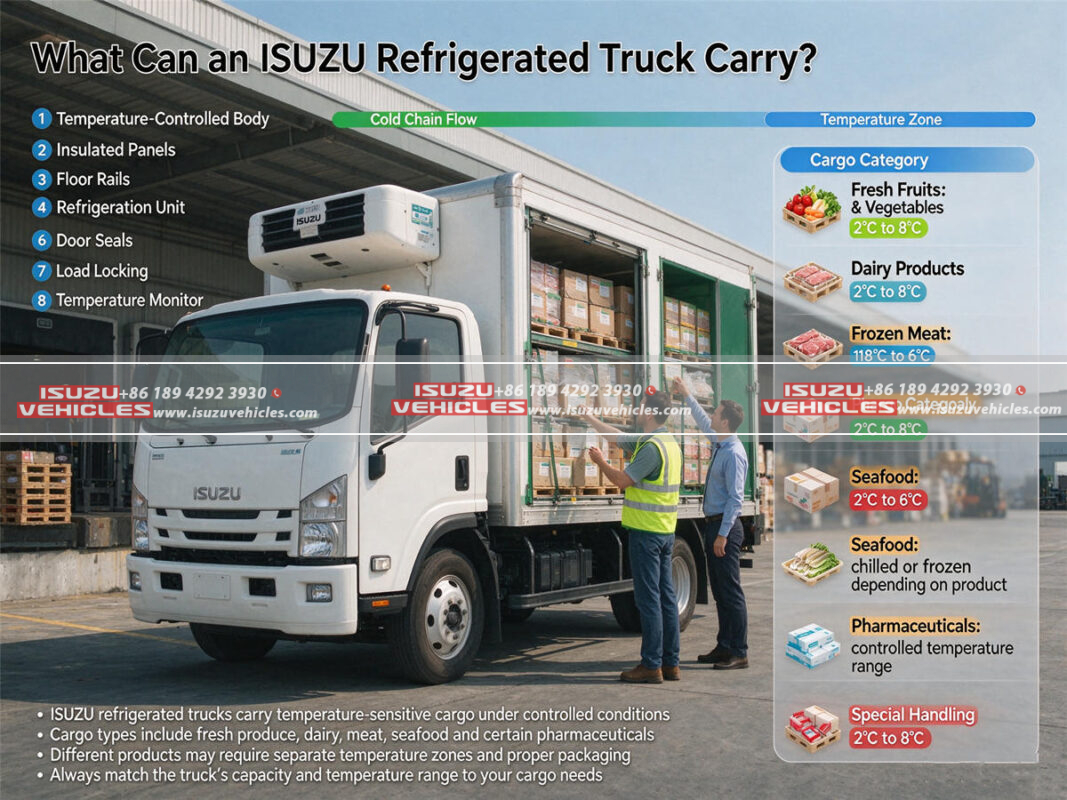
An ISUZU refrigerated truck is designed to transport products that need a controlled temperature environment during delivery, making it an important vehicle for food distribution, agricultural logistics, pharmaceutical transportation, and other businesses dealing with perishable or temperature-sensitive goods. Unlike an ordinary cargo truck that mainly protects products from rain, dust, and direct sunlight, a refrigerated truck combines an insulated cargo body with a refrigeration unit to help maintain suitable conditions throughout the journey.
The range of products that can be transported is quite broad, including fresh meat, seafood, dairy products, vegetables, fruits, frozen food, ice cream, prepared meals, beverages, flowers, and certain pharmaceutical products. However, these goods do not all require the same temperature, and choosing the right refrigerated vehicle involves understanding the specific transportation requirements of the cargo rather than simply selecting the coldest available refrigeration setting.
For example, a supermarket supplier may need one vehicle to deliver chilled dairy products and fresh vegetables, while a frozen food distributor may require a freezer truck capable of maintaining substantially lower temperatures. A seafood wholesaler may have different handling requirements from a flower distributor, even though both businesses depend on temperature-controlled transportation. The truck should therefore be configured according to the products being carried, the expected journey duration, the outside climate, and the frequency of loading and unloading.
ISUZU Vehicles offers different refrigerated vehicle configurations, ranging from compact refrigerated van trucks to larger refrigerated box trucks. This variety allows businesses to select a vehicle according to their daily delivery volume, road conditions, customer locations, and required cargo compartment dimensions.
Common cargo categories
- Fresh food: Meat, poultry, seafood, fish, vegetables, fruit, and other perishable agricultural products.
- Dairy products: Milk, yogurt, cheese, cream, butter, and other products that require chilled transportation.
- Frozen food: Frozen meat, seafood, vegetables, convenience meals, ice cream, and packaged frozen products.
- Prepared meals: Catering supplies, restaurant ingredients, ready-to-eat meals, and other food products requiring controlled transportation conditions.
- Pharmaceutical products: Certain medicines, vaccines, medical supplies, and laboratory materials, provided the vehicle and monitoring arrangements meet the applicable requirements.
- Flowers and plants: Cut flowers and selected horticultural products that benefit from controlled transportation temperatures.
2. Can an ISUZU Refrigerated Truck Carry Fresh Meat, Seafood, and Dairy Products?
Fresh meat, seafood, and dairy products are among the most common types of cargo transported by refrigerated trucks because their quality can deteriorate quickly when exposed to unsuitable temperatures. These products are frequently distributed from processing facilities, farms, fishing ports, and food warehouses to supermarkets, restaurants, hotels, wholesalers, and regional distribution centers. During this process, maintaining appropriate transportation conditions is essential for protecting product quality and supporting a reliable cold-chain operation.
Fresh meat and poultry
Fresh meat and poultry require careful temperature management from the processing facility to the final customer. An ISUZU refrigerated truck can provide an enclosed, insulated transportation environment for packaged meat, poultry products, and other chilled goods, helping reduce exposure to outside heat during transportation. This is particularly useful for meat distributors that make several deliveries each day and need to transport products between warehouses, butcher shops, supermarkets, and restaurants.
The cargo should be loaded at an appropriate temperature, packaged correctly, and arranged to allow cold air to circulate around the products. Operators should also avoid placing cargo directly against refrigeration air outlets or blocking the airflow path with oversized cartons. Good loading practices help maintain more consistent conditions throughout the refrigerated compartment.
Fish and seafood
Seafood distribution often involves strict handling requirements because fish, shrimp, shellfish, and other aquatic products can lose quality rapidly when exposed to unsuitable temperatures. A refrigerated truck is useful for moving seafood from fishing ports and processing plants to wholesale markets, supermarkets, restaurants, and food distribution facilities.
The appropriate transportation method depends on the product and its packaging. Some seafood is transported chilled, while other products must remain frozen. Buyers should therefore confirm the required temperature range and cooling capacity before choosing a vehicle. The refrigeration system should be suitable for the cargo volume and the expected outside temperature, particularly when the truck operates in hot coastal regions or makes frequent deliveries.
Milk and other dairy products
Milk, yogurt, cheese, cream, and similar dairy products are also common refrigerated cargo. Food manufacturers and distributors often need to move these products from production facilities to supermarkets, convenience stores, hotels, restaurants, and catering businesses. A properly configured refrigerated truck helps maintain the required transportation environment and reduces the risk of temperature fluctuations during distribution.
For companies serving multiple customers along the same route, a suitable refrigerated body, reliable door seals, and an organized loading sequence are particularly important because repeated door opening can allow warm outside air to enter the cargo compartment.
3. Can an ISUZU Refrigerated Truck Carry Frozen Food and Ice Cream?
Yes, an appropriately configured ISUZU freezer truck can transport frozen food and ice cream, provided that the refrigeration equipment, insulated body, and operating procedures are suitable for the required temperature conditions. Frozen products generally need lower transportation temperatures than ordinary chilled food, so buyers should not assume that every refrigerated truck is automatically suitable for every type of frozen cargo.
Common frozen cargo includes frozen meat, poultry, fish, shrimp, seafood, vegetables, packaged meals, dumplings, frozen bakery products, and ice cream. These products are distributed through food factories, cold-storage warehouses, supermarkets, restaurants, hotels, and wholesale markets. For businesses operating in this sector, a dedicated freezer truck can provide a more reliable transportation solution than an ordinary enclosed van or box truck.
Why frozen cargo needs a suitable refrigeration configuration
Frozen food transportation requires more than simply setting the refrigeration unit to a low temperature. The cooling equipment must have sufficient capacity for the cargo compartment and expected working conditions, while the insulated body must limit heat transfer from the outside environment. Door seals, floor construction, wall insulation, and roof insulation all contribute to the ability of the vehicle to maintain its intended internal temperature.
Operators should also understand that a refrigerated truck is generally intended to maintain suitable transportation conditions rather than rapidly freeze warm products. Frozen goods should normally be loaded at the appropriate temperature, and the refrigeration unit should be used to maintain the required environment during transportation. Loading products that have not been properly chilled or frozen can place unnecessary demands on the cooling system and may affect the condition of other cargo.
Ice cream distribution is a particularly demanding application because the product can be sensitive to temperature fluctuations during loading, unloading, and delivery. Businesses transporting ice cream should pay attention to the refrigeration unit’s performance, door-opening frequency, insulation quality, and actual cargo-compartment temperature rather than relying only on the temperature displayed on the refrigeration controller.
ISUZU Vehicles provides different refrigerated and freezer body configurations for businesses handling frozen food distribution. A compact refrigerated van truck may be suitable for smaller local deliveries, while a larger freezer box truck can provide additional space for wholesalers and regional distributors transporting substantial quantities of frozen products.
4. Can an ISUZU Refrigerated Truck Transport Vegetables, Fruits, and Agricultural Products?
Fresh vegetables and fruits are another important category of refrigerated cargo, particularly for farms, agricultural cooperatives, food wholesalers, supermarket suppliers, and companies distributing produce between rural production areas and urban markets. Many agricultural products are sensitive to temperature, humidity, handling conditions, and ventilation, so appropriate transportation can help preserve their quality after harvesting.
Products such as lettuce, broccoli, carrots, mushrooms, grapes, berries, apples, pears, and many other fruits and vegetables may benefit from controlled-temperature transportation. However, different agricultural products have different storage requirements. Some products are sensitive to excessively low temperatures, and certain fruits release ethylene gas that can affect the ripening of other produce. For this reason, businesses should not assume that every fruit and vegetable can be transported together under one universal temperature setting.
Protecting freshness during farm-to-market transportation
For agricultural distributors, the journey from the farm or packing facility to the wholesale market can have a significant effect on the final condition of the products. A refrigerated truck provides a more controlled environment than an ordinary open cargo body, helping limit the impact of high ambient temperatures during transportation. This is particularly valuable in regions where agricultural products must travel long distances before reaching retailers or processing facilities.
The internal arrangement of the cargo is also important. Boxes should be stacked securely without blocking the refrigeration unit’s air outlets or preventing cold air from circulating through the compartment. Overloading the vehicle or packing products too tightly can create uneven temperature conditions, even when the refrigeration equipment is operating normally.
Businesses transporting mixed agricultural products should consider whether separate deliveries or different temperature-controlled compartments are necessary. Certain products may be incompatible because of their temperature, humidity, odor, or ethylene sensitivity. A suitable loading plan can help prevent unnecessary product losses and make daily distribution more organized.
5. Can an ISUZU Refrigerated Truck Carry Pharmaceutical Products, Flowers, and Other Special Cargo?
Although food distribution is one of the best-known applications, refrigerated trucks can also serve industries that require controlled transportation conditions for non-food products. Pharmaceutical distributors, medical suppliers, flower wholesalers, laboratories, and specialized logistics companies may all need vehicles capable of maintaining a defined cargo environment during transportation.
Pharmaceutical and medical products
Certain medicines, vaccines, biological products, laboratory materials, and medical supplies must remain within specified temperature ranges throughout storage and transportation. A properly configured refrigerated truck can provide a controlled cargo compartment for these applications, but the vehicle must be selected according to the product manufacturer’s requirements and the applicable pharmaceutical transportation regulations.
For sensitive medical cargo, the refrigeration unit alone is not enough. Businesses may need calibrated temperature sensors, continuous data recording, alarm systems, documented loading procedures, and validated temperature-control arrangements. Some products require a specific temperature range that is different from ordinary food refrigeration, so buyers should confirm the requirements before ordering a vehicle.
Flowers and horticultural products
Cut flowers and selected plants can also benefit from temperature-controlled transportation, particularly when they are shipped from farms or growing facilities to flower markets, supermarkets, event suppliers, and export distribution centers. Maintaining appropriate conditions during transportation can help reduce premature wilting and preserve product appearance.
However, different flowers have different temperature and humidity requirements, and some varieties are sensitive to chilling injury. A suitable vehicle should therefore be configured according to the products being transported rather than using the same settings for every shipment. Proper packaging, ventilation, loading arrangements, and careful handling remain important throughout the delivery process.
Other specialized products
Depending on the required temperature and transportation standards, refrigerated vehicles may also be used for selected chemicals, specialty ingredients, laboratory materials, and other temperature-sensitive commercial products. These applications require additional consideration of cargo compatibility, packaging, safety regulations, and the suitability of the refrigeration equipment. A standard food-grade refrigerated truck should not automatically be assumed suitable for transporting regulated or hazardous materials.
6. How to Choose the Right ISUZU Refrigerated Truck for Different Cargo
The right refrigerated truck depends on more than the type of product being carried. Businesses should also consider average shipment weight, cargo volume, delivery distance, road conditions, loading arrangements, required temperature, and the number of stops made during a normal working day. A vehicle that is suitable for a small restaurant supplier may be inefficient for a large supermarket distributor, even when both companies transport similar products.
Compact refrigerated van trucks for local deliveries
A compact van truck is often suitable for businesses that deliver relatively small quantities of chilled or frozen products to customers within a city. Its smaller dimensions can make it easier to maneuver through crowded streets, enter commercial loading areas, and park near restaurants or retail stores. It may be particularly useful for bakery suppliers, small food distributors, dairy delivery companies, and local pharmaceutical logistics operators.
For example, the ISUZU 4 Meter Refrigerated Van Truck has listed overall dimensions of approximately 5,995 × 2,270 × 2,980 mm, a gross vehicle weight of 4,495 kg, and a rated payload of 1,100 kg. Its cargo body measures approximately 4,075 × 2,060 × 1,860 mm. This configuration illustrates how a compact refrigerated vehicle can provide a practical balance between cargo space and urban operating flexibility.
Medium-duty refrigerated trucks for regular distribution
Businesses that transport larger quantities of meat, seafood, dairy products, vegetables, and frozen food may need a medium-duty refrigerated truck with greater payload capacity and internal cargo volume. These vehicles are suitable for supermarket replenishment, food wholesale operations, regional restaurant supply, and transportation between warehouses and distribution centers.
The refrigerated truck range includes different vehicle configurations, from compact refrigerated vans to larger refrigerated box trucks. Buyers should compare the specifications of individual models rather than assuming that all vehicles in the category have the same payload or refrigeration performance.
Larger refrigerated box trucks for high-volume transportation
When a company needs to transport substantial quantities of products over longer routes, a larger refrigerated box truck may offer a more suitable solution. The increased cargo volume can reduce the number of trips required to move goods between warehouses, food processing facilities, and regional distribution points. However, the vehicle’s rated payload, axle capacities, overall dimensions, and local road restrictions must be checked before purchase.
Businesses comparing refrigerated vehicles with other commercial transportation options can also review the N Series truck range and F Series truck range. These categories include different commercial chassis and body configurations that may be relevant when selecting a suitable platform for specialized transportation.
7. Refrigerated Truck vs. Ordinary Cargo Truck: Which One Should You Use?
An ordinary cargo truck and a refrigerated truck may look similar from the outside, particularly when both use enclosed box bodies, but they are designed to perform different transportation tasks. A conventional cargo truck is suitable for dry goods, machinery, furniture, packaged consumer products, construction materials, and other items that do not require temperature control. Its enclosed body provides protection from weather, dust, and road debris, but it does not actively maintain a chilled or frozen environment.
A refrigerated truck, on the other hand, combines an insulated cargo body with refrigeration equipment to help maintain a controlled temperature during transportation. This makes it a better choice for fresh meat, seafood, dairy products, frozen food, vegetables, flowers, and other cargo that may deteriorate when exposed to unsuitable temperatures.
For businesses that transport both temperature-sensitive and ordinary goods, maintaining separate vehicles may be more practical than trying to use one vehicle for every delivery. A refrigerated truck can be assigned to food and other sensitive products, while a standard box truck or cargo truck can handle dry freight and general commercial goods. This arrangement helps avoid unnecessary refrigeration operating costs and makes it easier to organize loading and cleaning procedures according to the type of cargo.
When planning a refrigerated transportation fleet, businesses should also consider the complete cold-chain process, including product storage before loading, pre-cooling procedures, packaging, loading time, temperature monitoring, and unloading at the destination. A well-equipped truck is an important part of this process, but it cannot compensate for poor storage practices or incorrect product handling.
Ultimately, an ISUZU refrigerated truck can carry much more than fresh food. Depending on its refrigeration system, insulated body, payload, and operating configuration, it can transport fresh meat, seafood, dairy products, vegetables, fruits, frozen food, ice cream, prepared meals, pharmaceuticals, flowers, and other temperature-sensitive commercial products. From a compact refrigerated van truck for urban deliveries to a larger refrigerated box truck for regional distribution, the right vehicle should always be selected according to the cargo’s actual transportation requirements.
ISUZU Vehicles provides different commercial vehicle configurations for businesses involved in cold-chain logistics, food distribution, and general freight transportation. By identifying the products to be carried, confirming their required temperature range, and matching the cargo volume with the vehicle’s rated payload, buyers can choose a refrigerated truck that supports reliable daily operations and protects product quality throughout the delivery journey.