
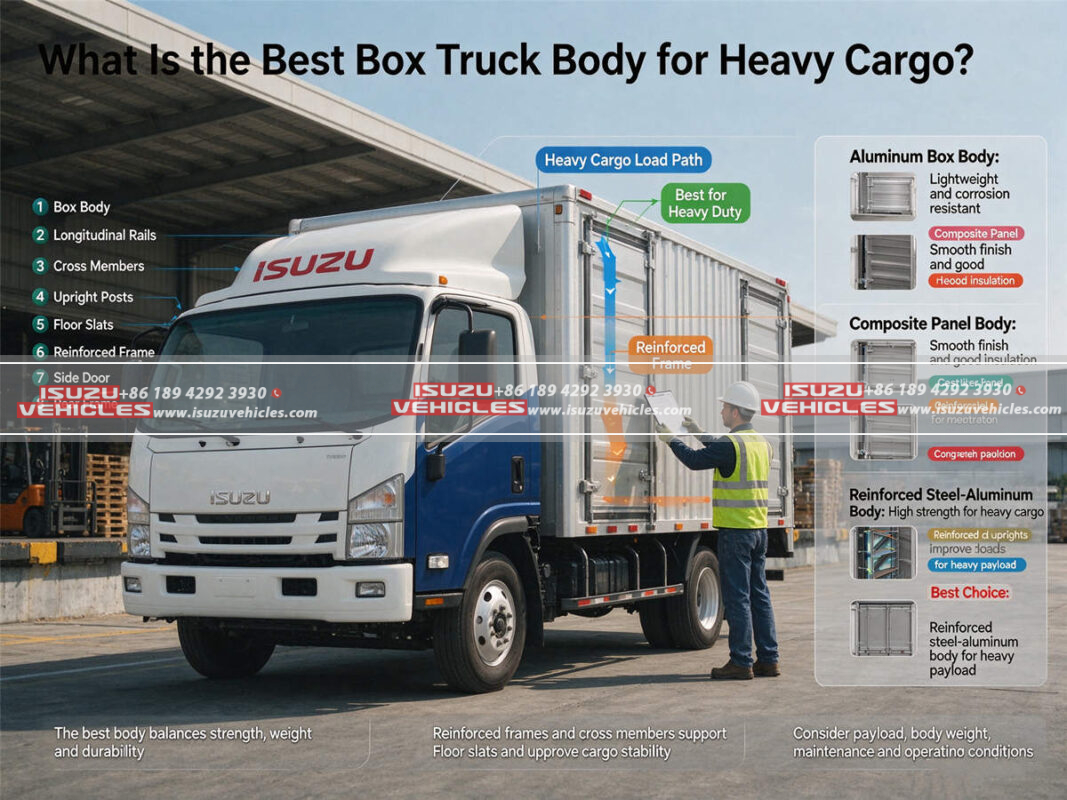
Choosing the right box truck body for heavy cargo is about much more than selecting a large cargo compartment or a truck with a high payload rating. When businesses transport machinery, construction materials, industrial equipment, packaged goods, furniture, or other heavy products, the body structure plays a major role in determining how safely and efficiently the vehicle performs. A well-designed body must withstand concentrated loads, resist deformation during daily operation, protect the cargo from external conditions, and remain practical for loading and unloading across different working environments.
For fleet operators, logistics companies, construction businesses, and commercial vehicle buyers, the best solution depends on the type of cargo, its weight distribution, transportation distance, loading equipment, and operating conditions. A steel box body may be suitable for demanding industrial applications, while an aluminum structure can offer valuable weight savings when payload capacity is a priority. Reinforced flooring, strong chassis mounting points, and properly designed rear doors are equally important because even a heavy-duty body can become unreliable if these supporting components are poorly matched to the vehicle.
At ISUZU Vehicles, selecting a suitable cargo truck involves considering the complete vehicle configuration rather than judging its performance by cargo box dimensions alone. Understanding the advantages and limitations of different body materials and structural designs helps buyers make a more informed investment and avoid unnecessary maintenance costs over the truck’s working life.
1. Understanding the Requirements of Heavy Cargo Transportation
Before comparing different box truck body materials, it is important to understand what makes heavy cargo transportation different from ordinary goods delivery. Lightweight cartons, household products, and general merchandise are usually distributed across a relatively large loading area, whereas machinery, metal components, building materials, and industrial equipment may create extremely concentrated loads in specific sections of the cargo floor. This difference places additional demands on the floor structure, crossmembers, side panels, and the connection between the cargo body and the truck chassis.
Payload Capacity Is the First Consideration
Payload capacity refers to the maximum weight of cargo that a truck can legally and safely carry, taking into account its gross vehicle weight rating and operating configuration. Buyers should remember that the weight of the cargo body itself is included in the vehicle’s overall weight, which means a particularly heavy steel body may reduce the amount of merchandise the truck can transport.
For example, a distribution company transporting industrial machinery might initially prefer a thick steel box because of its strength, but if the body consumes too much of the available payload allowance, the company may need additional trips to complete the same delivery schedule. In contrast, a lighter aluminum body could increase usable payload capacity while still providing adequate structural performance when it is properly engineered for the intended cargo.
Weight Distribution Matters as Much as Total Weight
A truck carrying 5,000 kg of evenly distributed cargo does not necessarily experience the same structural stress as a truck carrying 5,000 kg of concentrated steel components. Heavy items positioned over a small floor area can create excessive pressure on individual floor panels and supporting crossmembers, potentially causing bending, cracking, or permanent deformation.
For this reason, buyers should consider the dimensions and contact areas of their heaviest cargo, not simply its total weight. Reinforced floor sections, suitable load-bearing supports, and appropriate cargo-securing equipment are essential for preventing concentrated loads from damaging the body during transportation. The truck must also comply with its axle weight limits and applicable road regulations, even when the overall cargo weight remains below the advertised payload capacity.
2. Steel Box Truck Bodies: The Preferred Choice for Demanding Applications
Steel is one of the most widely used materials for heavy-duty commercial vehicle bodies because it offers excellent structural strength, good impact resistance, and considerable flexibility in fabrication. A steel box body can be designed with reinforced side panels, heavy-duty floor supports, protective corner sections, and strong mounting brackets, making it particularly suitable for businesses that regularly transport industrial products and construction-related materials.
Advantages of Steel Construction
The main advantage of a steel box body is its ability to withstand demanding working conditions. During loading and unloading, the cargo compartment may be exposed to forklifts, pallet jacks, metal equipment, and other heavy handling tools. A properly designed steel structure can tolerate these conditions better than many lightweight alternatives, particularly when the vehicle is used in warehouses, factories, construction sites, and industrial distribution centers.
Steel also allows manufacturers to customize the thickness and reinforcement of different structural components according to the intended application. For example, a truck transporting heavy machinery may use a reinforced steel floor with additional crossmembers, while a vehicle carrying metal products can incorporate protective interior panels and stronger tie-down points. This flexibility makes steel an attractive solution for specialized transportation requirements.
Limitations Buyers Should Consider
The biggest disadvantage of steel is its weight. A heavier cargo body increases the vehicle’s curb weight and reduces the remaining payload capacity, which can influence fuel consumption, operating efficiency, and the number of trips required to complete a delivery. Steel is also vulnerable to corrosion when its protective coating becomes damaged, especially in regions with high humidity, frequent rainfall, coastal conditions, or exposure to industrial chemicals.
Regular inspection, appropriate surface treatment, and timely repainting can help extend the service life of a steel body. For companies transporting particularly heavy or abrasive cargo, however, the additional weight may be an acceptable compromise for the durability and structural protection that a properly engineered steel design provides.
3. Aluminum Box Truck Bodies: A Lightweight Alternative for Higher Payload Efficiency
Aluminum box bodies have become increasingly popular among commercial vehicle operators who want to reduce vehicle weight without sacrificing the practical benefits of an enclosed cargo compartment. Compared with conventional steel construction, aluminum generally offers a favorable strength-to-weight ratio and naturally forms a protective oxide layer that provides good resistance to atmospheric corrosion.
For transportation companies operating under strict vehicle weight limits, the reduced body weight can create a meaningful payload advantage. This is particularly useful when a truck carries relatively dense commercial products over long distances, because every kilogram saved in the vehicle structure can potentially be allocated to additional cargo, provided that the chassis, axles, tires, and legal weight limits permit it.
Where Aluminum Performs Best
Aluminum is a practical option for packaged industrial products, general merchandise, consumer goods, and many types of commercial deliveries. It can also be used in refrigerated transportation, where lightweight insulated body structures help operators manage the combined weight of the chassis, insulation, refrigeration equipment, and cargo. A properly designed refrigerated truck can therefore benefit from carefully selected lightweight structural materials while maintaining the thermal performance required for temperature-sensitive goods.
Is Aluminum Strong Enough for Heavy Cargo?
The answer depends on the engineering design rather than the material name alone. Aluminum is not automatically unsuitable for heavy loads, but its lower stiffness and different mechanical properties mean that manufacturers must pay close attention to panel thickness, structural profiles, joint design, floor reinforcement, and load distribution. A lightweight aluminum body with inadequate supporting members may deform under concentrated loads, even if the material itself has good corrosion resistance.
For buyers comparing steel and aluminum, it is important to request information about the complete body construction, including the floor structure, crossmember spacing, reinforcement layout, and maximum permitted cargo weight. The best choice is the body that satisfies the actual operating requirements while maintaining a sensible balance between durability, weight, and long-term maintenance.
4. Reinforced Floors and Structural Components That Make a Difference
Although the exterior panels determine much of a box truck’s appearance, the floor and supporting framework are often more important when the vehicle is designed for heavy cargo. A truck may have thick steel side panels and a reinforced front wall, but if its floor cannot withstand concentrated pressure from machinery or heavy pallets, the entire cargo body can become a weak point during operation.
Choosing the Right Cargo Floor
Steel flooring is commonly selected for applications involving heavy equipment, metal products, and repeated forklift loading because of its durability and resistance to mechanical damage. Depending on the intended use, manufacturers may employ steel plates, patterned steel sheets, or a combination of structural supports and protective flooring materials.
Aluminum flooring can reduce overall body weight and provide good corrosion resistance, but its thickness and supporting structure must be appropriate for the cargo. Marine plywood and other engineered floor materials may also be used in certain commercial applications, particularly where the cargo is relatively evenly distributed and the body design prioritizes weight efficiency. However, these materials should not be assumed to offer the same resistance to concentrated impact or repeated heavy equipment loading as a suitably engineered steel floor.
Crossmembers, Side Rails, and Chassis Connections
Crossmembers support the cargo floor from underneath and help transfer cargo loads through the body structure toward the chassis. Their material, dimensions, spacing, and connection method all influence how effectively the floor distributes weight. For heavy industrial transportation, closely evaluated crossmember arrangements and reinforced longitudinal supports can help reduce localized stress and prevent excessive floor movement.
The connection between the box body and the vehicle chassis deserves equal attention because the truck experiences vibration, braking forces, cornering forces, and road impacts throughout its working life. Properly designed mounting brackets and suitable fastening arrangements help maintain structural stability while accommodating the movement and flexing of the chassis. Buyers should therefore evaluate the body and chassis as an integrated system rather than treating them as two unrelated components.
Cargo Restraint and Interior Protection
Heavy cargo must remain securely positioned throughout transportation, particularly when the truck travels on uneven roads or performs frequent stops and turns. Interior tie-down rings, load-securing rails, reinforced anchor points, and protective corner sections can make a significant difference in everyday operation. These features should be positioned according to the dimensions and securing requirements of the products being transported, rather than added without a clear loading plan.
5. Other Box Body Designs for Specialized Heavy Cargo
Steel and aluminum are the two main materials buyers usually compare, but the overall box body configuration is equally important. Different industries have different transportation requirements, and a body designed for palletized goods may not be the most suitable solution for transporting oversized machinery or fragile industrial components. Understanding these differences can help businesses choose a truck that performs efficiently under real working conditions.
Standard Dry Box Bodies
A standard dry box body is one of the most practical options for general commercial transportation because its enclosed structure protects cargo from rain, dust, sunlight, and other external conditions. It is widely used for transporting packaged industrial products, furniture, household appliances, electronics, building accessories, and warehouse supplies.
For heavy cargo applications, the most important considerations are reinforced flooring, adequate structural supports, durable interior walls, and properly designed loading access. Depending on the cargo, the body can also be equipped with interior tie-down rails, protective lining, and additional securing points to prevent goods from moving during transportation. Businesses looking for enclosed transportation solutions can explore the available box truck models and compare different body dimensions and vehicle configurations.
Refrigerated and Freezer Box Bodies
When transporting frozen food, fresh meat, seafood, dairy products, or other temperature-sensitive goods, an ordinary dry box body is not sufficient. A refrigerated body uses insulated panels, sealed joints, temperature-control equipment, and suitable interior materials to maintain the required cargo environment throughout the journey.
A freezer truck is particularly important for businesses transporting products that must remain frozen rather than simply cool. Its body typically incorporates polyurethane insulation between protective inner and outer panels, helping reduce heat transfer and maintain a consistent temperature. Although the insulation and refrigeration equipment add weight, this type of construction is essential for protecting products and maintaining cold-chain quality.
For operators handling both heavy and temperature-sensitive products, the body must be designed around the cargo’s weight, loading frequency, temperature requirements, and cleaning procedures. The floor should provide sufficient load-bearing capacity while maintaining a surface that is practical for regular washing and sanitation. This is especially important for food distribution companies that need to balance structural durability with hygiene requirements.
Custom Industrial Box Bodies
Some transportation applications require a more specialized body rather than a conventional enclosed box. Machinery manufacturers, electrical equipment suppliers, and industrial maintenance companies may need reinforced mounting points, removable interior supports, equipment racks, or customized access doors. In these situations, the cargo body should be developed around the physical dimensions and handling requirements of the products being transported.
For example, a company delivering industrial generators may need a reinforced floor and several securing points positioned around the equipment, while a business transporting long metal components may require a longer cargo compartment with carefully designed internal supports. Customization should always account for the vehicle’s maximum allowable weight and axle loading limits.
6. How to Choose the Right Box Truck Body for Your Business
After understanding the differences between body materials and structural designs, buyers should evaluate their transportation operations as a whole. The best box truck body is not necessarily the strongest, thickest, or most expensive option available. Instead, it should provide sufficient strength for the intended cargo while maintaining a reasonable vehicle weight, practical loading arrangements, and manageable maintenance requirements.
Match the Body to the Type of Cargo
The first step is to identify what the truck will carry during normal operation. Steel components, machinery, construction equipment, and industrial products may require reinforced steel flooring and heavy-duty structural supports. Palletized consumer goods and packaged products may be transported efficiently in a standard enclosed box body, while frozen food and perishable products require insulated compartments with appropriate refrigeration systems.
Businesses should also consider whether their cargo has sharp edges, irregular shapes, or fragile surfaces. These characteristics can influence the selection of interior wall protection, floor materials, securing equipment, and loading arrangements. A body that works well for one type of product may require substantial modifications for another.
Check the Chassis and Gross Vehicle Weight Rating
A heavy-duty box body cannot compensate for an undersized chassis. The vehicle frame, suspension, axles, tires, braking system, and engine must all be suitable for the intended operating weight and road conditions. Buyers should compare the gross vehicle weight rating, curb weight, rated payload, front and rear axle capacities, and recommended body configuration before placing an order.
For example, a medium-duty vehicle may be sufficient for regional distribution involving moderately heavy palletized products, whereas a larger truck may be necessary for transporting industrial equipment over longer distances. The correct selection depends on actual cargo weight, body dimensions, route conditions, and applicable vehicle regulations rather than engine horsepower alone.
Consider Loading and Unloading Efficiency
Loading arrangements can significantly influence daily operating costs, particularly for businesses that make several deliveries or collect goods from multiple warehouses. Rear swing doors are a common choice for standard box trucks because they provide straightforward access and can accommodate forklift loading when the surrounding working area allows sufficient clearance.
Roll-up doors may be more convenient in locations where there is limited space behind the vehicle, while side doors can improve access for frequent deliveries of smaller products. Depending on the cargo and vehicle configuration, a hydraulic tail lift may also be useful for moving heavy pallets or equipment between the ground and cargo floor without relying entirely on a loading dock.
Evaluate Long-Term Maintenance Costs
Purchase price is only one part of the total cost of owning a commercial truck. Body repairs, corrosion protection, floor replacement, door maintenance, and the availability of replacement components can all influence operating expenses over several years. Steel bodies require attention to damaged coatings and corrosion, while aluminum bodies need suitable inspection of joints, fasteners, and areas exposed to repeated mechanical stress.
Businesses should also pay attention to the quality of welding, panel assembly, sealing materials, and chassis mounting arrangements. A well-manufactured body can reduce unexpected downtime and help maintain vehicle productivity, particularly for fleets operating every day under demanding conditions.
7. Why ISUZU Chassis Are a Practical Foundation for Heavy-Duty Box Trucks
When choosing a heavy-cargo box truck, the body structure is only one part of the purchasing decision. The chassis beneath must provide sufficient load-bearing capacity, reliable power delivery, stable handling, and compatibility with the intended cargo body. This is why many commercial vehicle buyers consider the complete vehicle configuration instead of selecting a body independently of the truck platform.
ISUZU Vehicles offers different commercial truck configurations designed for transportation, logistics, industrial delivery, and specialized applications. Depending on the required payload and cargo dimensions, buyers can consider suitable ELF, N-Series, F-Series, and GIGA-based vehicles, with different wheelbases, chassis specifications, and body arrangements.
For smaller and medium-sized delivery operations, an ELF or N-Series platform may provide a practical balance between maneuverability and cargo capacity. These vehicles are commonly considered for urban distribution, warehouse deliveries, and regional transportation where access to narrow roads and loading areas is important. Larger operations may require an F-Series or GIGA platform with a longer wheelbase and a more substantial chassis configuration, depending on the intended gross vehicle weight and operating requirements.
Customization for Different Transportation Requirements
One advantage of commercial truck chassis platforms is their flexibility in supporting different body designs. A standard dry box, reinforced industrial cargo compartment, refrigerated body, or freezer body can be specified according to the customer’s application, provided that the completed vehicle meets the chassis manufacturer’s technical requirements and relevant regulations.
For example, a logistics company transporting heavy packaged machinery may prioritize a reinforced cargo floor, additional securing points, and wide rear access. A food distributor may instead require an insulated body, refrigeration equipment, and washable interior surfaces. A company handling general merchandise may prefer a lightweight structure that maximizes payload capacity while providing sufficient protection against weather and unauthorized access.
Before confirming a vehicle configuration, buyers should provide the manufacturer with accurate information about cargo weight, cargo dimensions, expected daily mileage, road conditions, loading methods, and required body features. This information makes it easier to determine whether a particular chassis and body combination is suitable for the intended application.
Ultimately, the best box truck body for heavy cargo is one that combines appropriate material strength, reinforced load-bearing components, practical cargo access, and compatibility with the truck chassis. Steel is often the preferred option for particularly demanding industrial applications, while aluminum can offer advantages when reducing vehicle weight and increasing usable payload are important priorities. By evaluating the complete vehicle rather than focusing on the cargo box alone, businesses can select a more reliable transportation solution that supports daily productivity and long-term operating efficiency.