
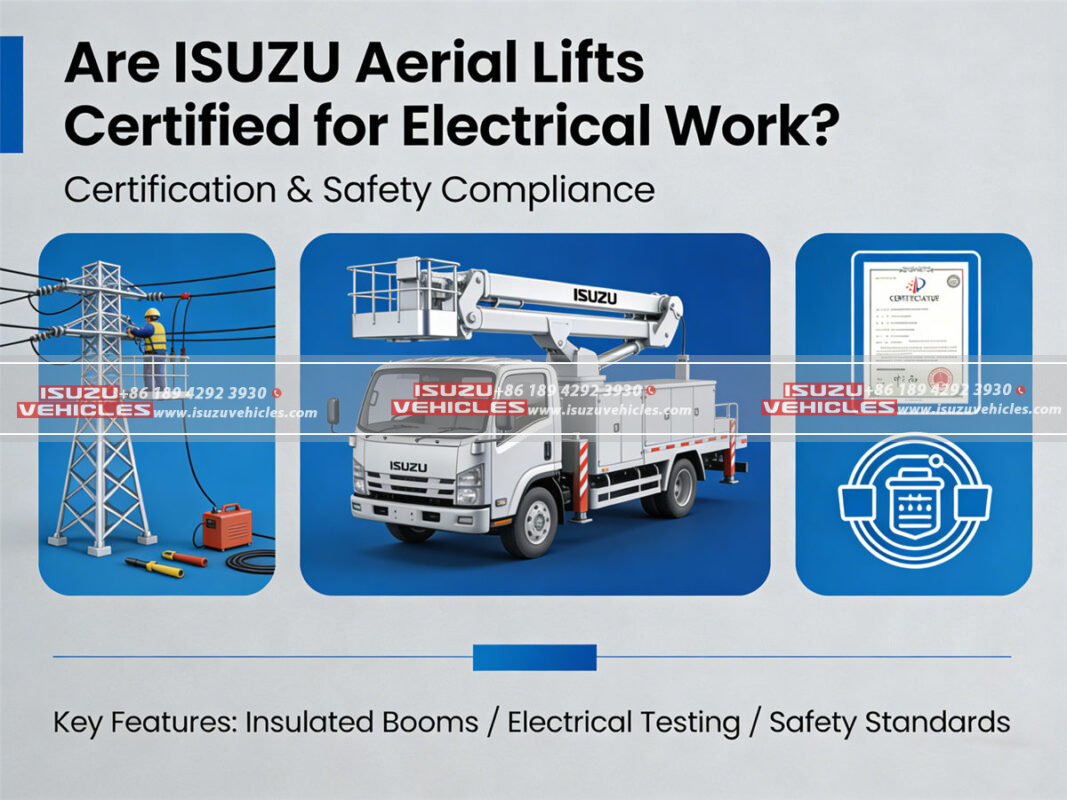
Understanding Certification Requirements for Electrical Aerial Work
When utility companies, telecommunications contractors, and industrial maintenance teams evaluate aerial lift equipment for electrical applications, the question of certification is not merely procedural but foundational to worker safety, regulatory compliance, and liability management. Electrical work performed at height—whether on power distribution lines, substations, street lighting systems, or industrial installations—requires equipment that meets stringent insulation, structural, and operational standards. Therefore, when professionals ask whether ISUZU aerial lifts are certified for electrical work, the answer depends on a nuanced understanding of both the chassis platform and the aerial device installed upon it.
It is important to clarify at the outset that certification for electrical work does not apply solely to the truck chassis itself; rather, it applies primarily to the aerial lift assembly, including the boom, bucket, insulation components, hydraulic systems, and dielectric properties. ISUZU, as a manufacturer of durable commercial truck chassis, provides the foundational vehicle platform upon which specialized aerial lift bodies are mounted by certified equipment manufacturers. The compliance of the completed vehicle therefore hinges on the specifications of the installed aerial system and its adherence to industry standards such as ANSI, OSHA, and relevant electrical safety codes.
In professional practice, understanding this distinction allows procurement managers and fleet directors to evaluate not only whether a vehicle can perform electrical tasks but whether it can do so within the framework of legally recognized safety certification.
The Role of ANSI and OSHA Standards in Electrical Aerial Work
Certification for electrical aerial lifts is governed by clearly defined standards intended to protect workers from electrocution, falls, and mechanical failure. In North America and many other markets, two principal frameworks shape compliance expectations.
ANSI A92 Standards for Mobile Elevating Work Platforms
The American National Standards Institute (ANSI) A92 series establishes design, testing, and performance requirements for mobile elevating work platforms (MEWPs), which include insulated boom lifts commonly used in electrical maintenance. These standards address:
- Structural integrity of booms and buckets
- Hydraulic system reliability
- Load capacity ratings
- Operator control systems
- Stability under dynamic conditions
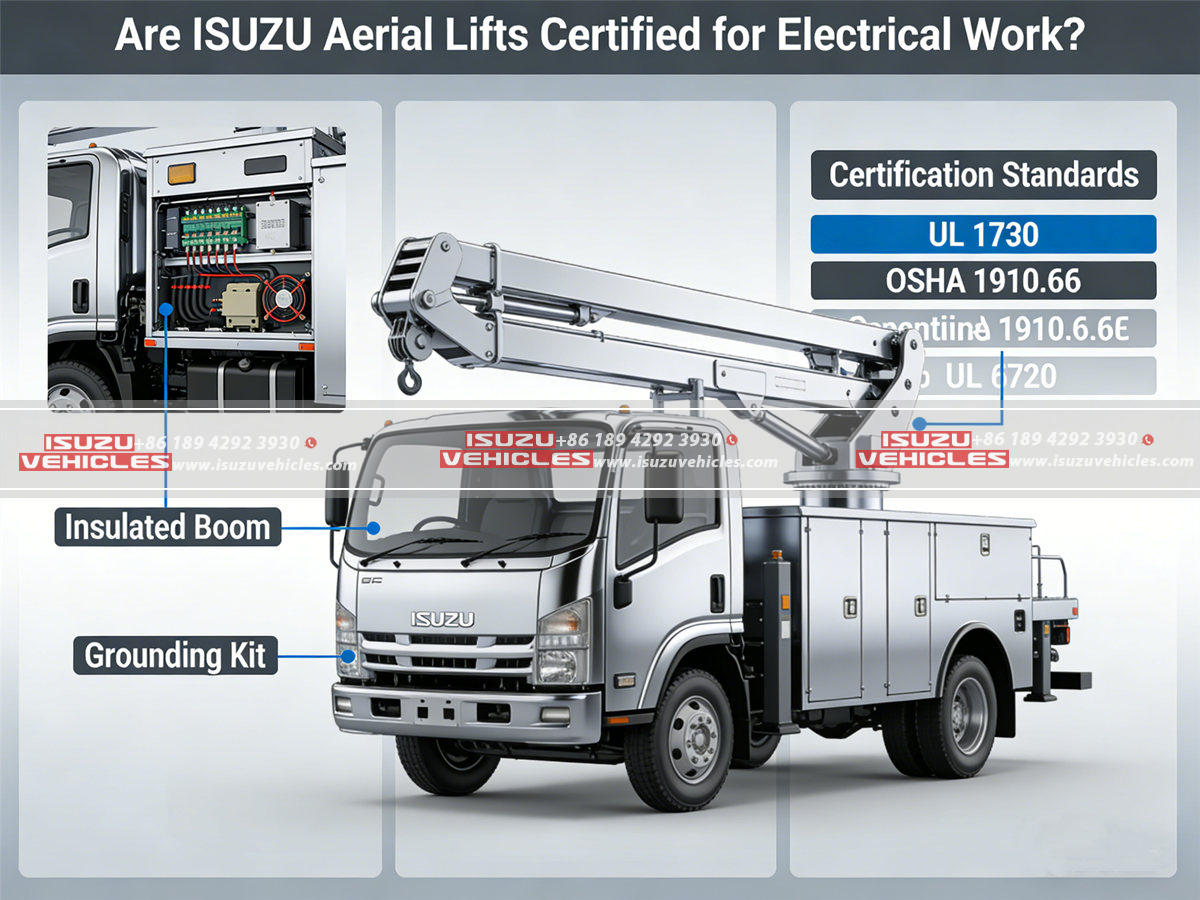
An ISUZU-based aerial lift configured for electrical work must incorporate a boom assembly certified under the applicable ANSI category to ensure compliance.
OSHA Regulations and Electrical Safety Requirements
The Occupational Safety and Health Administration (OSHA) outlines regulations for working near energized lines, including minimum approach distances, equipment insulation standards, and grounding procedures. For an aerial lift to be approved for live-line electrical work, it must meet dielectric testing requirements that verify its insulating capacity under controlled voltage conditions.
Fleet operators should verify that the completed aerial unit—mounted on an ISUZU chassis—has undergone proper dielectric testing and carries documentation confirming its certification status.
Insulation and Dielectric Protection in Aerial Lifts
The defining feature that distinguishes a standard aerial lift from one certified for electrical work is its insulation system. Electrical bucket trucks must be engineered to minimize the risk of current flow from energized conductors to the operator.
Fiberglass Boom Construction
Certified insulated aerial lifts typically incorporate fiberglass boom sections designed to provide a barrier against electrical conduction. The insulation rating of the boom determines the maximum voltage at which it can safely operate when properly maintained and tested.
ISUZU chassis platforms are commonly selected for insulated boom installations because of their stable frame geometry and dependable power delivery systems, which support the operational demands of hydraulic aerial devices.
Bucket Insulation and Liner Systems
In addition to the boom, the bucket itself must meet insulation standards. Many certified electrical lifts include:
- Fiberglass bucket shells
- Insulated liners
- Bonding and grounding components
- Protective covers for controls
Regular dielectric testing is required to maintain certification status, and this responsibility falls upon the fleet operator to ensure ongoing compliance.
Chassis Stability and Structural Support for Electrical Work
While the aerial device provides insulation and height access, the truck chassis contributes significantly to overall safety and performance during electrical tasks.
Frame Strength and Outrigger Stability
Electrical work often involves extended boom positioning at significant heights, sometimes under windy or uneven terrain conditions. A stable chassis with reinforced frame rails and properly engineered outriggers is critical to maintaining safe working conditions.
ISUZU’s commercial truck platforms are known for their balanced weight distribution and robust construction, attributes that support stable aerial lift integration. Outriggers deployed during operation further enhance stability by distributing load forces away from the suspension system.
Hydraulic and Electrical System Compatibility
Aerial lift performance depends on reliable hydraulic systems powered by the truck’s engine and auxiliary components. ISUZU engines provide consistent torque output suitable for powering hydraulic pumps without excessive strain, ensuring smooth boom articulation and responsive control.
Additionally, electrical system reliability is essential for powering warning lights, control panels, and safety interlocks, all of which contribute to compliance and operational safety.
Industry Applications for Certified ISUZU Aerial Lifts
When properly configured with certified insulated boom assemblies, ISUZU-based aerial lifts are widely used in industries that require electrical maintenance at height.
Utility Line Maintenance
Electric utility providers rely on insulated bucket trucks to perform live-line maintenance, transformer replacement, and line inspections. The combination of a dependable chassis and certified insulated boom ensures that technicians can work within prescribed safety margins.
Telecommunications and Street Lighting
Although not always involving live electrical conductors, telecommunications and municipal lighting maintenance still benefit from certified aerial lifts to mitigate risk when working near energized infrastructure.
Industrial Facilities
Manufacturing plants and industrial complexes often require maintenance of overhead power systems, conduit runs, and lighting fixtures. A certified ISUZU aerial lift allows maintenance teams to perform these tasks safely while complying with occupational safety regulations.
Verification, Maintenance, and Ongoing Compliance
Certification is not a one-time event; it is an ongoing process that requires regular inspection, documentation, and testing to remain valid.
Routine Dielectric Testing
To maintain certification for electrical work, insulated aerial lifts must undergo periodic dielectric testing according to manufacturer recommendations and regulatory guidelines. This testing verifies that insulation components remain effective and free of contamination or structural damage.
Operator Training and Documentation
Even a fully certified aerial lift becomes unsafe if operated improperly. Comprehensive operator training programs ensure that personnel understand load limits, approach distances, grounding procedures, and emergency protocols.
Fleet managers should maintain detailed service logs, inspection records, and certification documents to demonstrate compliance during audits or regulatory reviews.
Strategic Fleet Considerations for Electrical Contractors
For electrical contractors and utility providers evaluating fleet investments, the decision to purchase an ISUZU-based aerial lift should focus on integration between a reliable commercial chassis and a properly certified insulated boom assembly. It is the synergy between these components—not the chassis alone—that determines whether the vehicle is certified for live electrical work.
In many service fleets, a bucket truck configured with an insulated boom works alongside other specialized vehicles such as a crane truck for heavy equipment placement. By selecting durable platforms from ISUZU Vehicles, contractors can build versatile fleets that support electrical maintenance, infrastructure repair, and industrial service operations while maintaining compliance with safety and certification standards.