
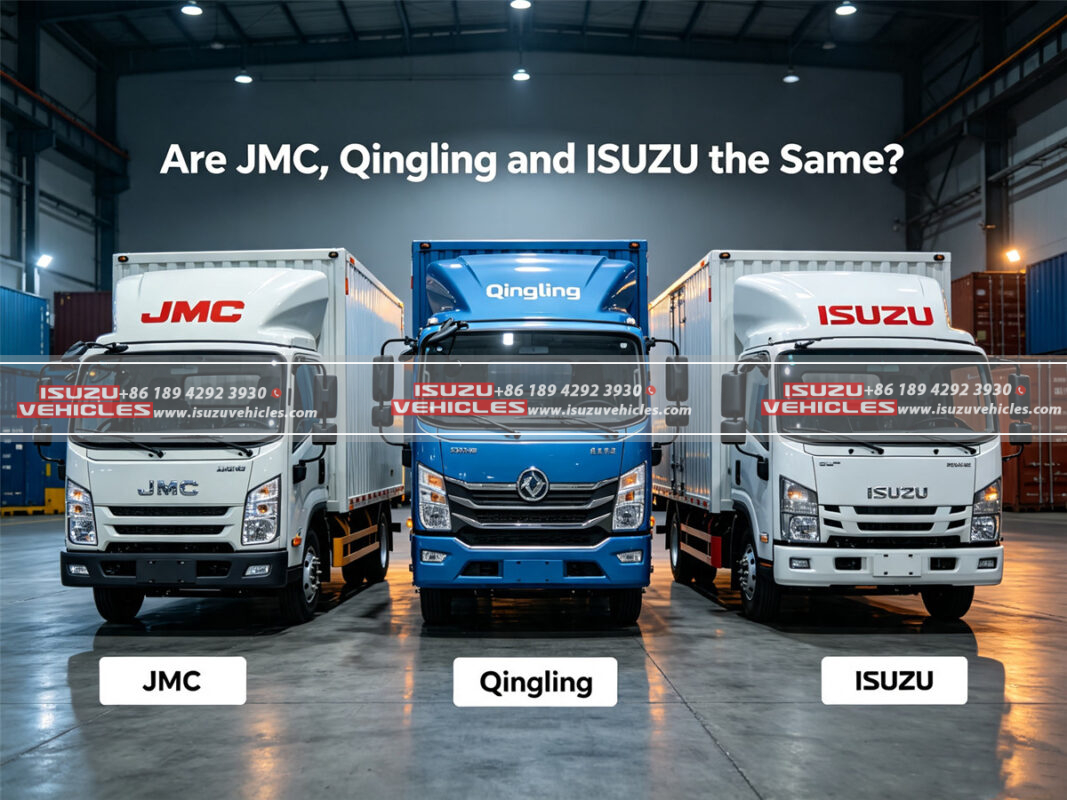
Are JMC, Qingling and ISUZU the Same? Understanding Their Relationship in China’s Commercial Vehicle Industry
When searching for commercial trucks in China, many buyers encounter three familiar names: JMC, Qingling, and ISUZU. Because these brands often produce vehicles with similar appearances and technologies, it is common for customers to assume they are the same company or that one is simply another name for the others. This confusion becomes even greater when browsing export markets, where vehicles may carry different badges depending on the destination country.
In reality, JMC, Qingling, and ISUZU are three separate companies with different ownership structures, histories, manufacturing strategies, and market positioning. While they have all maintained business relationships with ISUZU Motors of Japan at different stages of development, their products, technologies, and target customers differ significantly.
For fleet operators, government procurement departments, logistics companies, and overseas distributors, understanding these differences is essential before making an investment. Choosing the right manufacturer can affect vehicle reliability, maintenance costs, parts availability, and long-term resale value. This article explains how these three manufacturers are connected, where they differ, and how buyers can identify the right truck for their applications.
The Origins of JMC, Qingling, and ISUZU
China’s commercial vehicle market has grown rapidly over the past several decades, largely through international cooperation between domestic manufacturers and established global brands. Among the most influential partnerships has been the collaboration with ISUZU Motors, which has introduced advanced diesel engine technology, manufacturing standards, and vehicle engineering into China.
ISUZU – The Original Japanese Manufacturer
ISUZU Motors Limited, founded in Japan in 1916, is one of the world’s oldest commercial vehicle manufacturers and is particularly well known for its dependable diesel engines, medium-duty trucks, pickup trucks, and specialty vehicles. Over the years, ISUZU has built an international reputation for producing trucks that combine durability, fuel efficiency, and relatively low maintenance costs.
Rather than manufacturing every vehicle independently around the world, ISUZU has formed strategic partnerships with manufacturers in various countries, including China, to expand production capacity and better serve regional markets.
Qingling Motors – ISUZU’s Long-Term Chinese Joint Venture
Qingling Motors is one of ISUZU’s closest and longest-standing partners in China. Established in Chongqing, Qingling entered into a formal joint venture with ISUZU Motors in the 1980s, allowing the company to manufacture genuine ISUZU commercial vehicles under licensed production.
This partnership has continued for decades, making Qingling one of the most recognized producers of ISUZU-branded trucks within the Chinese market. Many Qingling vehicles share chassis platforms, engines, transmissions, and manufacturing standards that closely follow Japanese ISUZU specifications.
JMC – An Independent Manufacturer with Technical Cooperation
JMC, officially Jiangling Motors Corporation, is another major Chinese commercial vehicle manufacturer. Although JMC has cooperated with ISUZU on several vehicle programs and engine technologies over the years, it remains an independent company with its own product planning, research and development, and manufacturing operations.
Unlike Qingling, JMC produces numerous vehicles developed independently or through partnerships with other international manufacturers, making its product portfolio considerably broader.
How Are They Connected?
Although these companies are independent entities, they share a network of technical cooperation that often creates confusion among customers.
Technology Sharing
ISUZU has licensed various technologies to Chinese manufacturers over many years, including:
- Diesel engine designs
- Transmission technologies
- Chassis engineering
- Manufacturing processes
- Quality control systems
As a result, certain JMC products may utilize ISUZU-derived engines, while Qingling manufactures vehicles that are much closer to original ISUZU designs.
However, sharing technology does not mean the companies are identical.
For example, many automotive manufacturers worldwide purchase engines from the same supplier while producing completely different vehicles. A truck equipped with an ISUZU-derived engine does not automatically become an authentic ISUZU truck.
Different Corporate Structures
One of the easiest ways to distinguish these companies is by ownership.
- ISUZU Motors is a Japanese multinational manufacturer.
- Qingling Motors operates as a Chinese company with long-term investment and technical cooperation from ISUZU.
- JMC is an independent Chinese automaker with multiple strategic partnerships across different vehicle segments.
Each company maintains its own management team, production facilities, research departments, and long-term business strategies.
Comparing Their Product Lines
Although product overlap exists in some market segments, each manufacturer focuses on different customer groups and vehicle applications.
ISUZU and Qingling Products
Vehicles manufactured through Qingling generally emphasize:
- High reliability
- Proven diesel technology
- Long service life
- Fleet operation efficiency
- Municipal applications
- Premium commercial transportation
Many export customers specifically request Qingling-built vehicles because they prefer the close association with Japanese ISUZU engineering.
Common vehicle categories include:
- Light-duty cargo trucks
- Medium-duty trucks
- Heavy-duty trucks
- Refrigerated trucks
- Dump trucks
- Fire trucks
- Garbage trucks
- Vacuum sewage trucks
- Aerial work platforms
These vehicles are widely used by government agencies, utility companies, logistics operators, and industrial enterprises.
JMC Products
JMC offers a much wider variety of commercial and passenger vehicles.
Its lineup includes:
- Light commercial trucks
- Pickup trucks
- Vans
- SUVs
- Electric commercial vehicles
- Logistics vehicles
JMC has invested heavily in independent product development while continuing to incorporate selected ISUZU technologies where appropriate.
Because of this diversified strategy, JMC often competes in market segments beyond traditional commercial trucks.
Which Vehicles Use Genuine ISUZU Technology?
One of the most common questions from overseas buyers is whether every truck carrying an ISUZU-style appearance contains original ISUZU engineering.
The answer depends on the manufacturer and vehicle model.
Qingling’s Close Technical Integration
Qingling vehicles generally maintain stronger technical continuity with Japanese ISUZU products. Many components, including engines, chassis structures, driveline configurations, and production standards, are developed under long-standing cooperation agreements.
This makes Qingling particularly attractive for customers seeking vehicles that closely resemble Japanese ISUZU specifications while benefiting from Chinese manufacturing efficiency.
JMC’s Selective Technology Adoption
JMC has used licensed ISUZU diesel engines in numerous models throughout its history.
However, many current JMC vehicles feature independently developed platforms, updated styling, different suspension systems, or alternative powertrain options. These vehicles may incorporate ISUZU-inspired technologies without being direct ISUZU products.
Therefore, buyers should evaluate each vehicle individually rather than assuming every JMC truck shares the same engineering heritage.
How Should International Buyers Choose Between Them?
Selecting the right manufacturer depends less on brand recognition and more on operational requirements, after-sales support, and total ownership cost.
For customers operating municipal fleets, construction companies, sanitation departments, or international logistics businesses, reliability often outweighs initial purchase price.
If the priority is obtaining trucks that closely follow traditional Japanese engineering principles with long-established diesel technology, Qingling-produced ISUZU models remain a preferred choice for many fleet operators.
On the other hand, businesses seeking cost-effective transportation solutions, broader model selections, or emerging electric vehicle options may find JMC’s product portfolio better suited to their requirements.
Another important consideration is spare parts availability. Since both manufacturers maintain extensive domestic production networks, replacement parts are generally easier to obtain than for imported Japanese-built vehicles. However, compatibility between JMC and Qingling components should never be assumed without confirming specific model numbers, engine families, and production years.
Experienced buyers also evaluate dealer support, warranty coverage, maintenance training, and long-term service capability before making procurement decisions, especially when exporting vehicles to Africa, Southeast Asia, the Middle East, or South America.
Understanding the Right Choice for Your Business
Although JMC, Qingling, and ISUZU are closely connected through decades of industrial cooperation, they should not be considered identical manufacturers. ISUZU remains the original Japanese commercial vehicle producer, Qingling serves as its long-established Chinese manufacturing partner with deep technical integration, while JMC operates as an independent Chinese automaker that has adopted selected ISUZU technologies alongside its own engineering innovations. Recognizing these distinctions allows buyers to evaluate trucks based on their engineering background, intended application, service network, and long-term operating value rather than relying solely on brand names. Whether your business requires durable municipal equipment, dependable logistics trucks, or specialized commercial vehicles for demanding industries, understanding these relationships helps ensure a more informed purchasing decision. For buyers seeking professionally manufactured ISUZU Vehicles designed for global markets, working with experienced exporters and authorized suppliers is the best way to match the right vehicle with your operational needs while ensuring reliable after-sales support and genuine technical specifications.