
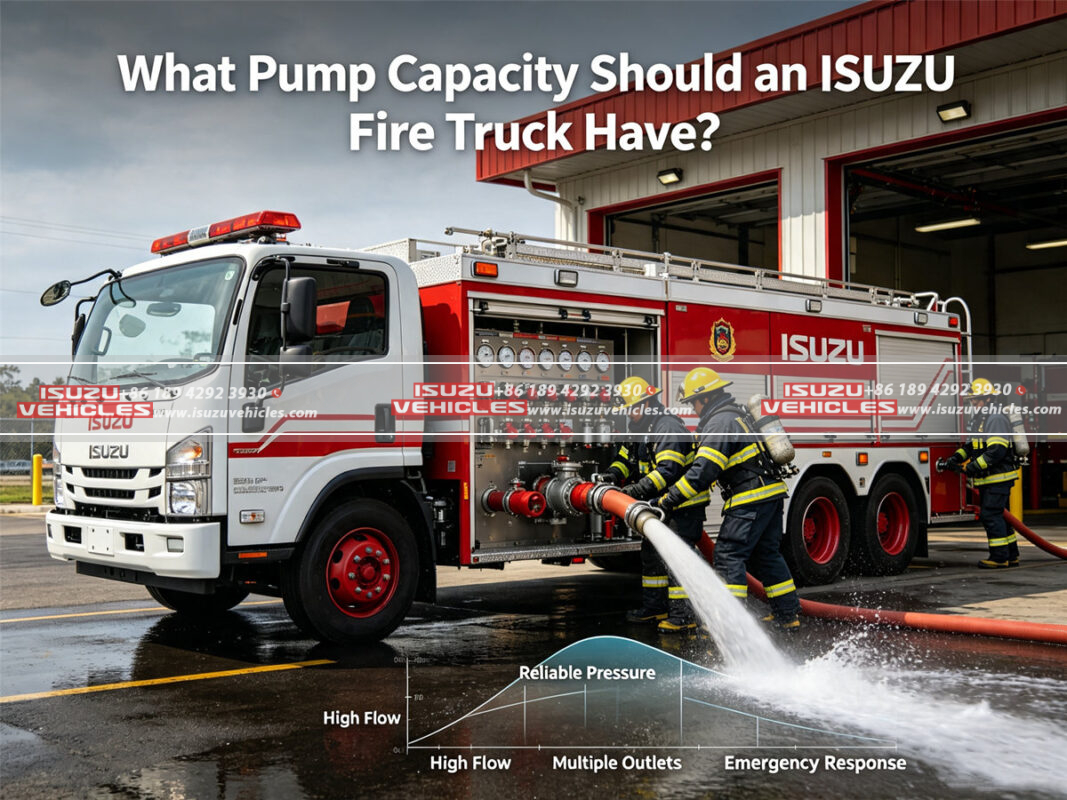
When responding to a fire emergency, having enough water onboard is important, but delivering that water effectively is equally critical. A fire truck may carry thousands of liters of water, yet without a properly sized pump system, firefighters cannot achieve the pressure and flow required to control flames quickly and safely. This is why pump capacity is one of the most important specifications when selecting an ISUZU fire truck.
The pump determines how much water can be delivered per minute and how effectively that water can reach the fire source through hoses, monitors, and other firefighting equipment. However, choosing the right pump capacity is not simply about selecting the highest possible flow rate. The ideal configuration depends on the firefighting environment, water supply conditions, vehicle size, and the types of emergencies the truck is expected to handle.
An ISUZU fire truck is designed with flexible firefighting configurations, allowing customers to select pump systems that match different operational requirements, from compact urban emergency response to industrial firefighting support. Understanding pump capacity helps fire departments and emergency organizations choose a vehicle that delivers reliable performance when every second matters.
Understanding Fire Truck Pump Capacity
Pump capacity refers to the amount of water a fire pump can move within a specific period, usually measured in liters per minute (L/min) or gallons per minute (GPM). It indicates the maximum water flow that the pump can provide under certain pressure conditions.
Common pump capacities for an ISUZU fire truck may include:
- 1,000–2,000 L/min for compact firefighting vehicles
- 2,500–4,000 L/min for standard municipal fire trucks
- 4,000–6,000 L/min or higher for heavy-duty firefighting applications
The appropriate capacity depends on the intended mission of the vehicle.
For example:
- A small urban response truck may need a moderate pump because it operates near reliable hydrant networks.
- A rural firefighting vehicle may require a stronger pump because it must transport and distribute water independently.
- An industrial firefighting truck may need high flow rates to handle large-scale emergencies.
Flow Rate and Pressure Must Work Together
A common misunderstanding is that higher flow always means better firefighting performance. In reality, firefighters need a balance between water volume and pressure.
High flow rates are useful for:
- Large structural fires
- Industrial fires
- Open-area fires
Higher pressure is important for:
- Long hose distances
- Elevated spraying
- Reaching upper floors
- Fighting fires from a distance
A well-designed pump system provides the correct combination of flow and pressure for the expected application.
Choosing Pump Capacity Based on Firefighting Applications
Different fire situations require different levels of water delivery. The right pump capacity depends largely on where and how the ISUZU fire truck will operate.
Urban Fire Response
Urban environments often have:
- Dense buildings
- Heavy traffic
- Limited access space
- Nearby hydrant systems
For city firefighting, mobility and quick deployment are often as important as maximum pump output.
A medium-capacity pump allows the truck to:
- Arrive quickly
- Connect to hydrants
- Supply multiple hoses
- Perform initial attack operations
Compact ISUZU fire trucks with efficient pumps are commonly used for residential areas, commercial districts, and public facilities.
Industrial and Large-Scale Firefighting
Industrial facilities often involve higher fire risks because they may contain:
- Flammable materials
- Large storage areas
- Heavy machinery
- Chemical products
These situations require stronger water delivery capability.
A high-capacity pump system helps firefighters:
- Cover larger areas
- Operate multiple hose lines
- Supply foam equipment
- Maintain continuous firefighting operations
For industrial applications, pump performance is often a priority when configuring a fire truck.
How the Water Tank and Pump Work Together
The pump capacity of an ISUZU fire truck must match the vehicle’s water storage capacity. These two systems work together to determine how long the truck can operate independently before requiring additional water supply.
For example, a truck with a large water tank but a small pump may carry sufficient water but deliver it too slowly. Conversely, a powerful pump with a small tank may run out of water quickly.
An effective firefighting configuration balances:
- Tank volume
- Pump flow rate
- Hose capacity
- Operating pressure
- Refill availability
Continuous Water Supply Considerations
During major fires, trucks often connect to external water sources while continuing operation. The pump must be capable of transferring water efficiently from:
- Fire hydrants
- Water pools
- Rivers
- Water supply vehicles
This makes pump reliability and versatility extremely important during extended firefighting operations.
Technical Features That Improve Pump Performance
A high-quality pump system includes more than just a powerful motor. The entire firefighting system must work together to provide stable and reliable water delivery.
Important components include:
- Centrifugal fire pump
- Pressure control valves
- Water intake connections
- Flow monitoring systems
- Pump control panels
Modern ISUZU fire trucks often use integrated control systems that allow operators to monitor and adjust pump performance during emergency situations.
Reliable Pump Materials and Construction
Fire pumps operate under demanding conditions and must withstand frequent use.
Durable pump systems provide:
- Corrosion resistance
- Stable operation
- Reduced maintenance requirements
- Longer service life
Since firefighting equipment may remain unused for periods but must perform immediately during emergencies, reliability is one of the most important design priorities.
Factors to Consider When Selecting an ISUZU Fire Truck Pump
Choosing the correct pump capacity requires evaluating the complete firefighting strategy rather than focusing on one specification.
Important considerations include:
Fire Risk Level
Areas with higher fire risks may require larger pumps and greater water delivery capability.
Water Availability
Locations with limited hydrant networks may need trucks with stronger independent pumping systems.
Road and Access Conditions
A compact truck with a moderate pump may perform better in narrow urban streets than a larger vehicle with higher capacity.
Response Requirements
Emergency teams should consider whether the vehicle is designed for:
- Initial fire attack
- Water supply support
- Industrial protection
- Rescue operations
Selecting the right pump ensures that the vehicle performs efficiently throughout its service life.
Building a Reliable Firefighting Solution
The ideal pump capacity for an ISUZU fire truck depends on the specific firefighting mission, with common configurations ranging from approximately 1,000 L/min for compact emergency vehicles to over 6,000 L/min for specialized heavy-duty applications. Instead of selecting the highest capacity available, fire departments should choose a system that matches their water supply conditions, operational environment, and emergency response requirements.
A properly configured fire truck combines the right pump capacity with suitable tank volume, reliable chassis performance, and professional firefighting equipment. This balanced approach ensures that firefighters have the water flow, pressure, and reliability needed to respond effectively during critical situations.
For organizations building a complete emergency and municipal fleet, an ISUZU fire truck can operate alongside a water tank truck for additional water transportation and a bucket truck for elevated rescue and maintenance tasks. Together with dependable ISUZU Vehicles, these specialized solutions provide the durability, flexibility, and professional performance required to support modern firefighting operations and emergency services worldwide.