
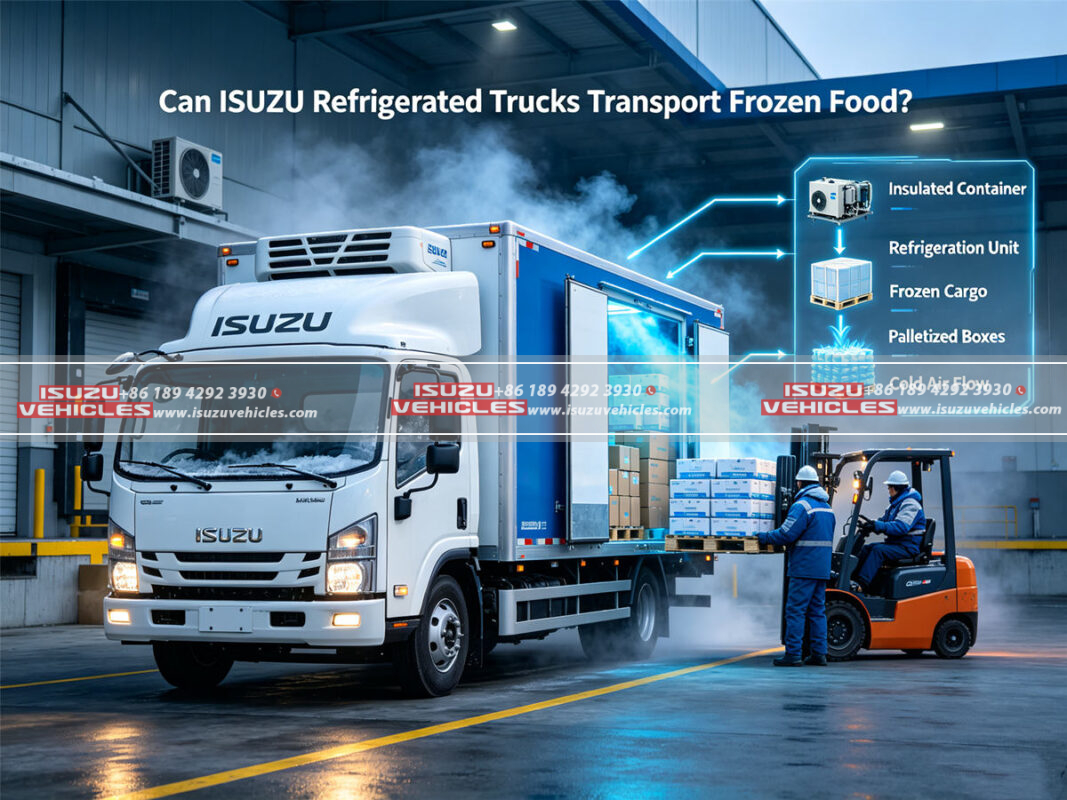
1. Can ISUZU Refrigerated Trucks Transport Frozen Food?
Yes, an ISUZU refrigerated truck can be configured to transport frozen food, provided that the vehicle is equipped with an appropriate low-temperature refrigeration unit, properly insulated cargo body, reliable door sealing, and a temperature-control system designed for frozen products. Frozen meat, seafood, poultry, ice cream, frozen vegetables, prepared meals, and other deep-frozen products require a much colder and more stable environment than ordinary fresh food, so a standard cargo vehicle without active refrigeration is not suitable for maintaining the required conditions over a delivery route. Current ISUZU refrigerated truck configurations include dedicated freezer box trucks as well as larger refrigerated vehicles, giving food distributors and cold-chain operators different options depending on cargo volume, route length, and temperature requirements.
For frozen-food logistics, the important question is not simply whether the truck can become cold, but whether it can maintain the required temperature consistently from loading through transportation and unloading. Current ISUZU refrigerated truck information indicates that frozen-food applications commonly operate around -18°C to -20°C, while some appropriately equipped vehicles can reach approximately -25°C or lower depending on the refrigeration system, insulation, ambient conditions, and body configuration. This makes the vehicle suitable for a wide range of frozen-food distribution tasks when the refrigeration specification is correctly matched to the cargo.
The distinction between chilled and frozen transport is particularly important for businesses planning a cold-chain fleet. A vehicle designed mainly for fresh vegetables or dairy products may operate around 0°C to +5°C, whereas frozen seafood, ice cream, frozen meat, and similar products require significantly lower temperatures. Choosing the correct refrigeration class therefore protects not only product quality but also the commercial value of the shipment, because partially thawed or temperature-abused frozen products may no longer meet the requirements of the customer or distribution chain.
Frozen Food Needs Continuous Temperature Control
A refrigerated truck should be viewed as a mobile temperature-controlled room rather than simply a truck with a cooling machine attached to it. The refrigeration unit, insulated box, doors, air circulation, loading method, and operating procedures all influence the temperature inside the cargo compartment, and the entire system must work together if frozen food is to remain properly protected throughout transportation.
2. What Temperature Does an ISUZU Refrigerated Truck Need for Frozen Food?
Most frozen-food transportation is commonly associated with an internal temperature of approximately -18°C or below, although the precise requirement depends on the product, applicable food regulations, customer specifications, storage conditions, and the complete cold-chain process. Current ISUZU refrigerated truck guidance identifies approximately -18°C for frozen foods such as ice cream and frozen meat, while some freezer configurations are designed for around -20°C to -25°C operation.
Maintaining a low temperature is important because freezing substantially slows biological and chemical processes that can affect food quality, but transportation should not be treated as an opportunity to freeze warm food from scratch. Ideally, frozen products should already be properly frozen before they are loaded into the truck, while the vehicle’s refrigeration system is responsible for maintaining the required transport environment rather than rapidly freezing large quantities of warm food.
-18°C Is a Common Reference Point
For many frozen-food distribution operations, -18°C is a familiar reference temperature because it provides a practical balance between maintaining frozen condition and controlling energy consumption. Products such as frozen poultry, seafood, beef, frozen vegetables, ready-made meals, and ice cream are commonly transported in this low-temperature range, although individual products may have more specific requirements. The operator should therefore always follow the product’s specified transportation temperature rather than assuming that every frozen product requires exactly the same setting.
Another important consideration is temperature recovery. Every time the rear doors are opened, warm and humid outside air enters the cargo compartment, while cold air escapes, causing a temporary temperature increase. A well-designed refrigeration system should be able to bring the compartment back toward its target temperature efficiently, but repeated door opening can still place a significant load on the cooling system, particularly during urban multi-stop distribution.
3. How Does the Refrigeration System Keep Frozen Food Cold?
The refrigeration unit is the active component that continuously removes heat from the cargo compartment, while the insulated box reduces the amount of heat entering from the outside. These two functions are closely connected: even a powerful refrigeration unit can struggle if the cargo body has poor thermal insulation, damaged panels, poorly sealed doors, or excessive heat leakage around openings.
Modern ISUZU refrigerated trucks are available in a range of body sizes, from compact N Series and ELF configurations to larger F Series and high-capacity refrigerated box trucks. The current product range includes 4.2-meter freezer box trucks, 5-meter refrigerated trucks, 16 CBM freezer and refrigerated trucks, 28 CBM refrigerated box trucks, 30 CBM refrigerated box trucks, and a 36 CBM refrigerated box truck, allowing operators to select a body size appropriate for different distribution requirements.
Insulation Prevents Heat From Entering
The refrigerated body is normally constructed with insulated panels designed to reduce heat transfer between the outside environment and the cargo compartment. This becomes particularly important when the truck operates in hot climates, because the temperature difference between the exterior and the frozen cargo area can be substantial. If excessive heat enters the body, the refrigeration unit must operate for longer periods and consume more energy simply to maintain the desired temperature.
Good insulation therefore contributes to both temperature stability and refrigeration efficiency. It also helps the cooling system recover more quickly after the doors have been opened, which is particularly useful for distribution routes involving supermarkets, restaurants, food warehouses, and other locations where the vehicle may stop many times during a working day.
Door Sealing Is Equally Important
The rear doors are another critical part of the cold-chain system because even a well-insulated cargo body can lose a significant amount of cold air if the door seals are damaged or do not close correctly. Regular inspection of rubber seals, hinges, locks, door alignment, and insulation around the door frame can help reduce unnecessary cold-air loss and prevent warm outside air from entering the compartment. Current ISUZU guidance also highlights door sealing as an important factor in maintaining stable refrigerated temperatures.
4. What Frozen Foods Can an ISUZU Refrigerated Truck Transport?
The range of frozen foods that can be transported by an appropriately configured ISUZU refrigerated truck is broad, covering many of the products found throughout modern food distribution networks. Frozen seafood, poultry, beef, pork, frozen vegetables, ice cream, frozen fruit, dumplings, prepared meals, processed foods, and other commercially frozen products can all require controlled low-temperature transportation, although each product should be transported according to its specific storage and handling requirements.
Frozen Meat and Poultry
Frozen meat and poultry are particularly dependent on an uninterrupted cold chain because temperature fluctuations can affect product quality and increase the risk of partial thawing and refreezing. A properly configured freezer truck keeps the cargo compartment at the required low temperature while protecting the products from external heat during transportation between processing plants, cold-storage facilities, distribution centers, supermarkets, restaurants, and food-service businesses.
Frozen Seafood
Frozen seafood is another major application because products such as fish, shrimp, squid, crab, and other seafood items may travel considerable distances between production areas, processing facilities, ports, warehouses, and retail markets. Long-distance transportation places greater demands on the refrigeration system, insulation, door sealing, and temperature monitoring, particularly when the truck operates through hot climates or spends extended periods on the road.
Ice Cream and Frozen Prepared Foods
Ice cream can be especially sensitive to temperature fluctuations because softening and refreezing can affect its texture and commercial quality. Frozen ready meals, dumplings, vegetables, pizzas, and other prepared foods similarly depend on stable low-temperature transportation. For these applications, a reliable freezer box and refrigeration unit can provide much more consistent protection than an ordinary delivery vehicle with temporary cooling equipment.
The broad ISUZU refrigerated range is therefore useful for both specialized frozen-food operators and businesses that handle several categories of temperature-sensitive products, provided that the refrigeration system and temperature settings are selected according to the cargo rather than using one generic temperature for everything.
5. Can ISUZU Refrigerated Trucks Maintain Frozen Temperatures During Long-Distance Transport?
Yes, an appropriately specified ISUZU refrigerated truck can support long-distance frozen-food transportation, but maintaining temperature over a long journey depends on the entire cold-chain operating procedure rather than the refrigeration unit alone. A current ISUZU refrigerated truck range includes larger-capacity vehicles intended for regional and high-volume logistics, while the F Series platform is specifically presented as a foundation for large-scale temperature-controlled transport, with the refrigerated body and refrigeration equipment configured to maintain controlled conditions for perishable goods.
Long-distance transportation creates several challenges that are less significant on a short urban delivery route. Ambient temperature may remain high for many hours, the truck may encounter traffic delays, the refrigeration system may need to operate continuously, and the doors may be opened at multiple distribution points. The vehicle therefore needs sufficient refrigeration capacity, effective insulation, reliable electrical and mechanical systems, and proper operating procedures to maintain the required environment throughout the journey.
Pre-Cooling the Cargo Body
One of the most useful practices before loading frozen products is to pre-cool the cargo compartment to the required transport temperature, allowing the body to begin the journey already cold rather than relying on the refrigeration system to remove a large amount of heat after loading. The frozen products themselves should also be properly frozen before loading, because the purpose of the transport refrigeration system is primarily to preserve the existing frozen condition and compensate for heat entering the compartment during normal operation.
Organizing the Cargo Properly
Loading arrangement also affects cooling performance. Frozen products should be positioned so that cold air can circulate appropriately throughout the cargo compartment rather than blocking the evaporator outlet or creating large areas where air cannot move effectively. Overloading the body beyond its intended capacity can restrict airflow and make temperature distribution less uniform, even when the refrigeration unit itself is operating correctly.
This is why professional cold-chain transportation considers airflow management just as seriously as refrigeration capacity. The goal is not merely to create one very cold area inside the truck, but to maintain an appropriate and reasonably uniform temperature environment throughout the cargo space.
6. What Is the Difference Between a Refrigerated Truck and a Freezer Truck?
The terms refrigerated truck and freezer truck are sometimes used interchangeably in the commercial vehicle market, but they can describe somewhat different operating requirements. A general refrigerated truck may be configured for chilled products such as fresh meat, vegetables, dairy products, beverages, or seafood, where temperatures can remain above freezing. A dedicated freezer truck, by contrast, is designed around lower-temperature applications where the cargo must remain frozen throughout transportation.
Current ISUZU product listings include both general refrigerated trucks and dedicated freezer box configurations, such as the 4.2-meter Freezer Box Truck and 16 CBM Refrigerator Freezer Box Truck, demonstrating that the product range can be configured for different temperature-control applications.
Chilled Transport
Fresh meat, vegetables, dairy products, and many other foods can require temperatures around 0°C to +5°C, depending on the product. These goods need to remain cool without being frozen, so the refrigeration system must be controlled carefully to avoid unnecessary freezing damage.
Frozen Transport
Frozen food requires substantially lower temperatures, commonly around -18°C or below, meaning that the refrigeration system must have sufficient low-temperature capability and the cargo body must provide effective thermal insulation. Using a truck configured specifically for freezer applications is therefore preferable when frozen food represents the primary cargo rather than occasionally transporting frozen products in a vehicle mainly intended for chilled distribution.
Businesses that regularly carry both chilled and frozen products may also consider multi-temperature or multi-zone solutions, depending on their delivery pattern. This can allow different products to be transported within the same vehicle under appropriately controlled conditions, although such systems require more careful planning, loading, airflow management, and temperature monitoring.
7. How Should Businesses Choose an ISUZU Refrigerated Truck for Frozen Food?
The right vehicle should be selected according to the actual cold-chain workload rather than simply choosing the largest cargo body or most powerful refrigeration unit. Daily cargo volume, average delivery distance, number of stops, ambient climate, frozen product type, required temperature, loading method, road conditions, and available maintenance support should all be considered when specifying the truck.
For urban frozen-food distribution, a compact N Series or ELF-based freezer truck may be more practical because its smaller dimensions make it easier to maneuver through narrow streets and crowded commercial districts. Current ISUZU listings include compact freezer and refrigerated van configurations designed around urban logistics.
For regional or high-volume distribution, a larger F Series refrigerated truck may provide more useful cargo capacity and longer operating range. The current F Series range includes 16 CBM refrigerated trucks and 18 CBM food refrigerator box trucks, while the broader ISUZU refrigerated category includes vehicles reaching 28, 30, and 36 CBM of refrigerated cargo volume.
Consider Payload as Well as Cargo Volume
A larger box does not automatically mean that the truck can legally carry more frozen food, because payload depends on the chassis gross vehicle weight, curb weight, body construction, refrigeration equipment, and local road regulations. A current ISUZU EVM100 4-meter refrigerated truck, for example, has a gross vehicle weight of 4.495 tonnes and a rated payload of 1.11 tonnes, illustrating why operators should examine the complete vehicle specification rather than judging capacity only by body dimensions.
For buyers, it is also important to distinguish between the cargo box’s physical volume and its useful loading capacity. Frozen products may be packed in cartons, pallets, crates, or specialized containers, and the arrangement required for adequate airflow can mean that the entire geometric volume of the box cannot be filled indiscriminately.
8. How ISUZU Refrigerated Trucks Support the Frozen Food Cold Chain
An ISUZU refrigerated truck can be an effective solution for frozen-food transportation when the vehicle is equipped with a refrigeration system capable of reaching the required low temperature, a well-insulated cargo body, reliable door seals, appropriate airflow management, and suitable temperature monitoring. The current ISUZU range covers compact freezer trucks for urban deliveries, medium-duty refrigerated vehicles for regional distribution, and larger refrigerated box trucks for higher-volume logistics, allowing operators to select a configuration based on their actual cold-chain requirements rather than relying on a single standard vehicle.
The most important principle is that frozen-food transportation is a complete process: the products should already be properly frozen before loading, the cargo compartment should be pre-cooled, the load should be arranged to support cold-air circulation, doors should remain closed whenever possible, and the refrigeration system should be maintained so that the target temperature remains stable throughout the route. In a broader food-distribution fleet, a water box truck may serve specialized liquid or food-service support duties, a cargo truck can handle products that do not require temperature control, while ISUZU Vehicles provide refrigerated and freezer configurations specifically designed to protect temperature-sensitive food as it moves from processing facilities and cold-storage centers to supermarkets, restaurants, wholesalers, and final customers.