
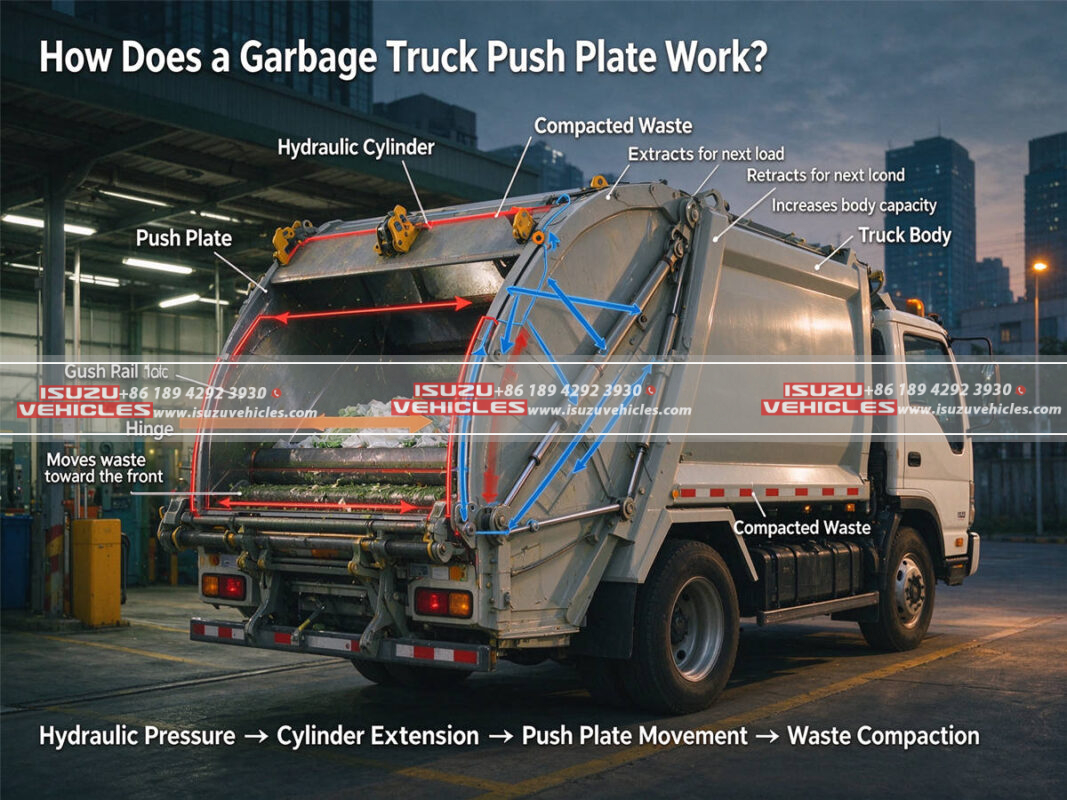
A modern garbage truck does much more than collect refuse and transport it to a disposal facility. Behind its loading hopper and enclosed storage compartment is a carefully engineered mechanical system that receives loose waste, compresses it, and moves it into the available storage space. One of the most important components in this process is the garbage truck push plate, a heavy-duty steel structure that uses hydraulic power to move waste through the loading and compaction system. Although it may appear to be a relatively simple metal panel, its movement, strength, and coordination with other components have a direct influence on collection efficiency, loading capacity, and the overall reliability of the vehicle.
In a typical rear-loading compactor garbage truck, the push plate works together with the loading hopper, scraper, hydraulic cylinders, control valves, and garbage compartment. These components form an integrated system that repeatedly gathers and compresses household refuse during a collection route. Understanding how the push plate works helps fleet operators, sanitation contractors, and municipal buyers evaluate garbage truck designs more effectively, especially when comparing different body capacities and compaction configurations offered by manufacturers such as ISUZU Vehicles.
1. What Is a Garbage Truck Push Plate?
A garbage truck push plate is a reinforced steel component installed inside the garbage body or as part of the rear-loading compaction mechanism, depending on the vehicle’s design. Its primary purpose is to apply controlled mechanical force to collected waste, moving it from one section of the truck to another or pushing it toward the discharge opening when the vehicle is being emptied. In a rear-loading compactor, the term may also be used to describe the packer plate that moves through the loading hopper and pushes refuse into the main storage compartment. Although the exact arrangement varies between models, both functions rely on a strong plate connected to a hydraulic operating system.
The plate is normally manufactured from high-strength steel because it must withstand repeated contact with mixed household refuse, which can include cardboard, plastic packaging, food waste, textiles, containers, and other irregular materials. During daily operation, the plate is exposed to substantial resistance as it moves against accumulated garbage, so its thickness, structural reinforcement, mounting points, and surface design are important considerations in the overall engineering of the truck.
The Difference Between a Push Plate and a Scraper Plate
Although these two components work closely together, they do not necessarily perform the same task. The scraper plate is generally responsible for gathering and controlling refuse inside the loading hopper, helping move loose material into the correct position before or during compression. The push plate or packer plate provides the main pushing movement, transferring the collected waste toward the storage compartment and helping reduce the amount of unused space between individual pieces of refuse.
In some garbage truck designs, the scraper and packer are connected through a coordinated mechanism, while other configurations use separate hydraulic cylinders to control their movements independently. This arrangement allows the manufacturer to adjust the working sequence according to the body structure, hopper dimensions, and intended collection application. The important point is that the plates are not simply moving randomly; they follow a designed operating sequence that helps the truck process waste consistently.
2. How Does the Hydraulic System Move the Push Plate?
The push plate does not normally operate through direct manual force or an independent electric motor. Instead, it is powered by the truck’s hydraulic system, which converts engine power into controlled mechanical movement. When the vehicle is stationary at a collection point, the engine supplies power to the hydraulic pump through a Power Take-Off (PTO). The pump draws hydraulic oil from the reservoir and delivers it under pressure to the control valves, which direct the oil toward the cylinders responsible for operating the compaction mechanism.
When the operator activates the appropriate control, hydraulic oil enters one side of a cylinder, causing its piston rod to extend or retract. Because the cylinder is mechanically connected to the push plate or its supporting linkage, this movement causes the plate to travel along its designed path. The direction and speed of movement depend on the hydraulic circuit, valve configuration, cylinder dimensions, and control settings. When the operating sequence changes, the control valves redirect the oil so that the cylinder can move the plate back to its starting position.
Why Hydraulic Cylinders Are Essential
Hydraulic cylinders are particularly suitable for garbage truck applications because they can generate substantial pushing force within a relatively compact installation. Waste is rarely uniform, and a loading hopper may contain a mixture of light packaging, dense food waste, cardboard, and objects with irregular shapes. A hydraulic mechanism provides the force needed to move this material while allowing the operator to control the movement through the vehicle’s operating system.
The hydraulic system must also be properly matched to the mechanical structure. If the cylinders are undersized, the push plate may struggle when handling heavily loaded or poorly distributed refuse. If the system is designed without sufficient attention to pressure control and structural strength, repeated operation can place unnecessary stress on the plate, mounting brackets, pins, and other components. For this reason, a reliable garbage truck depends on the coordinated design of its hydraulic equipment and mechanical assembly rather than on cylinder force alone.
3. How Does the Push Plate Work During Waste Collection?
During a normal collection route, the push plate operates as part of a repeated loading and compaction cycle. The process begins when garbage is placed into the rear hopper, either manually or through a mechanical bin-lifting device. The refuse accumulates temporarily in the hopper until the operator activates the compaction mechanism. The scraper and packer components then move in a coordinated sequence to gather the material, compress it, and transfer it into the main garbage compartment.
Step 1: Waste Enters the Loading Hopper
The loading hopper is the receiving area at the rear of a rear-loading garbage truck. It is designed to accommodate incoming refuse before the compaction mechanism moves it into the body. Since collected garbage can vary considerably in size, weight, and shape, the hopper provides a controlled space where the material can be gathered before the next working movement begins.
For trucks equipped with automatic or semi-automatic bin lifters, standardized garbage containers can be raised and emptied into the hopper, helping reduce manual handling and improve collection consistency. The hopper must be strong enough to withstand repeated loading operations, while its shape should allow waste to move toward the compaction mechanism without leaving excessive material trapped in difficult-to-reach areas.
Step 2: The Scraper and Push Plate Begin Moving
Once enough refuse has entered the hopper, the hydraulic control system activates the working mechanism. Depending on the truck’s design, the scraper may first gather the waste toward the packer plate, or the components may begin moving through a coordinated sequence. The push plate then advances along its operating path, forcing the material toward the main garbage compartment.
As the plate moves, loose refuse is pressed against the material already inside the body. Flexible packaging collapses, cardboard becomes flatter, and irregular objects are forced closer together, reducing the empty spaces that would otherwise occupy valuable storage volume. The plate must maintain stable movement throughout this process so that waste is transferred effectively without causing unnecessary mechanical impact.
Step 3: Waste Is Compressed and Transferred Into the Body
As the push plate continues its movement, the refuse is progressively compressed and transferred into the main compartment. The scraper and other guiding components help manage the material inside the hopper, while the hydraulic cylinders provide the force required to complete the working cycle. After the waste has been moved into the body, the mechanism returns to its initial position, allowing the hopper to receive another load.
This cycle is repeated throughout the collection route. Rather than storing every bag and container in its original loose condition, the garbage truck gradually reduces the volume occupied by the collected material. The actual compression performance depends on the type of waste, moisture content, body design, hydraulic pressure, and operating method, so a stated compression ratio should always be understood as a design or test figure rather than a guaranteed result for every collection route.
4. How Does the Push Plate Help Empty a Garbage Truck?
In addition to supporting waste loading and compaction, a push plate can also play an important role in unloading, depending on the truck’s body design. After the vehicle reaches a transfer station, landfill, or designated disposal facility, the operator prepares the garbage body for discharge. On many rear-loading compactor trucks, the rear tailgate is opened or raised through a hydraulic mechanism, creating an exit for the collected refuse. A separate ejection plate or discharge push plate then moves along the inside of the garbage compartment to force the compacted material outward.
During transportation, the ejection plate remains in its designated position and provides a moving boundary for the stored waste. When unloading begins, hydraulic cylinders drive the plate toward the rear of the body, gradually pushing the accumulated refuse through the discharge opening. The plate helps prevent compacted material from remaining deep inside the compartment, reducing the need for manual intervention and making the unloading process more controlled.
It is important to distinguish this discharge function from the rear hopper’s packer plate. The packer plate primarily handles incoming waste and supports compaction, whereas the ejection plate moves stored refuse out of the body. Some truck designs use different names for these components, and their structures can vary according to the manufacturer’s engineering arrangement. When purchasing a garbage truck, buyers should therefore check the actual working diagram and equipment configuration rather than assuming that every component described as a push plate performs exactly the same function.
5. What Makes a Garbage Truck Push Plate Effective?
A reliable push plate requires more than a thick steel panel and a powerful hydraulic cylinder. Its performance depends on several interconnected engineering factors, including material quality, structural design, guiding arrangements, hydraulic control, sealing, and maintenance accessibility. These details become especially important for municipal fleets that operate garbage trucks for many hours each day and repeat the loading cycle hundreds of times during demanding collection schedules.
High-Strength Steel Construction
The push plate must resist bending, abrasion, and repeated mechanical loading. High-strength steel is commonly used because it provides a practical balance between structural strength and weight. Reinforced edges, carefully designed mounting points, and suitable welding quality help distribute working loads across the plate instead of concentrating stress at a small number of connection points. The appropriate steel thickness depends on the vehicle’s size, body configuration, and intended operating conditions.
Stable Movement and Proper Alignment
The plate should travel smoothly along its designed path without excessive vibration, twisting, or uneven contact with surrounding structures. Guide rails, sliding surfaces, pivot points, and connecting brackets all contribute to stable operation. If the plate becomes misaligned, it may create additional friction, increase hydraulic resistance, or leave refuse trapped in parts of the hopper. Regular inspection of these mechanical connections helps maintain consistent movement and reduces the risk of premature wear.
Reliable Hydraulic Components and Sealing
Hydraulic hoses, cylinders, control valves, seals, and oil connections must be suitable for repeated operation under working pressure. Leakage can reduce system performance, contaminate the working area, and eventually prevent the plate from completing its movement. The hydraulic reservoir also needs to maintain an appropriate oil level and cleanliness because contaminated hydraulic oil can accelerate wear inside pumps, valves, and cylinders.
For garbage trucks that handle wet household refuse, the overall body design should also include suitable drainage and liquid collection arrangements. Wastewater can accumulate during compaction, and a properly designed sewage collection system helps prevent uncontrolled leakage during loading and transportation. These details are important because an effective garbage truck must manage both solid waste and the liquid that may be released from it.
6. Common Push Plate Problems and Maintenance Tips
Because the push plate operates repeatedly under load, regular inspection is essential for keeping the garbage truck in good working condition. Many problems develop gradually, and early detection can prevent a minor issue from causing a longer period of vehicle downtime. Operators should pay attention to unusual noises, slow plate movement, visible hydraulic leakage, uneven compression, and waste that remains trapped inside the hopper after a working cycle.
Slow or Incomplete Plate Movement
If the push plate moves more slowly than usual or cannot complete its normal stroke, the cause may involve insufficient hydraulic oil, a restricted filter, a damaged hose, a malfunctioning control valve, internal cylinder leakage, or an issue with the hydraulic pump. The system should be inspected according to the manufacturer’s maintenance procedure, and pressure testing should be performed by qualified technicians when necessary. Operators should not attempt to compensate for poor movement by repeatedly forcing the controls or increasing system pressure beyond the specified operating range.
Unusual Noise, Vibration, or Misalignment
Metallic knocking, scraping, or irregular vibration may indicate loose mounting hardware, worn pins and bushings, damaged guide components, or debris interfering with the plate’s movement. The plate and its surrounding structure should be inspected for deformation, cracks, excessive wear, and uneven contact. Any damaged structural component should be repaired or replaced using an appropriate procedure before the vehicle returns to regular operation.
Daily Cleaning and Preventive Inspection
Garbage residue can accumulate around the hopper, guide surfaces, seals, and moving connections, particularly when the truck handles wet or sticky refuse. Cleaning these areas at suitable intervals helps prevent material buildup from interfering with the mechanism. Operators should also check hydraulic hoses and cylinder connections for leakage, inspect visible fasteners, and follow the recommended lubrication schedule for moving joints and guide components.
Before anyone works beneath or around a raised tailgate, moving plate, or other hydraulically operated structure, the vehicle must be secured using the manufacturer’s approved safety procedure. Hydraulic systems can retain dangerous stored energy even after the engine has been switched off, so maintenance should only be carried out by trained personnel who understand the correct isolation and support requirements.
7. Choosing the Right Garbage Truck for Your Collection Requirements
The push plate is only one part of a complete garbage collection vehicle, and buyers should evaluate it together with the chassis, body capacity, hopper design, hydraulic system, discharge arrangement, and intended operating environment. A compact garbage truck designed for narrow residential streets may require a different compaction arrangement from a large-capacity vehicle used for municipal transfer operations. The right choice depends on daily waste volume, collection distance, road conditions, container standards, available maintenance resources, and the disposal facilities used by the operator.
For example, the ISUZU 8 CBM Compactor Garbage Truck provides a reference for buyers looking at a rear-loading vehicle with an integrated hopper, hydraulic compaction components, and a dedicated waste storage body. For operations requiring a larger storage compartment, the ISUZU 12 CBM Rear Compactor Garbage Truck illustrates how a larger body can combine a loading hopper, push plate, hydraulic system, and sewage collection equipment in one municipal sanitation vehicle.
Buyers can also review the wider ISUZU garbage truck range to compare different capacities and collection configurations. When evaluating a quotation, it is useful to request information about push plate material, cylinder specifications, hydraulic working pressure, compaction cycle, body construction, and the method used to discharge refuse. These details provide a clearer understanding of the vehicle’s actual working capability than body volume alone.
A complete municipal sanitation fleet may also include vehicles that handle different types of cleaning work. A sweeper truck is designed to collect road dust, leaves, sand, and surface debris, while a vacuum truck is used for liquid waste, sludge, and sewer-cleaning applications. These vehicles perform different functions from a garbage compactor, but when deployed together they help municipalities manage solid waste, road cleanliness, and drainage maintenance more systematically.
As a supplier of commercial sanitation vehicles, ISUZU Vehicles provides different garbage truck configurations for municipal authorities, waste management contractors, industrial facilities, and other professional operators. By considering the push plate structure alongside the hydraulic system, body capacity, and local working conditions, buyers can select a vehicle that is better suited to their collection routes and long-term operating requirements.
8. Why the Push Plate Matters in Daily Waste Management
The garbage truck push plate is a fundamental part of the vehicle’s waste-handling system because it transforms the collection body from a passive storage container into an active loading, compression, and discharge mechanism. Through controlled hydraulic movement, it helps transfer refuse from the hopper into the main compartment, reduces the space occupied by loose materials, and, when configured as an ejection plate, supports the unloading of compacted waste at the disposal site. Its performance directly affects how smoothly the truck can complete repeated collection cycles and how effectively the available body volume is used.
For fleet operators, understanding this mechanism is useful not only when selecting a new vehicle but also when planning maintenance, diagnosing operating problems, and training drivers and sanitation crews. A well-designed push plate must work in harmony with the scraper, hydraulic cylinders, control valves, guide structures, and garbage body, while regular inspection helps protect these components from avoidable wear. When the entire system is properly matched to the vehicle’s intended application, a garbage truck can provide dependable service across demanding municipal collection routes and contribute to a cleaner, more organized waste management operation.