
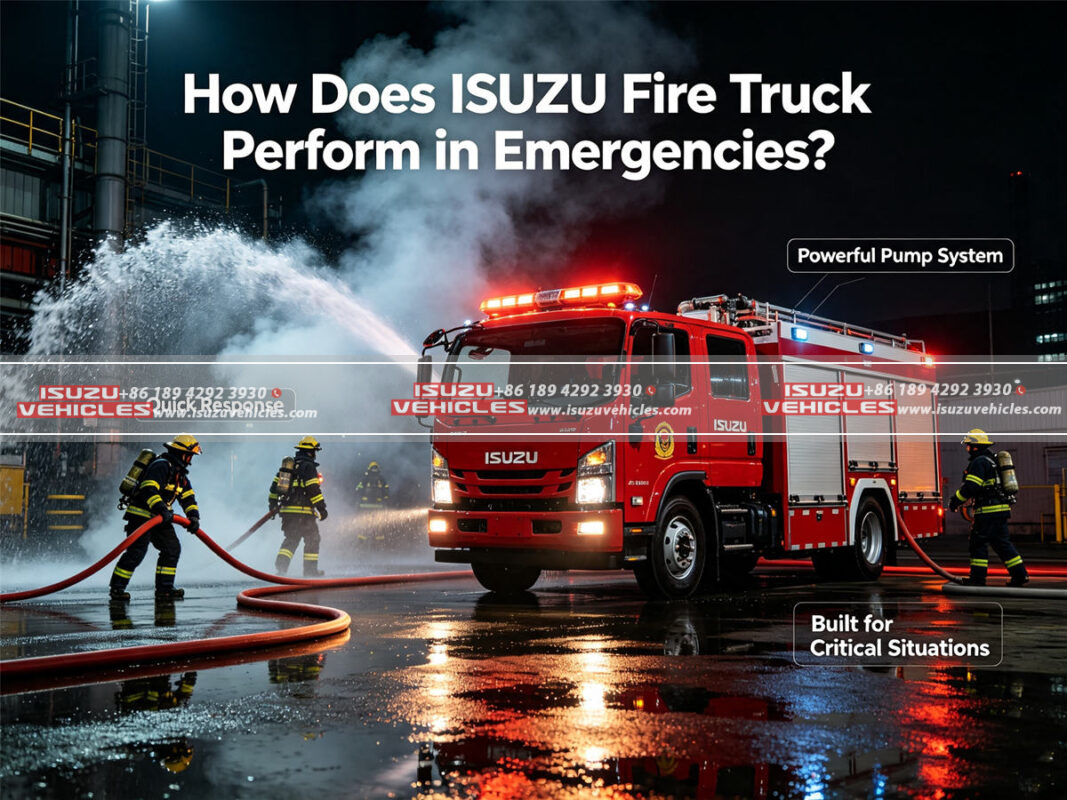
When a fire alarm sounds, every second becomes critical. Firefighters rely not only on their training and experience but also on the performance of their vehicles to reach the scene quickly, operate efficiently, and support rescue efforts without interruption. A fire truck that experiences delays, mechanical failures, or unstable performance can significantly affect emergency response and place lives, property, and critical infrastructure at greater risk.
Over the years, ISUZU fire trucks have earned the trust of fire departments, industrial enterprises, municipal authorities, airports, and emergency rescue organizations in many countries. Their reputation is built on dependable chassis engineering, durable diesel engines, practical vehicle design, and the ability to integrate advanced firefighting equipment for a wide variety of emergency situations. Whether responding to an urban building fire, a hazardous chemical accident, or a remote wildfire, an ISUZU fire truck is designed to provide consistent performance when reliability matters most.
So, how does an ISUZU fire truck actually perform during real emergency operations? The answer lies in its balanced combination of mobility, firefighting capability, operational efficiency, and long-term durability.
Rapid Response Begins with Reliable Mobility
Reaching the emergency scene quickly is the first and perhaps most important responsibility of any fire truck. Even the most advanced firefighting equipment becomes ineffective if the vehicle cannot arrive promptly or safely.
Powerful Engine Performance for Immediate Response
One of the defining characteristics of ISUZU fire trucks is their dependable diesel engine technology. ISUZU has spent decades refining commercial diesel engines that deliver strong low-speed torque, smooth acceleration, and excellent fuel efficiency.
Unlike ordinary transportation vehicles, fire trucks often remain parked for extended periods before suddenly being required to operate at full capacity within seconds. ISUZU engines are engineered for this demanding operating cycle, providing rapid engine response and stable performance without excessive mechanical stress.
Whether accelerating through city traffic, climbing steep roads, or transporting a fully loaded vehicle carrying water, foam, rescue tools, and firefighting equipment, the engine provides the consistent power firefighters depend on during emergencies.
Excellent Road Stability
Emergency driving requires more than speed. Fire trucks must remain stable while carrying thousands of liters of water and heavy rescue equipment.
ISUZU chassis feature reinforced frames, carefully balanced suspension systems, and optimized weight distribution that improve handling during cornering, emergency braking, and uneven road conditions. This stability allows drivers to maintain better vehicle control while reducing fatigue during extended emergency operations.
Efficient Fire Suppression Capabilities at the Scene
Arriving quickly is only the beginning. Once firefighters reach the incident, the vehicle must immediately support suppression and rescue activities without unnecessary delays.
High-Capacity Water and Foam Delivery
Most ISUZU fire trucks are equipped with professionally integrated water pumps capable of delivering stable pressure and continuous water flow throughout prolonged firefighting operations.
Depending on the vehicle configuration, firefighters can obtain water from:
- Onboard water tanks
- Municipal hydrants
- Rivers and lakes
- Portable water reservoirs
- Relay pumping systems
Foam-equipped models provide additional flexibility for handling petroleum fires, chemical storage facilities, airports, fuel depots, and industrial environments where conventional water alone may not provide sufficient extinguishing performance.
The combination of efficient pump systems and carefully designed piping layouts ensures consistent water delivery, enabling firefighters to concentrate on controlling the incident rather than dealing with equipment interruptions.
Practical Equipment Layout
An emergency scene is often chaotic, making equipment accessibility extremely important.
Professional ISUZU fire truck manufacturers arrange hose reels, ladders, rescue tools, breathing apparatus, hydraulic rescue equipment, lighting systems, and storage compartments according to operational workflow. This organized layout reduces the time required to retrieve equipment and helps firefighters begin rescue operations immediately after arriving at the scene.
Reliable Performance Across Different Emergency Scenarios
One reason ISUZU fire trucks are widely used around the world is their versatility. Emergency situations vary greatly depending on location, climate, and industry, requiring vehicles capable of adapting to diverse operating conditions.
Urban Firefighting
In cities, fire trucks must navigate narrow streets, heavy traffic, residential neighborhoods, and commercial districts while carrying substantial payloads.
ISUZU fire trucks offer compact turning radii on light-duty chassis and greater carrying capacity on medium-duty and heavy-duty models, allowing municipalities to select configurations that match local infrastructure and response requirements.
Industrial and Chemical Emergencies
Factories, warehouses, refineries, and power plants present unique hazards that require specialized firefighting equipment.
ISUZU fire trucks designed for industrial applications often include:
- Foam extinguishing systems
- High-capacity pumps
- Large water and foam tanks
- Additional rescue equipment
- Hazardous material response accessories
These specialized configurations allow emergency teams to respond effectively to complex industrial incidents where conventional municipal fire trucks may not provide sufficient capability.
Rural and Wildland Operations
Fire departments serving rural communities frequently encounter long travel distances, limited water supplies, and rough road conditions.
The dependable drivetrain and durable suspension systems found on ISUZU chassis enable these vehicles to operate confidently on gravel roads, construction areas, agricultural regions, and mountainous terrain. Larger onboard water capacities further enhance operational independence when hydrants are unavailable.
Built for Long-Term Dependability and Low Downtime
Emergency vehicles are valuable only when they are available for service. Unexpected breakdowns or lengthy repair times can reduce fleet readiness and increase operational costs.
Durable Commercial Vehicle Engineering
Unlike platforms developed exclusively for emergency use, ISUZU chassis benefit from decades of continuous improvement across multiple commercial industries, including logistics, construction, municipal services, and heavy transportation.
This extensive real-world experience has resulted in proven mechanical systems that deliver exceptional durability even under demanding operating conditions. Components are designed to withstand repeated heavy loading, continuous engine operation, and varying environmental conditions while maintaining dependable performance over many years.
Convenient Maintenance and Parts Availability
Another advantage of ISUZU fire trucks is the widespread availability of replacement parts and maintenance expertise.
Because ISUZU commercial vehicles are used extensively around the world, many service technicians are already familiar with their mechanical systems. This familiarity simplifies routine maintenance and accelerates repairs when necessary, helping emergency fleets minimize downtime and maximize operational readiness.
For municipalities and private organizations managing multiple emergency vehicles, this translates into lower life-cycle costs and more predictable maintenance planning.
Designed to Grow with Modern Emergency Response Needs
The role of modern fire trucks has expanded significantly beyond traditional firefighting. Today’s emergency vehicles are expected to support rescue operations, disaster relief, hazardous material incidents, flood response, technical rescue, and public safety missions.
ISUZU chassis provide a flexible foundation for integrating advanced technologies such as intelligent control systems, LED emergency lighting, remote pump monitoring, hydraulic rescue tools, aerial platforms, communication equipment, and environmental protection systems.
Manufacturers can also customize vehicles according to local regulations, climate conditions, operational budgets, and specific rescue requirements. This flexibility allows customers to select compact municipal fire engines, industrial foam tenders, airport rescue vehicles, or multifunction emergency trucks while maintaining the dependable performance associated with the ISUZU platform.
As emergency response organizations continue investing in modern equipment, the proven engineering of ISUZU fire trucks remains an important advantage, combining operational reliability with the adaptability needed for future firefighting challenges.
A Trusted Choice for Professional Emergency Fleets
The outstanding emergency performance of ISUZU fire trucks results from the careful integration of reliable commercial chassis, efficient diesel engines, professionally engineered firefighting systems, durable structural components, and practical operational design. Their ability to respond rapidly, maintain stable performance under demanding conditions, support a wide range of firefighting missions, and deliver long-term reliability has made them a preferred choice for municipal fire departments, industrial facilities, airports, and rescue organizations across the globe. For fleet managers seeking dependable specialty vehicles beyond firefighting applications, including bucket truck solutions for utility maintenance, water tank truck models for municipal and industrial operations, and a complete portfolio of ISUZU Vehicles, the ISUZU platform continues to provide the versatility, engineering quality, and operational confidence required in today’s demanding commercial and emergency service industries.