
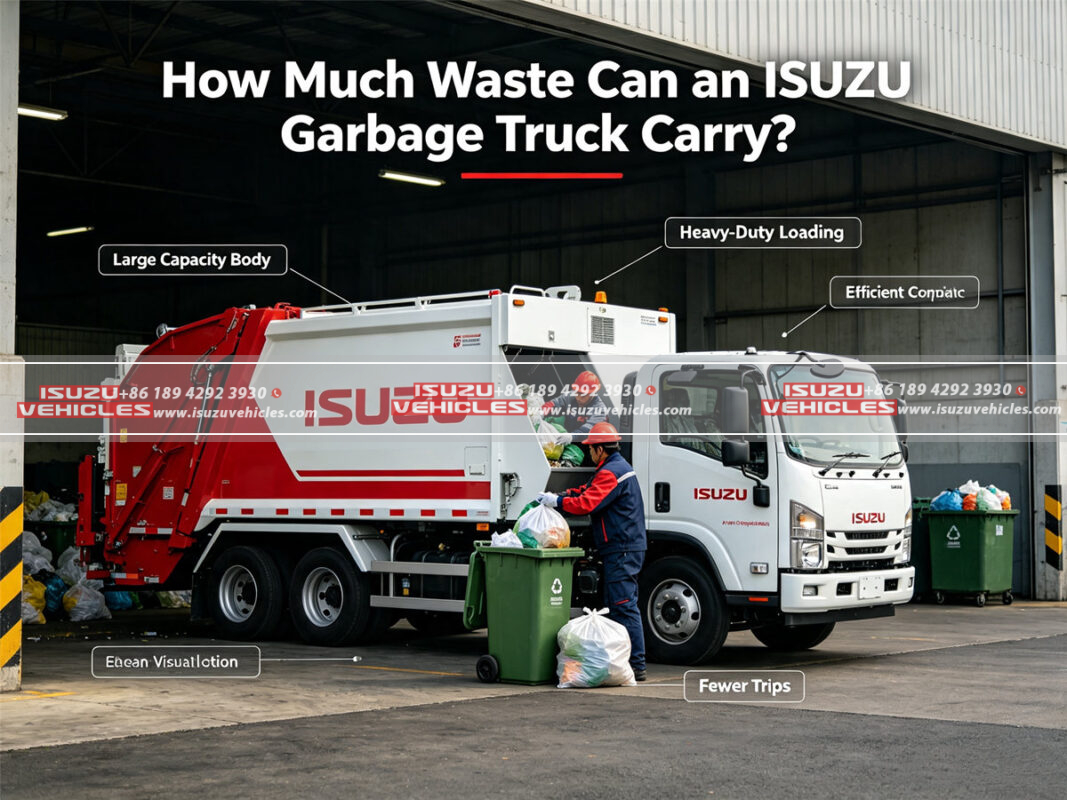
Waste collection is one of the most essential services supporting modern cities, commercial areas, industrial facilities, and residential communities. Every day, thousands of tons of household waste, commercial refuse, and recyclable materials must be collected, transported, and processed efficiently. For waste management companies and municipal sanitation departments, choosing the right collection vehicle directly affects operating costs, route efficiency, and service quality.
One of the most common questions when selecting a refuse collection vehicle is, “How much waste can an ISUZU garbage truck carry?” The answer depends on several factors, including the truck model, body size, compression system, chassis configuration, waste density, and local transportation regulations.
An ISUZU garbage truck is available in various configurations designed for different collection environments, from compact urban streets to large commercial waste routes. Rather than focusing only on maximum capacity, professional operators consider how efficiently the vehicle can collect, compress, transport, and unload waste throughout daily operations.
Understanding the factors that determine waste capacity helps businesses and municipalities choose a garbage truck that delivers the best balance between payload, maneuverability, and long-term operating efficiency.
Different ISUZU Garbage Truck Models Offer Different Capacities
The waste-carrying capacity of an ISUZU garbage truck is mainly determined by the size of the refuse body and the chassis it is built on. Smaller models are designed for narrow streets and residential collection, while larger models are intended for high-volume waste transportation.
Typical ISUZU garbage truck configurations include:
- 3–5 cubic meter models for small communities and urban areas
- 6–10 cubic meter models for standard municipal waste collection
- 12–18 cubic meter models for large residential and commercial routes
- 20 cubic meter or larger models for high-volume operations
The actual payload in tons varies because waste density can change significantly.
For example:
- Household waste containing packaging materials may be relatively light.
- Food waste may have higher density because of moisture content.
- Industrial waste may be heavier depending on the materials collected.
Therefore, a truck’s volume capacity does not always equal its maximum weight capacity.
Matching Truck Size to Collection Routes
Selecting the correct garbage truck size requires analyzing daily collection conditions.
Small-capacity models are often preferred for:
- Narrow urban roads
- Residential neighborhoods
- Tourist areas
- Communities with limited access
Larger models are better suited for:
- Commercial districts
- Industrial zones
- Large apartment complexes
- Long-distance waste transportation
The most efficient truck is usually the one that matches the collection environment rather than simply the largest available option.
How Compression Technology Increases Waste Capacity
One of the biggest advantages of a modern ISUZU garbage truck is its hydraulic compaction system. Without compression, a truck would quickly reach its volume limit because loose waste contains large amounts of air space.
The compaction system reduces the volume of collected waste, allowing the truck to transport significantly more material during each trip.
A typical compression ratio may range from approximately 3:1 to 5:1, depending on the garbage truck design and the type of waste being collected.
For example, if loose waste occupies 15 cubic meters of space, a compaction system with a 4:1 ratio can reduce it to around 3.75 cubic meters inside the refuse body.
Benefits of Higher Compression Efficiency
Effective compaction provides several advantages:
- More waste collected per trip
- Fewer trips to disposal facilities
- Lower fuel consumption
- Reduced labor requirements
- Improved route productivity
For large cities where waste collection vehicles operate every day, these improvements can create significant savings over time.
Factors That Affect the Actual Waste Load
Although manufacturers provide rated capacities, real-world loading conditions determine how much waste a truck can carry during daily operation.
Waste Type and Density
Different materials create different loading results.
Light materials include:
- Cardboard
- Plastic packaging
- Paper waste
- Dry household refuse
Heavier materials include:
- Food waste
- Wet garbage
- Organic materials
- Industrial refuse
A garbage truck collecting restaurant waste may reach its weight limit before filling the entire body, while a truck collecting dry household waste may reach volume capacity first.
Compression System Performance
The effectiveness of the hydraulic compaction system directly affects usable capacity.
Important factors include:
- Hydraulic pressure
- Packing blade design
- Body structure
- Loading method
- Operator experience
A well-maintained compression system ensures that waste is packed efficiently without placing excessive stress on the equipment.
Local Weight Regulations
Every country and region has regulations regarding vehicle weight limits.
The maximum legal payload depends on:
- Axle configuration
- Road restrictions
- Vehicle classification
- Safety requirements
Even if the refuse body has additional space, operators must remain within legal weight limits.
Durable Design for Heavy-Duty Waste Collection
Waste collection is a demanding application because garbage trucks operate continuously, frequently stopping and starting, carrying heavy loads, and working in challenging environments.
The ISUZU garbage truck is designed around a reliable commercial chassis capable of supporting repeated collection cycles.
Strong Chassis and Engine Performance
A durable chassis provides the foundation needed for carrying compressed waste loads safely.
Important advantages include:
- High structural strength
- Stable load distribution
- Reliable suspension performance
- Efficient diesel power
The engine must provide enough torque to move fully loaded vehicles through urban traffic, inclines, and frequent collection routes.
Practical Maintenance Design
Waste collection vehicles must remain operational because service interruptions directly affect communities.
Easy maintenance access and reliable mechanical components help operators reduce downtime.
Regular inspection of:
- Hydraulic systems
- Compression plates
- Sealing systems
- Waste body components
ensures consistent performance and extends vehicle service life.
Choosing the Right Waste Capacity for Your Operation
The best ISUZU garbage truck is not necessarily the one with the largest body. The right choice depends on route conditions, waste volume, disposal distance, and operational goals.
A city department serving dense residential areas may benefit from a medium-sized compactor truck that can maneuver through crowded streets while carrying enough waste for efficient routes. A private waste management company handling commercial clients may require a larger-capacity model to reduce transportation frequency.
Other considerations include:
- Available maintenance facilities
- Driver experience
- Fuel costs
- Collection frequency
- Future expansion plans
A properly selected garbage truck improves productivity because it allows operators to collect more waste with fewer interruptions while maintaining safe and efficient operation.
As urban populations continue to grow, waste management systems require vehicles that can handle increasing volumes without significantly increasing operational costs. Efficient collection equipment has become an important part of creating cleaner and more sustainable cities.
A Reliable Solution for Modern Waste Collection
The ISUZU garbage truck offers flexible waste-carrying capacity through different body sizes, chassis options, and advanced compression systems. Depending on the configuration, these vehicles can handle everything from small community collection routes to large-scale municipal waste operations.
More importantly, capacity is not only about the number of cubic meters a truck can hold. Efficient waste transportation depends on compression performance, vehicle reliability, operating environment, and the ability to complete more collection work with fewer trips.
With durable chassis construction, efficient hydraulic systems, and practical designs for daily sanitation work, ISUZU garbage trucks provide a dependable solution for municipalities, contractors, and waste management companies worldwide.
For organizations building complete environmental service fleets, an ISUZU garbage truck can operate alongside a vacuum truck for sewage and drainage cleaning and a sweeper truck for road maintenance and urban cleanliness. Together with dependable ISUZU Vehicles, these specialized solutions provide the efficiency, durability, and versatility required to support modern waste management, environmental protection, and municipal service operations.