
How Does an ISUZU Tanker Truck Prevent Leakage?
An ISUZU tanker truck is designed to transport large quantities of water, fuel, oil, chemicals, or other liquid materials while keeping the contents safely contained throughout loading, transportation, and discharge, and preventing leakage is therefore not a single-feature function but the result of coordinated tank construction, sealing, piping, welding, valve design, structural reinforcement, and regular inspection. Unlike a conventional cargo truck carrying solid goods, a tanker has to deal with liquid movement, pressure changes, vibration, road impacts, temperature variation, and repeated loading and unloading cycles, all of which can gradually place stress on the tank and its connections. The tanker truck range from ISUZU Vehicles includes water tankers, fuel tankers, aircraft refueling trucks, bulk-feed vehicles, and other liquid or bulk-material transportation configurations, so the exact tank structure and sealing system are selected according to the material being transported and the operating environment.
Leak prevention begins with the tank itself, but it continues through every component that allows liquid to enter, remain inside, or leave the vehicle. A properly engineered tanker therefore needs a strong tank shell, carefully manufactured seams, reliable manholes, secure covers, properly sealed outlets, durable pipelines, and valves that remain closed when the system is traveling. The chassis and tank mounting system also matter because excessive movement between the tank and chassis can eventually place unnecessary stress on connections. In practical operation, preventing leakage means keeping all these systems working together rather than relying on one particular component.
The Tank Body Is the First Line of Protection
The tank body is the most obvious part of a tanker truck, and it is also the first barrier between the transported liquid and the outside environment. Depending on the application, tank bodies may be manufactured from different grades and thicknesses of steel or stainless steel, with the material selected according to the liquid’s chemical properties, required durability, corrosion resistance, hygiene requirements, and operating conditions.
Strong Tank Construction
A properly designed tank needs sufficient structural strength to withstand the combination of liquid weight, road vibration, braking forces, acceleration, cornering, and pressure variations that occur during everyday operation. A water tanker and a fuel tanker may carry liquids with very different characteristics, but both require a tank structure capable of maintaining its shape and integrity throughout repeated service cycles. Current ISUZU tanker offerings include configurations such as 10 CBM water tankers, 16 CBM fuel tankers, 20,000-liter aircraft refuelers, and stainless-steel water sprinkler tankers, illustrating how tank construction can vary considerably according to the intended application.
Proper Welding and Seam Quality
The joints between tank sections are especially important because a large tank is normally assembled from multiple formed panels rather than manufactured as one seamless piece. Welding must therefore create strong, continuous joints without leaving weak points, cracks, pinholes, or other defects that could eventually become leakage paths. The quality of welding becomes even more important when the tank is exposed to constant vibration, because repeated movement can turn a small defect into a much larger problem over time.
For this reason, tank manufacturing should include appropriate inspection of welds and critical connection areas, particularly around the tank bottom, manholes, outlets, baffles, and other locations where mechanical stress can be concentrated. A tank that looks perfectly intact from the outside can still require careful inspection of its seams and fittings before being placed into demanding service.
How Seals, Manholes, and Valves Stop Liquid Escaping
Even when the main tank shell is strong and correctly welded, leakage can still occur through openings and connections, which is why tanker trucks rely on a network of seals, gaskets, covers, valves, and pipe connections to keep the liquid contained. These components may be smaller than the tank itself, but they are among the most important areas to inspect because they are repeatedly opened, closed, connected, disconnected, and exposed to vibration.
Manhole Covers and Gaskets
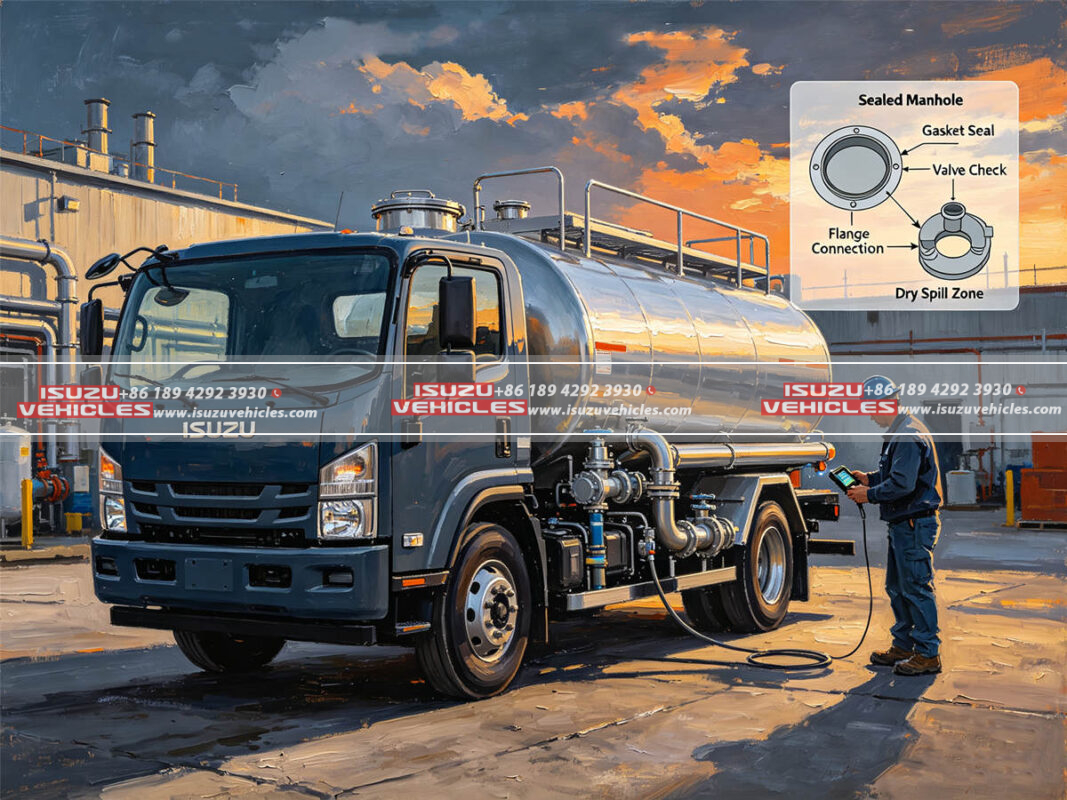
A tanker normally requires access openings for inspection, cleaning, maintenance, and filling, and these openings must be securely closed during transportation. The manhole cover typically uses a gasket or sealing element to create a tight interface between the cover and the tank opening. If the gasket becomes worn, hardened, cracked, contaminated, or incorrectly installed, liquid may escape even though the tank itself remains structurally sound.
Operators should therefore inspect the sealing surface and gasket condition rather than simply checking whether the cover appears closed. A properly tightened cover with a damaged gasket does not necessarily provide a reliable seal, while dirt or foreign material trapped between the sealing surfaces can also create a small leakage path.
Valves and Discharge Connections
The discharge system is another critical area because the tank must eventually release its contents through a controlled outlet. A tanker can use manually operated or specialized valves depending on the application, and these valves need to close securely when the vehicle is moving. The surrounding pipe connections, flanges, threaded joints, and flexible sections must also remain properly sealed because a leak at a connection can be just as significant as a leak through the tank shell.
This becomes particularly important with fuel or other hazardous liquids, where even a small leak can create environmental, fire, or occupational safety concerns. A water tanker may have different risk characteristics, but preventing leakage remains essential because uncontrolled discharge can waste the transported liquid, damage roads, or create slippery surfaces.
How Internal Baffles Help Reduce Leakage Risk
One of the less visible but important features inside many tanker bodies is the baffle system. Baffles divide the tank into sections or partially restrict the movement of liquid, reducing the amount of uncontrolled fluid movement that can occur when the vehicle accelerates, brakes, or turns. Although baffles do not function as seals in the conventional sense, they contribute to leak prevention indirectly by reducing the dynamic forces that the tank structure and its fittings experience during transportation.
Imagine a partially filled tanker traveling around a corner: the liquid does not remain perfectly stationary, but moves toward one side of the tank as the truck changes direction. During braking, the liquid can also surge toward the front, while acceleration can produce movement toward the rear. This phenomenon, commonly referred to as liquid surge or sloshing, can influence vehicle stability and place additional forces on the tank structure.
Baffles help divide the liquid mass and reduce the scale of these movements, which can make the vehicle easier to control while also reducing repeated loading on the tank shell, internal components, outlets, and mounting points. The design and arrangement of baffles depend on the tank’s intended application, capacity, geometry, and applicable engineering requirements, so they should be treated as part of the overall tanker design rather than as an optional accessory.
How the Tank Is Mounted to the Truck Chassis
Preventing leakage is not only about the tank body because the relationship between the tank and chassis also has a direct influence on long-term durability. A tanker carries a considerable amount of weight, and the liquid inside continuously interacts with the vehicle as the truck travels over uneven roads, climbs slopes, brakes, accelerates, and turns. If the tank is poorly supported or excessive movement is allowed between the tank and chassis, repeated mechanical stress can eventually affect welds, mounting brackets, pipes, valves, and other connections.
A suitable tank mounting system distributes the tank’s weight and operational forces across the chassis in a controlled manner while allowing the complete vehicle structure to handle normal road movement. Reinforcement and mounting components need to be selected according to the tank’s size, liquid density, chassis configuration, and expected working conditions. Heavy-duty ISUZU chassis platforms are available for specialized applications where substantial tank capacity and payload are required, including GIGA-based configurations for demanding transport work.
This is also why a tanker should not be treated simply as a standard truck with a large container attached to its frame. The chassis, tank, suspension, axle configuration, mounting system, piping, and operating equipment need to be considered as one complete vehicle system. A well-matched configuration reduces unnecessary structural stress and supports more reliable long-term operation.
How Different Liquids Require Different Leakage-Prevention Designs
Not all tanker trucks transport the same type of liquid, and this is one of the most important points when discussing leakage prevention. Water, diesel, gasoline, chemicals, food-grade liquids, and aviation fuel have different physical and chemical properties, so the tank material, seals, valves, hoses, internal coatings, and safety equipment may need to be selected differently.
Water Tankers
Water tankers are widely used for municipal water supply, agricultural irrigation, construction-site dust suppression, road cleaning, and emergency water delivery. Their primary concerns include structural durability, corrosion resistance, reliable outlets, and cleanable internal surfaces where water quality is important. A well-maintained water tanker should prevent leakage not only during transportation but also during filling and discharge operations.
Fuel and Oil Tankers
Fuel and oil transport requires greater attention to sealing, static electricity, vapor management, valves, hoses, and fire safety because many petroleum products are flammable. The tank must be appropriate for the specific fuel being transported, and the loading and unloading system needs to minimize accidental release. ISUZU’s current tanker range includes fuel tank trucks and aircraft refueling vehicles designed for specialized fuel transportation applications, showing why tanker design needs to be matched closely to the transported product.
Specialized Liquid Transport
Some tank vehicles are designed for materials that require specialized internal construction or handling systems, while others are configured for bulk feed or industrial materials rather than ordinary water transportation. In these applications, material compatibility becomes especially important because a seal or lining that works well with one substance may not perform the same way when exposed to another. Vehicle buyers should therefore specify the exact liquid, concentration, temperature range, density, and operating environment before selecting the tank structure and accessories.
Inspection and Maintenance Are Essential for Leak Prevention
Even a well-designed tanker can eventually develop leakage problems if it is not inspected and maintained properly, because seals wear out, valves accumulate deposits, pipes experience vibration, welds can be stressed, and corrosion can gradually weaken exposed surfaces. Regular inspection therefore plays an important role in keeping the tanker’s original sealing performance throughout its service life.
Before operation, drivers and maintenance personnel should visually inspect the tank body, manholes, valves, outlets, hoses, pipe connections, and mounting points, paying particular attention to unusual stains, wet areas, fuel odor where applicable, corrosion, loose fasteners, damaged gaskets, or unexpected changes in valve operation. Any sign of leakage should be investigated rather than ignored simply because the amount appears small.
Periodic maintenance should also include inspection of sealing components and replacement of worn parts according to the manufacturer’s maintenance recommendations and the requirements applicable to the transported liquid. Cleaning is important as well because accumulated residue can hide corrosion or damage around fittings and sealing surfaces. For fuel or hazardous-liquid tankers, inspection and maintenance should follow the applicable local regulations and safety procedures rather than relying solely on general truck maintenance practices.
Why Leakage Prevention Matters in Real-World Tanker Operations
A reliable tanker truck protects more than the liquid inside its tank; it also protects the road environment, nearby workers, other road users, the vehicle itself, and the business depending on the delivery. A water leak may reduce the amount of usable water reaching a remote work site, while a fuel leak can introduce much more serious fire, environmental, and operational risks. For this reason, leakage prevention should be considered from the moment a tanker is specified and manufactured rather than treated as a maintenance issue only after a problem appears.
The most effective approach combines a properly engineered tank shell, quality welding, dependable gaskets and seals, secure manholes, reliable valves, correctly designed piping, suitable baffles, appropriate chassis mounting, and regular inspection. When these elements are supported by careful loading and unloading procedures, operators can significantly reduce the possibility of unwanted liquid release during daily transportation.
Tanker trucks also form part of a much broader family of specialized vehicles used for municipal services, emergency response, infrastructure maintenance, and industrial operations. For example, an fire truck may carry substantial quantities of water or foam for emergency suppression, while an aerial truck is designed for elevated utility and maintenance work rather than liquid transportation. In the end, effective tanker performance depends on matching the tank structure and sealing system to the specific liquid and working environment, and ISUZU Vehicles offers a range of specialized truck configurations that can be adapted to different transportation and service requirements.