
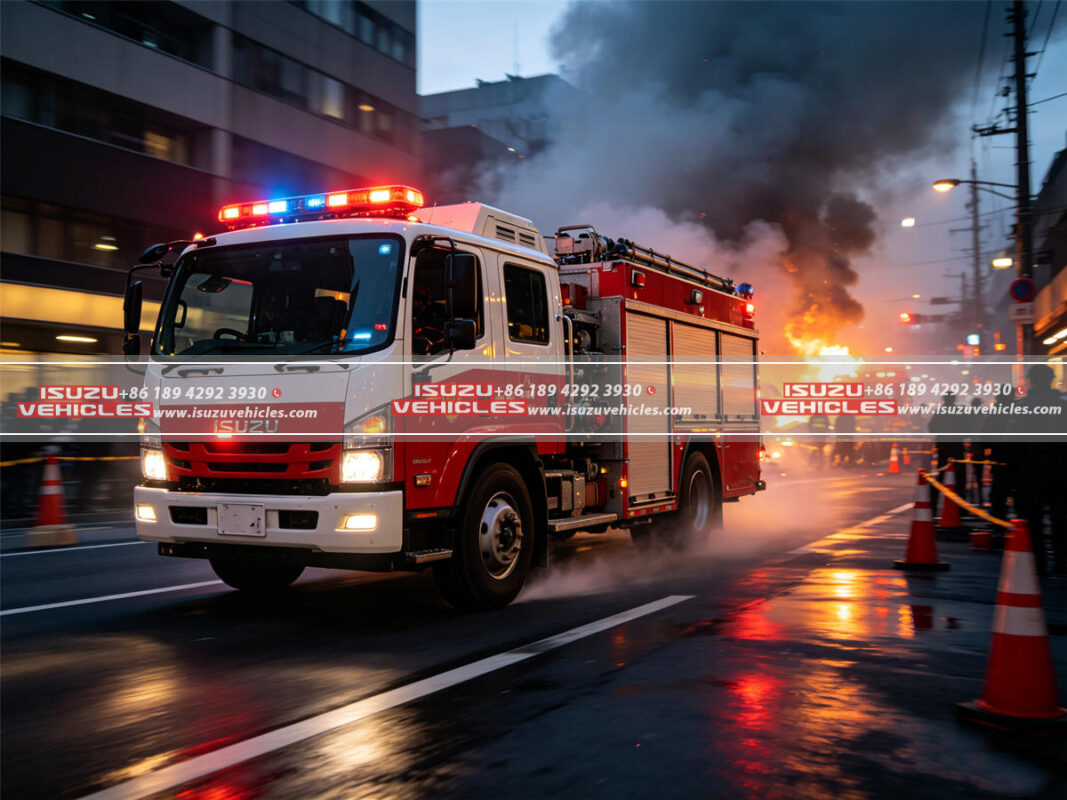
When a fire breaks out, every second between receiving the emergency call and arriving at the scene can influence the scale of damage, the safety of people inside the building, and the amount of time firefighters have to establish an effective suppression operation. This is why the response speed of a fire truck is much more than a simple specification such as maximum road speed. An ISUZU fire truck must combine dependable engine performance, suitable chassis design, responsive handling, sufficient braking capability, stable firefighting equipment, and practical maneuverability so that firefighters can travel quickly without compromising control or operational readiness.
So, how fast can an ISUZU fire truck actually reach an emergency scene? The answer depends on the specific chassis, vehicle weight, road conditions, traffic, distance, weather, and the type of firefighting equipment installed. Current ISUZU fire truck models show that maximum road speeds can reach approximately 95 km/h on certain configurations, while the real emergency response time depends heavily on the route and the conditions encountered along the way. For example, the current ISUZU 8 CBM Water Foam Fire Truck is listed with a maximum driving speed of 95 km/h and is designed for urban districts, industrial facilities, airports, logistics parks, petrochemical plants, and other demanding emergency applications.
What Determines the Response Speed of an ISUZU Fire Truck?
The speed at which a fire truck reaches an emergency scene is determined by a combination of vehicle engineering and operating conditions rather than by engine horsepower alone. A powerful engine certainly provides the acceleration and climbing ability required for emergency driving, but the complete vehicle must also remain stable while carrying water, foam, pumps, hoses, ladders, rescue tools, protective equipment, and a firefighting crew.
An ISUZU fire truck is therefore designed as a specialized emergency vehicle rather than simply a conventional truck with a water tank mounted on the chassis. The chassis, suspension, braking system, transmission, steering system, tires, body structure, and firefighting equipment all need to work together so the vehicle can move efficiently between the fire station and the emergency location.
Engine Power and Chassis Configuration
Engine output is particularly important when the truck must accelerate from a stationary position, merge into traffic, climb an incline, or maintain speed while carrying a large firefighting load. A heavier fire truck with a large water tank naturally requires more power to accelerate than a compact fire engine, which is one reason different ISUZU models are built around different chassis classes.
For example, current ISUZU fire truck offerings include compact water fire trucks as well as larger 6×4 heavy-duty rescue and firefighting vehicles, allowing emergency organizations to choose a platform according to the size of the water load, equipment requirements, terrain, and expected operating environment.
How Fast Can an ISUZU Fire Truck Travel on the Road?
Maximum driving speed varies according to the specific model, chassis, payload, engine, transmission, and local configuration, so there is no single speed that applies to every ISUZU fire truck. Some compact and medium-duty configurations are designed for relatively agile urban response, while larger fire engines prioritize payload capacity, equipment carrying ability, water volume, and stability.
The current ISUZU 8 CBM Water Foam Fire Truck, for instance, is listed with a maximum driving speed of 95 km/h. It carries a 6,000 kg water tank and a 2,000 kg foam tank and uses a 380 HP engine, making it a good example of how an emergency vehicle can combine substantial firefighting capacity with highway-capable road performance.
Maximum Speed Is Not the Same as Response Time
It is important to understand that a truck capable of reaching 95 km/h does not mean that firefighters will always arrive at a scene at 95 km/h. Emergency response normally involves urban roads, intersections, congestion, narrow streets, traffic signals, pedestrians, parked vehicles, road construction, weather conditions, and other factors that can significantly reduce average travel speed.
For this reason, a more useful way to evaluate an emergency vehicle is to consider how effectively it can accelerate, maneuver, brake, and maintain stable control under realistic road conditions. A fire truck that can respond predictably and safely through complicated urban traffic may be more valuable to a fire department than a vehicle with a higher theoretical top speed but poorer maneuverability.
Why Acceleration and Maneuverability Matter in Urban Emergencies
Many fire emergencies occur in densely populated areas where the distance from the fire station to the incident may be relatively short, but the route itself can be complicated. A truck may need to make several turns, negotiate narrow streets, pass through intersections, or position itself around other emergency vehicles before reaching the optimal firefighting location.
This is where the chassis characteristics of an ISUZU fire truck become particularly important. A vehicle with predictable steering, appropriate wheelbase, responsive acceleration, and effective braking can reduce unnecessary delays during the journey and make it easier for the driver to maintain control while responding under pressure.
Compact Fire Trucks for Dense Urban Areas
Compact fire trucks can be especially useful in residential districts, older city centers, industrial compounds, and other locations where road width and turning space are limited. The current ISUZU 3,000 L Water Tank Fire Truck, for example, is positioned as a compact firefighting vehicle for initial fire suppression, municipal fire protection, industrial facilities, warehouses, and residential areas. Its relatively compact configuration can be advantageous where maneuverability is more important than carrying an extremely large volume of water.
In these environments, response efficiency is not simply about traveling fast on an open road; it is about getting through the final part of the journey without becoming restricted by road width, parked cars, tight intersections, or difficult access points.
How Water Capacity Affects Fire Truck Response Performance
Water capacity is another factor that influences the overall performance of an emergency vehicle. A larger water tank allows firefighters to begin suppression immediately after arriving without depending entirely on an external hydrant or another water source, but the additional water also increases the vehicle’s total operating weight.
This creates a practical balance between firefighting capacity and mobility. A compact truck with a smaller tank may be easier to maneuver through narrow streets, while a large water-and-foam fire truck can provide greater initial firefighting capability but requires a heavier-duty chassis and more careful handling.
Why Tank Capacity Should Match the Mission
Choosing the largest possible tank is not necessarily the best solution for every fire department. If a vehicle is primarily assigned to dense urban areas with extensive hydrant networks, a smaller and more maneuverable fire truck may provide an excellent balance between rapid arrival and initial suppression capability. In contrast, industrial facilities, airports, remote areas, warehouses, and large commercial sites may benefit from larger water and foam capacities because the truck may need to operate for a longer period before a stable external water supply is established.
The current ISUZU fire truck range reflects this difference, with models ranging from 3,000 L water fire trucks to 6,000 L water and 2,000 L foam configurations, as well as much larger water and foam vehicles.
How Road Conditions Influence Emergency Arrival Time
Even a well-engineered fire truck cannot eliminate external factors that affect emergency response time. Traffic congestion is one of the most significant variables in urban areas, particularly during rush hours when the average speed of all vehicles can fall dramatically. Road width, traffic density, intersections, bridges, hills, road surfaces, construction zones, weather, and the availability of emergency lanes can all influence how quickly a fire engine reaches its destination.
For the driver, emergency response therefore requires a careful balance between speed and vehicle control. A heavily loaded fire truck has considerable momentum, and sudden braking or sharp steering at excessive speed can create unnecessary risks. The objective is not simply to drive as fast as possible, but to maintain the highest practical speed that remains appropriate for the road and traffic conditions.
Urban Roads vs. Open Highways
On an open road with little traffic, a fire truck may be able to approach its listed maximum road speed, while in a city center its average speed may be much lower. This is why fire departments often evaluate response performance based on realistic route times rather than theoretical maximum speed.
For example, a station located only a few kilometers from an incident may still require several minutes to arrive if the route contains multiple intersections and heavy congestion, while a more distant incident on an open road may sometimes be reached surprisingly quickly. The vehicle’s road performance matters, but route planning and emergency traffic management are equally important.
How Firefighting Equipment Influences Vehicle Design and Response
An ISUZU fire truck must carry much more than water, and the additional equipment has to be integrated into the vehicle without creating unnecessary compromises in road performance. Pumps, monitors, hoses, foam systems, ladders, rescue tools, warning equipment, lighting systems, generators, and other emergency equipment all contribute to the vehicle’s overall configuration and weight.
The current ISUZU fire truck range includes specialized vehicles with different firefighting and rescue functions, including water fire trucks, water-foam fire trucks, aerial ladder fire trucks, rescue fire trucks, and other configurations. This variety is important because a municipal fire department, petrochemical facility, airport, and industrial rescue team may have completely different requirements for response and firefighting operations.
Fast Arrival Must Be Followed by Fast Deployment
Arriving at the emergency scene quickly is only the first stage of an effective response. Once the fire truck stops, firefighters need to position the vehicle correctly, establish hoses, operate the pump, connect to a water source when required, deploy ladders or aerial equipment, and begin suppression or rescue operations.
A well-designed emergency truck therefore needs to minimize the transition between road travel and firefighting operation. Equipment placement, access doors, control panels, pump layout, hose storage, warning systems, and body design can all influence how quickly the crew moves from arrival to active intervention.
How ISUZU Fire Trucks Support Different Emergency Scenarios
Not every emergency requires the same type of fire truck, and the fastest response vehicle is not necessarily the vehicle with the highest top speed. A compact water fire truck may be ideal for residential streets, while a larger water-foam truck may be more suitable for industrial facilities where a significant volume of extinguishing agent is required. A rescue fire truck can provide additional equipment for road accidents and disaster response, while an aerial fire truck is designed for situations where elevated access is critical.
For example, the current ISUZU 8M Rescue Fire Truck is listed with a maximum road speed of approximately 90 km/h and combines a 240 HP diesel engine with an 8-meter hydraulic crane, traction winch, generator, and elevated lighting system. This demonstrates how emergency response vehicles can be designed around a broader mission than conventional water-based firefighting alone.
For elevated rescue and access operations, the broader ISUZU specialized-truck range also includes bucket truck configurations, with current models ranging from compact aerial platforms to 45-meter telescopic boom vehicles. These vehicles are intended for elevated work and access applications and demonstrate how specialized chassis platforms can be adapted for different operational requirements.
How to Choose an ISUZU Fire Truck for Rapid Emergency Response
When a fire department or emergency organization is selecting an ISUZU fire truck, it is better to evaluate the complete response system rather than focusing on a single maximum-speed figure. Engine output, chassis type, wheelbase, drive configuration, gross vehicle weight, water and foam capacity, braking performance, maneuverability, equipment arrangement, road conditions, and the normal emergency radius should all be considered together.
For urban firefighting, a compact configuration may provide an excellent combination of maneuverability and rapid initial suppression. For industrial or large-scale firefighting, a heavier truck with greater water and foam capacity may be more appropriate even if its operating speed is naturally affected by its larger dimensions and payload. For difficult terrain, an appropriate drive configuration can be more valuable than additional top speed, while for elevated rescue operations, access equipment becomes a critical part of the overall mission.
Fire departments should also consider how the fire truck fits into the rest of their emergency fleet. A water tanker truck can provide additional water transportation and supply capacity when hydrants or fixed water sources are limited, while a bucket truck can support elevated access and specialized municipal operations. Together with the dedicated ISUZU fire truck range, these specialized vehicles allow emergency and municipal organizations to build a more flexible response fleet based on the actual conditions of their service area.
Ultimately, the question of how fast an ISUZU fire truck can reach an emergency scene cannot be answered by maximum speed alone. Current models demonstrate road speeds of around 90–95 km/h on certain configurations, but real response time depends on acceleration, maneuverability, traffic, road conditions, vehicle load, route distance, and the driver’s ability to operate safely under emergency conditions. By matching the right chassis, firefighting capacity, and equipment configuration to its operating environment, ISUZU Vehicles can provide emergency fleets with practical solutions designed to arrive quickly, establish firefighting operations efficiently, and remain dependable when every minute matters.