
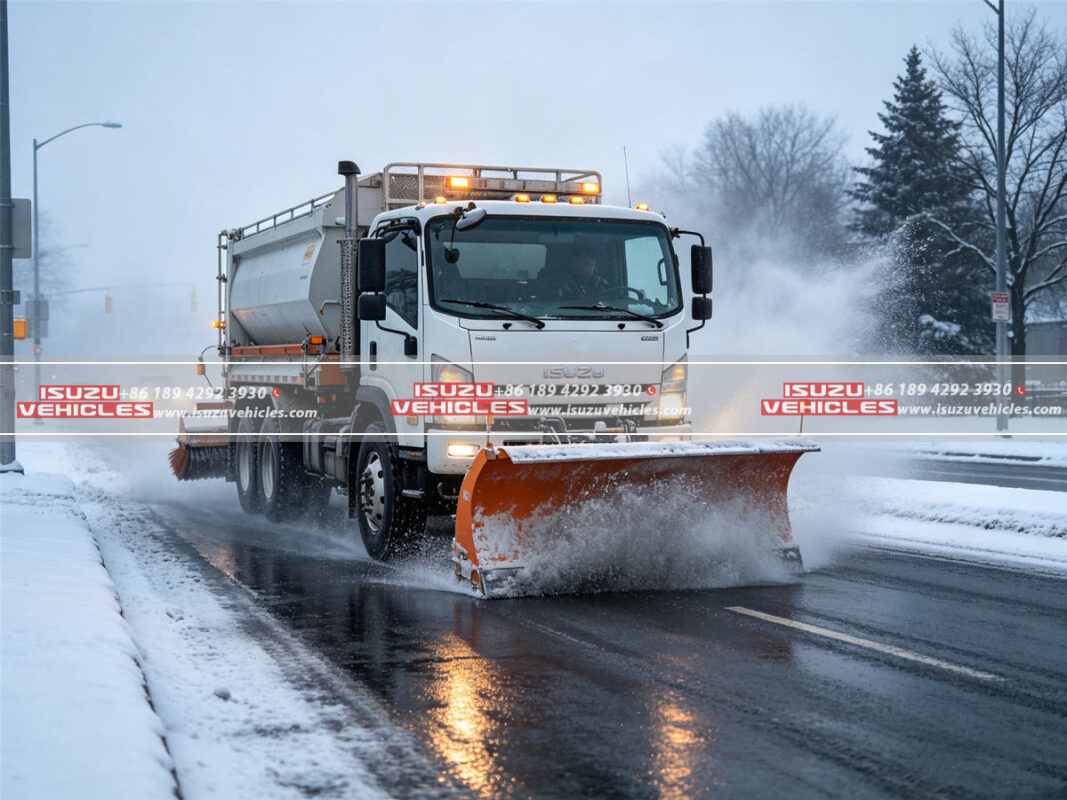
Winter road maintenance is rarely about snow removal alone. When temperatures fall below freezing, a road that has already been cleared can quickly become slippery again because of compacted snow, ice, freezing rain, or meltwater that refreezes overnight. For municipalities, highway departments, airports, industrial parks, and private road-service contractors, keeping transportation routes safe therefore requires a combination of snow plowing, de-icing, surface treatment, and continuous monitoring. This is why many modern winter-service vehicles are designed to perform more than one task.
An ISUZU snow plow truck can be configured not only to push accumulated snow away from the driving surface but also to carry and distribute de-icing materials such as road salt. When the truck is equipped with a properly designed salt spreader, hydraulic or electric drive system, material hopper, conveyor or auger, and calibrated discharge mechanism, it can provide consistent material distribution while traveling along roads. The combination of snow removal and de-icing allows one truck to respond to changing road conditions more efficiently than a vehicle dedicated to only one winter-maintenance function.
1. Why Salt Spreading Is Important After Snow Plowing
Snow plowing removes the bulk of accumulated snow, but the result is not always a completely dry or ice-free road. A thin layer of compacted snow can remain on the pavement, especially when traffic has repeatedly compressed the snow before the plow arrives. In addition, temperatures around the freezing point can cause snow to partially melt and then freeze again, creating a layer of ice that is much more difficult for vehicles to grip.
Road salt is commonly used as part of a broader winter road-treatment strategy because it can lower the freezing point of water and help prevent or weaken the bond between ice and pavement under appropriate temperature and operating conditions. Instead of simply removing snow mechanically, a municipal operator can combine plowing with controlled application of de-icing material to make the road surface safer and easier to maintain.
Plowing and de-icing work better as a coordinated process
The most effective winter maintenance operation is usually not a choice between a snow plow and a salt spreader. The two systems address different problems. The plow removes accumulated snow, while the spreader distributes material intended to reduce remaining ice or prevent new ice from bonding strongly to the road.
This is particularly useful during changing weather conditions. For example, a truck may first clear a lane after moderate snowfall and then apply a controlled amount of salt to the remaining surface. During freezing rain or rapidly dropping temperatures, the salt-spreading function can become even more important because a clean-looking road may still develop a dangerous layer of ice.
2. How an ISUZU Snow Plow Truck Can Spread Salt
The ability of a snow plow truck to spread salt efficiently depends primarily on its specialized spreading equipment rather than the chassis alone. The ISUZU truck provides the mobile platform, powertrain, payload capacity, and working environment, while the salt-spreading body is responsible for storing, metering, and distributing the de-icing material.
A typical salt-spreading system includes a hopper mounted on the rear of the truck, a material-feeding mechanism such as an auger or conveyor, a spinner or discharge assembly, and a control system that allows the operator to adjust the application rate. Depending on the configuration, the system may also use hydraulic power supplied by the truck’s PTO system or an independent electric drive.
Controlled material flow is the key to efficiency
Simply throwing salt from the back of a moving truck would not provide consistent winter road treatment. An effective spreader needs to control how much material leaves the hopper and how widely it is distributed across the road. If too much salt is applied, operating costs increase and unnecessary material may accumulate along the roadside. If too little is applied, the treatment may not provide the expected level of ice control.
A properly calibrated spreading system therefore allows the operator to adjust the application rate according to vehicle speed, road condition, temperature, material type, and the required treatment strategy. This is one of the most important factors determining whether a snow plow truck can spread salt efficiently.
3. The ISUZU Chassis Provides a Practical Platform for Winter Service
Winter maintenance can be demanding because trucks often operate for long hours in low temperatures, on slippery roads, and under conditions where stopping and turning require greater care. The base vehicle therefore needs to provide stable road performance, sufficient payload capacity, dependable braking, and good maneuverability, while the snow-plowing and salt-spreading equipment adds another layer of mechanical requirements.
An ISUZU chassis can provide a practical foundation for this type of specialized body because the vehicle can be configured for different municipal applications. The appropriate chassis should be selected according to the combined weight of the salt hopper, snow equipment, hydraulic components, and payload, rather than simply according to the physical size of the truck.
Payload capacity matters when carrying road salt
Salt is a relatively dense material, so the available payload can become a major consideration during winter operations. A spreader body that appears relatively compact can still carry a significant amount of material, and operators need to ensure that the finished vehicle remains within applicable axle and gross-weight limits.
Correct weight distribution is equally important. The salt hopper should be mounted and loaded in a way that maintains appropriate axle loading and vehicle stability. This becomes especially important when the truck is operating on snow-covered roads, where available traction is already reduced and sudden changes in vehicle balance can affect handling.
For municipalities that experience frequent snowfall, choosing the right chassis and spreading-body combination at the beginning of a vehicle project can therefore have a major effect on both productivity and winter driving safety.
4. Efficient Salt Distribution Depends on Proper Calibration
Even a high-quality spreader cannot perform efficiently if its application rate is not properly calibrated. Salt distribution should be treated as a controlled operational process rather than simply a matter of filling the hopper and switching the spreader on. Different materials have different physical properties, and moisture, particle size, temperature, and storage conditions can all influence how easily the material flows through the spreading mechanism.
Matching spread rate to road conditions
Winter maintenance crews generally need to consider several variables before determining how much material to apply. These include pavement temperature, air temperature, current precipitation, expected weather changes, traffic volume, road classification, and whether the objective is preventive anti-icing or reactive de-icing.
Preventive treatment can be used before or during an expected freezing event to reduce the likelihood of a strong ice bond forming on the pavement. Reactive treatment, by comparison, is carried out after snow or ice has already accumulated. In both cases, the correct application rate should follow local road-maintenance policies, material specifications, and environmental requirements rather than relying on a fixed amount for every situation.
Vehicle speed and spreading width also matter
A spreader needs to remain synchronized with the truck’s operating speed. If the truck travels faster without an appropriate adjustment to the material-feed rate, the amount of salt applied per unit of road surface may fall. Conversely, traveling slowly without reducing the feed rate can result in excessive application.
For this reason, modern spreading systems are often designed around adjustable controls that help operators maintain a more consistent treatment rate. The target spreading width should also correspond to the lane configuration so that the material reaches the intended portion of the road rather than being unnecessarily thrown outside the travel area.
5. Combining Snow Plowing, Salt Spreading, and Road Cleaning
A well-managed winter road fleet does not stop working when the snow disappears. Once winter precipitation has passed, the salt, sand, gravel, and debris left on the pavement need to be removed. This is where a sweeper truck becomes a valuable complement to the snow plow fleet.
ISUZU’s current sweeper range includes different configurations for municipal road maintenance, including 6 CBM, 8 CBM, 9 CBM, 12 CBM, and 20 CBM models. These vehicles are designed to collect dust, sand, leaves, gravel, and other road debris, and some configurations combine brushing, suction, flushing, and dust suppression functions.
After a winter storm, a municipality can therefore use the snow plow and salt spreader to restore road accessibility first, followed by a sweeper truck to remove accumulated loose material once the weather and road conditions allow. This creates a more complete maintenance cycle rather than treating snow removal as an isolated operation.
Why post-winter cleaning is part of efficient fleet management
Excess salt and abrasive materials left on roads can create additional cleaning requirements, while loose gravel and debris can become a problem for traffic, drainage systems, and roadside environments. A dedicated sweeping vehicle can collect these materials much more effectively than a conventional truck.
For example, the current ISUZU 9 CBM Sweeper Truck has a 3-meter maximum sweeping width and combines road sweeping with dust collection, while the ISUZU 12 CBM model combines sweeping, suction, flushing, and dust-suppression functions for larger municipal operations.
6. Where a Vacuum Truck Fits into Winter Municipal Operations
Winter road maintenance can also create problems that are not directly related to snow or salt. Melting snow can enter storm drains, while frozen debris, sediment, and accumulated material can obstruct drainage systems. When temperatures fluctuate rapidly, blocked drains can contribute to localized flooding or prevent meltwater from leaving the road efficiently.
This is where a vacuum truck can complement a snow plow and sweeper fleet. Rather than using the snow plow for a task it was not designed to perform, municipal crews can deploy a specialized vacuum or sewer vehicle to remove liquid waste, sludge, debris, or material from drainage and sewer infrastructure.
The current ISUZU vacuum truck range includes 14 CBM vacuum sewer trucks, 6,000-liter vacuum sewer trucks, 11 CBM vacuum tank trucks, combined sewer jetting vehicles, and other municipal liquid-waste configurations.
A complete winter maintenance fleet
When these vehicle types are used together, each machine has a clearly defined responsibility. The snow plow clears accumulated snow, the salt spreader manages ice and freezing conditions, the sweeper truck removes loose road debris after winter treatment, and the vacuum truck supports drainage and liquid-waste maintenance.
This approach can be much more efficient than expecting one vehicle to perform every operation. Specialized equipment also makes it easier for fleet managers to schedule maintenance, allocate operators, and measure productivity according to the actual function of each vehicle.
An ISUZU snow plow truck can therefore spread salt efficiently when it is equipped with a properly matched and calibrated salt-spreading system, operated within its payload limits, and used according to appropriate winter road-treatment practices. The chassis provides the foundation, but real spreading performance comes from the complete vehicle configuration, including hopper design, material-feeding mechanism, discharge system, control technology, calibration, and operator technique. When integrated with a sweeper truck for post-winter road cleaning and a vacuum truck for drainage and liquid-waste maintenance, the winter-service fleet can respond to a much wider range of seasonal challenges. For municipalities and contractors seeking a practical platform for demanding road maintenance work, ISUZU Vehicles can provide a flexible foundation for building a coordinated and productive winter road-service fleet.