
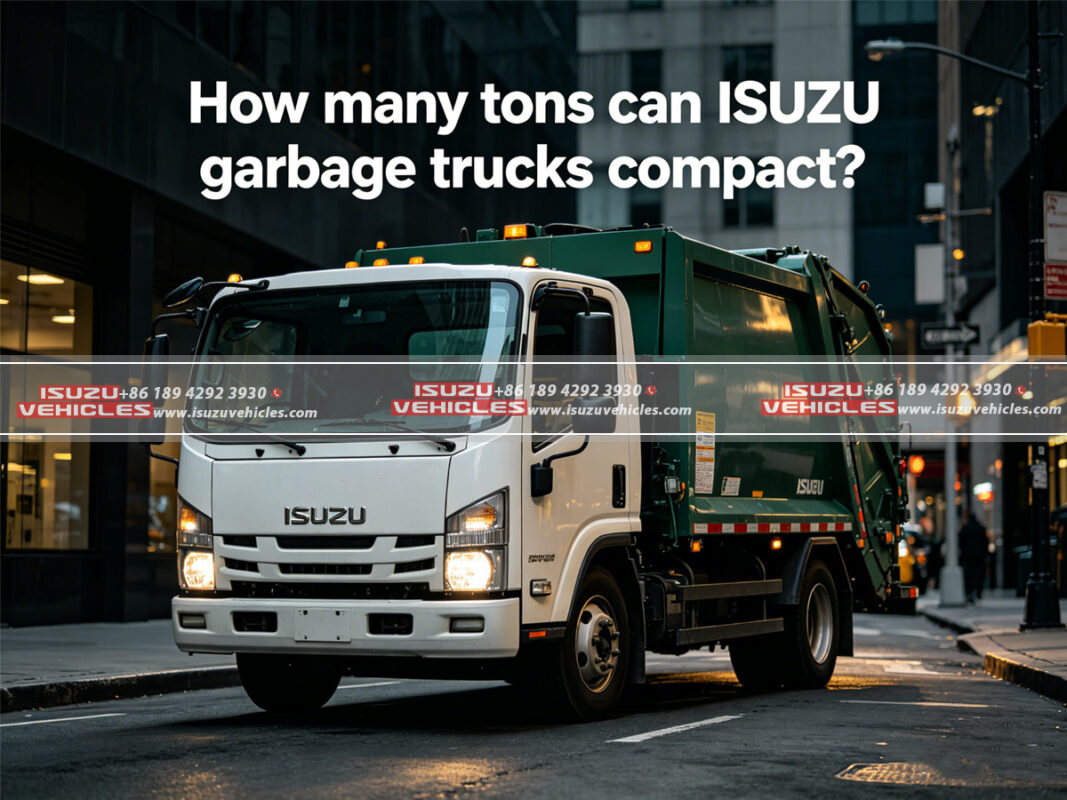
Understanding Waste Compaction in Modern Sanitation Systems
Efficient waste management is a cornerstone of urban infrastructure, and as cities grow in population and density, the need for effective collection and disposal systems becomes increasingly critical. One of the most important aspects of this process is waste compaction, which allows municipalities to handle larger volumes of refuse while optimizing transportation and disposal resources.
At the center of this operation are ISUZU garbage trucks, which are widely recognized for their reliability, durability, and adaptability in sanitation fleets. A common question among fleet managers and municipal planners is how many tons these trucks can compact, and the answer depends on several technical and operational factors that influence performance.
What Determines Compaction Capacity in Garbage Trucks
The compaction capacity of a garbage truck is not defined by a single number, as it varies based on design, configuration, and the type of waste being handled. Instead, it is a combination of volume capacity, compaction ratio, and weight limits that determines how much material a truck can effectively process and transport.
Volume capacity refers to the size of the truck’s hopper or body, which is typically measured in cubic meters, while the compaction ratio indicates how much the waste can be compressed compared to its original volume. Weight limits, on the other hand, are determined by the truck’s chassis and legal load restrictions, which ensure safe operation on public roads.
Understanding these factors is essential for accurately estimating how many tons a garbage truck can compact during a typical operation.
Typical Compaction Capacity of ISUZU Garbage Trucks
ISUZU garbage trucks come in a range of sizes and configurations, each designed to meet specific operational needs, from small urban routes to large-scale municipal collections.
Light-Duty and Medium-Duty Models
Smaller ISUZU garbage trucks, often used in narrow urban streets or residential areas, typically have a capacity of around 5 to 10 tons after compaction, depending on the type of waste and the efficiency of the compaction system. These trucks are designed for maneuverability and frequent stops, making them ideal for dense city environments.
Their compact size allows them to access areas that larger vehicles cannot, while still providing sufficient capacity for daily collection routes.
Heavy-Duty Models
Larger ISUZU garbage trucks, built for high-volume operations, can compact and carry between 12 to 20 tons or more, depending on the configuration and load conditions. These trucks are equipped with more powerful compaction systems and larger storage bodies, enabling them to handle significant volumes of waste in a single trip.
Heavy-duty models are commonly used for commercial or industrial waste collection, where efficiency and capacity are critical.
The Role of Compaction Ratio
One of the key factors influencing how much waste a garbage truck can carry is the compaction ratio, which measures how effectively the truck compresses waste.
Understanding Compaction Ratios
A typical compaction ratio for modern garbage trucks ranges from 3:1 to 6:1, meaning that the truck can compress waste to one-third or even one-sixth of its original volume. This significantly increases the amount of material that can be transported in a single load.
Higher compaction ratios are particularly beneficial in urban areas, where reducing the number of trips to disposal sites can lead to substantial time and cost savings.
Impact on Ton Capacity
While compaction ratios improve volume efficiency, the actual tonnage is still limited by the truck’s الوزن capacity and legal load limits. This means that even if more waste can be compressed into the body, the total weight must remain within safe and regulated limits.
Balancing volume and weight is therefore essential for maximizing efficiency without compromising safety.
Types of Waste and Their Influence on Capacity
The type of waste being collected plays a significant role in determining how much a garbage truck can compact and carry, as different materials have varying densities and compressibility.
Household and Organic Waste
Residential waste, which often includes organic materials and packaging, tends to compress well and allows trucks to achieve higher compaction ratios. This makes it possible to carry larger volumes without exceeding weight limits.
Such waste is commonly handled by standard municipal collection trucks.
Commercial and Industrial Waste
Waste from commercial and industrial sources may include heavier materials such as metal, construction debris, or dense packaging, which can limit the overall tonnage despite available volume. In these cases, trucks may reach their weight limit before fully utilizing their storage capacity.
This requires careful planning to ensure efficient collection and transport.
Recyclable Materials
Recyclables such as paper, plastic, and cardboard vary in density and compressibility, influencing how they are handled during collection. Specialized trucks may be used to optimize compaction for these materials.
Proper segregation and handling improve both efficiency and sustainability.
Technological Features Enhancing Compaction Efficiency
Modern ISUZU garbage trucks are equipped with advanced technologies that improve compaction performance and overall operational efficiency.
Hydraulic Compaction Systems
Hydraulic systems provide the force needed to compress waste, and advancements in this technology have led to more efficient and reliable compaction processes. These systems are designed to handle continuous operation without significant wear.
Consistent performance ensures that trucks can maintain high productivity levels throughout their routes.
Automated Controls and Monitoring
Automation allows operators to control compaction processes with precision, reducing the risk of overloading or inefficient packing. Monitoring systems provide real-time data on load levels and system performance.
These features help optimize operations and prevent potential issues.
Durable Body Construction
The construction of the truck body plays a crucial role in supporting compaction, as it must withstand repeated الضغط from compressed waste. High-strength materials and reinforced designs ensure durability and longevity.
This reliability is essential for maintaining consistent performance over time.
Operational Considerations for Maximizing Capacity
Achieving optimal compaction capacity requires more than just advanced equipment, as operational practices also play a significant role.
Route Planning and Load Management
Efficient route planning ensures that trucks collect waste in a logical sequence, maximizing capacity before returning to disposal sites. Proper load management prevents uneven توزيع and helps maintain stability during transport.
These practices contribute to safer and more efficient operations.
Operator Training and Best Practices
Well-trained operators understand how to use compaction systems effectively, ensuring that waste is evenly distributed and properly compressed. This not only improves capacity but also reduces wear on equipment.
Training is an essential component of successful waste management operations.
Maintenance and System Reliability
Regular maintenance ensures that compaction systems remain in optimal condition, preventing breakdowns and maintaining efficiency. Routine inspections help identify potential issues before they escalate.
Reliable equipment supports consistent performance and reduces downtime.
Choosing the Right ISUZU Garbage Truck for Your Needs
Selecting the appropriate garbage truck depends on a combination of factors, including route conditions, waste type, and required capacity. ISUZU offers a range of options that can be tailored to meet specific operational needs, ensuring that municipalities and private contractors can find the right solution for their requirements.
Understanding the relationship between volume, compaction ratio, and weight capacity is key to making an informed decision, as it allows buyers to choose a truck that delivers optimal performance without exceeding operational limits.
In modern sanitation fleets, garbage trucks often operate alongside specialized vehicles such as a vacuum truck for liquid waste management or a sweeper truck for street cleaning, forming an integrated system that supports urban cleanliness and efficiency, with many organizations relying on the proven performance and durability associated with ISUZU Vehicles.