
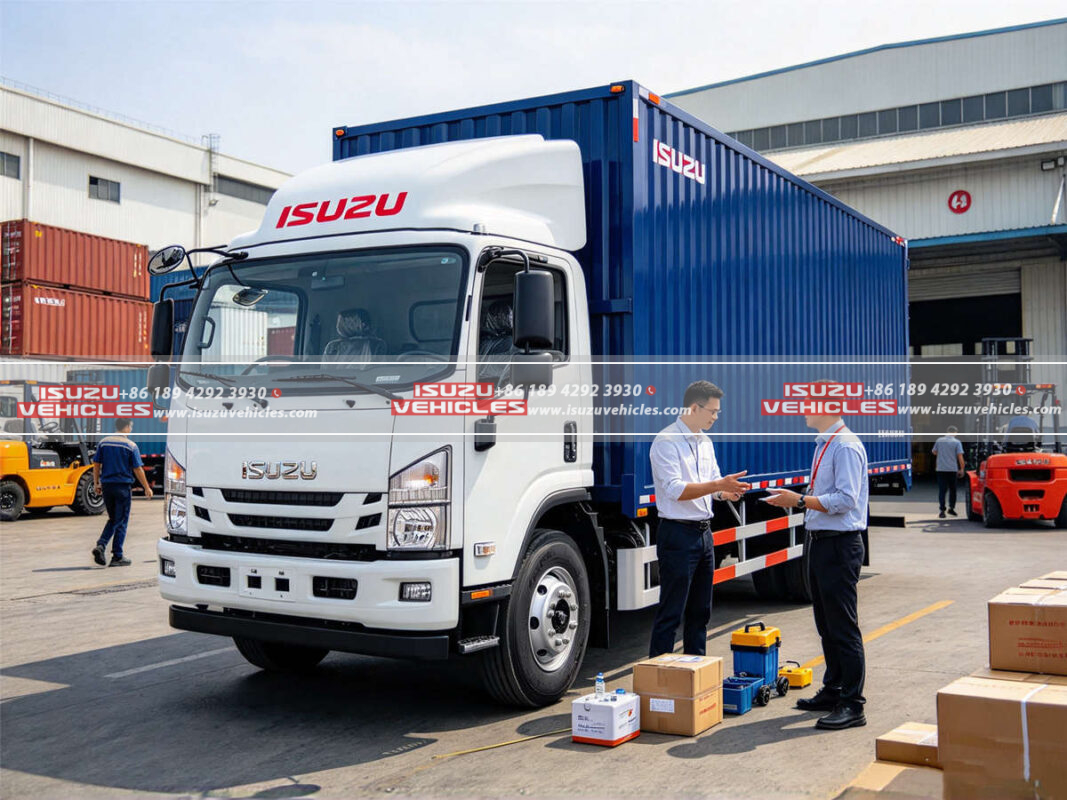
Choosing the best commercial truck for a business is not simply a matter of comparing engine horsepower, payload ratings, or purchase prices, because the right truck must fit the way a company actually works every day. A logistics company delivering packages through busy city streets has very different requirements from a construction contractor transporting materials, a utility company maintaining power lines, or a distributor moving goods between warehouses over long highway routes. When the vehicle is correctly matched to its workload, road conditions, cargo type, and operating schedule, it can improve productivity, reduce unnecessary operating costs, and remain a dependable business asset for many years. This is why companies considering ISUZU Vehicles should evaluate the complete transportation task before choosing a particular model or body configuration.
Commercial trucks are available in many forms, including light-duty delivery trucks, cargo truck models, box trucks, dump trucks, refrigerated trucks, tanker trucks, crane trucks, and specialized vehicles such as a bucket truck. Each configuration solves a different business problem, and selecting the wrong one can create unnecessary fuel consumption, limited payload capacity, difficult loading, excessive maintenance, or reduced productivity. The most effective purchasing process therefore begins with a simple question: what does the truck need to accomplish every working day?
1. Start by Understanding Your Business and Daily Workload
The first step in selecting a commercial truck is to understand the actual work the vehicle will perform rather than starting with a specific truck model. Businesses should consider what they transport, how much they transport, how far they travel, how frequently they stop, what types of roads they use, and whether the truck will operate mainly in urban areas, rural regions, construction sites, or highways. These details provide the foundation for selecting the appropriate chassis, payload, body type, engine, wheelbase, and equipment.
For example, a company that delivers consumer products to supermarkets may need an enclosed cargo body that protects goods from weather and allows organized loading, while a construction company may benefit from an open flatbed or dump body that makes it easier to transport and unload building materials. A telecommunications contractor may have completely different requirements, because the primary purpose of its vehicle may be to safely lift technicians and tools to elevated work areas rather than simply transport cargo.
Calculate Your Typical Payload
Payload should be calculated according to normal business requirements rather than an occasional maximum load. If a company usually transports two tons of goods, purchasing a much larger heavy-duty truck simply because it can carry substantially more may result in unnecessary vehicle weight, higher purchase costs, greater fuel consumption, and reduced maneuverability. On the other hand, choosing a vehicle that is too small can lead to overloading or repeated trips, both of which can increase operating costs.
The ISUZU cargo truck range includes different configurations, from compact 600P models and medium-duty vehicles to larger GIGA cargo trucks, making it possible to select a truck according to the expected workload rather than forcing every business into the same vehicle class.
A useful purchasing approach is to record the average payload, maximum normal payload, cargo dimensions, and number of trips completed during a typical week. This information gives the buyer a much clearer picture of what the truck actually needs to accomplish.
2. Choose the Right Truck Type for the Job
Once the workload has been identified, the next step is choosing the right truck configuration. Commercial trucks are highly specialized tools, and the body mounted behind the cab can be just as important as the chassis itself. A truck that is perfectly suited to one business can be inefficient or impractical for another simply because its body does not match the cargo or working environment.
A conventional cargo truck is a flexible option for transporting packaged goods, equipment, agricultural products, construction supplies, and many other types of freight. An enclosed box body can provide protection from weather and dust, while an open flatbed can make loading oversized or irregular cargo easier. Businesses transporting temperature-sensitive products may require refrigerated or freezer bodies, while construction companies may need hydraulic dump systems for fast unloading.
ISUZU Vehicles offers different commercial configurations so that customers can select the body type according to their application. The ISUZU flatbed truck range, for example, is designed around the practical advantages of an open loading platform and can be useful in construction, manufacturing, agriculture, and logistics applications.
Consider Specialized Equipment When It Creates Productivity
Some businesses should not simply choose a standard cargo body because their work requires specialized equipment. Utility contractors, for example, may need a bucket truck that can transport workers and tools while providing controlled access to elevated work areas. A construction contractor may require a crane truck to lift materials directly at the job site, while a roadside service company may need a tow truck to recover disabled vehicles.
The important question is whether the specialized equipment directly contributes to the company’s core operation. If a business regularly hires external lifting or aerial-access equipment, investing in a specialized truck may reduce dependence on outside contractors and allow the company to complete more jobs with its own fleet.
3. Match Truck Size and Chassis Capacity to Your Operation
Truck size should be considered from several perspectives rather than only the maximum payload. Wheelbase, overall length, turning radius, cab dimensions, axle configuration, ground clearance, and gross vehicle weight all influence how easily the vehicle can operate in its intended environment. A truck that performs well on a highway may be difficult to maneuver through narrow urban streets, while a compact vehicle that is excellent for city deliveries may not provide enough capacity for long-distance freight.
Urban businesses often benefit from compact commercial trucks because they can navigate narrow streets, crowded loading areas, and small customer locations more easily. The ISUZU N-Series is a good example of a commercial platform designed for versatility, with NNR, NPR, NHR, and NKR configurations serving different payload and application requirements. Its compact cab-over-engine layout also makes efficient use of the vehicle’s overall length, which can be valuable for businesses operating in dense urban environments.
For businesses transporting substantially heavier loads, a larger platform may be more appropriate. The ISUZU GIGA series is positioned for heavy-duty applications and includes cargo, refrigerated, construction, and other specialized configurations, providing a stronger platform for operators whose business depends on larger payloads and demanding transport conditions.
Do Not Buy More Truck Than You Need
A common purchasing mistake is assuming that a larger truck automatically provides better business value. While additional capacity can be useful, the larger vehicle may also have higher purchase costs, greater fuel consumption, more expensive tires, larger maintenance requirements, and greater difficulty operating in restricted areas. If the additional capacity is rarely used, the business may spend money every day for capabilities it does not actually need.
The better strategy is to choose a truck with enough capacity to handle the normal workload safely, while leaving a reasonable margin for variation in cargo weight and business growth.
4. Evaluate Engine Performance, Fuel Economy, and Operating Costs
The purchase price of a commercial truck is only the beginning of its financial impact. Fuel, maintenance, tires, insurance, repairs, driver costs, and downtime can account for a significant portion of the truck’s total cost over its working life. This means that a truck with a slightly higher purchase price may actually be the more economical choice if it provides better fuel efficiency, reliability, durability, and productivity.
Engine selection should therefore be based on the truck’s real workload. A vehicle operating primarily in urban delivery service may benefit from an engine and gearing combination optimized for frequent acceleration and lower-speed operation, while a truck traveling long distances with substantial payloads needs sufficient torque and power for sustained highway operation and gradients.
Fuel efficiency is also influenced by driving habits, payload, tire pressure, road conditions, aerodynamic design, and maintenance. A business should therefore avoid evaluating fuel economy based solely on a manufacturer’s theoretical figure and instead consider how the truck will actually be operated.
Think About Total Cost of Ownership
Total cost of ownership is a much more useful purchasing measurement than the initial purchase price alone. A simple calculation can include the expected annual mileage, average fuel consumption, fuel price, scheduled maintenance, tire replacement, insurance, financing, and estimated downtime. When these expenses are compared over several years, the long-term difference between two seemingly similar trucks can become substantial.
Reliability also has a financial value that is sometimes overlooked. If a delivery truck is unavailable because of an unexpected mechanical problem, the company may lose delivery revenue, miss customer commitments, and potentially pay for emergency replacement transportation. A dependable commercial vehicle therefore contributes to profitability not only through fuel efficiency but also through availability.
5. Consider Cargo Body Design and Loading Efficiency
The cargo body should be selected according to the physical characteristics of the goods as well as the way those goods are loaded and unloaded. Businesses transporting cartons, parcels, electronics, clothing, or packaged food may benefit from an enclosed body that provides protection against rain and dust. Companies moving machinery, steel, timber, construction materials, or oversized equipment may need an open flatbed that allows cranes, forklifts, or other equipment to access the load easily.
Loading efficiency can have a surprisingly large effect on business productivity. If workers need a long time to load and unload every truck, the vehicle may spend more time sitting at warehouses and customer locations than actually transporting goods. A body designed around the company’s loading process can therefore increase the number of deliveries that a truck can complete during a working day.
For example, businesses that regularly handle palletized products should consider whether the cargo body dimensions are compatible with their pallet sizes and loading equipment. Companies transporting long or irregular products should consider platform length and side access, while businesses carrying valuable products may prioritize enclosed compartments and secure locking systems.
Leave Enough Space Without Carrying Excess Weight
Cargo volume and payload are not the same thing. A truck may have enough physical space for a large quantity of lightweight products but exceed its payload rating if the goods are extremely dense. Conversely, heavy goods may reach the payload limit while leaving considerable unused space. Businesses should therefore consider both cubic capacity and weight when choosing a commercial truck.
This distinction becomes particularly important for distribution businesses whose products vary significantly throughout the year. The ideal truck should be capable of handling the normal combination of cargo weight and volume rather than being selected according to only one measurement.
6. Think About Safety, Driver Comfort, and Daily Usability
A commercial truck is also a workplace, and the driver’s experience can have a direct influence on productivity and safety. Drivers may spend many hours inside the cab every day, so visibility, seating position, controls, ventilation, climate control, storage, and general ergonomics deserve serious consideration during the purchasing process.
Good visibility is particularly important for urban delivery vehicles that operate around pedestrians, motorcycles, passenger cars, loading areas, and narrow intersections. A practical cab design can reduce driver fatigue while making it easier to position the truck accurately at customer locations.
Safety equipment should also be considered according to the operating environment. Depending on the vehicle and market, buyers may evaluate braking systems, lighting, mirrors, cameras, stability-related equipment, seat belts, emergency equipment, and other safety features. Specialized vehicles require additional consideration; for example, a bucket truck must incorporate appropriate stabilization and aerial-work controls because its operating risks are very different from those of a standard cargo vehicle.
Specialized Trucks Require More Than a Strong Chassis
When purchasing a truck with cranes, aerial platforms, dump bodies, tanks, or other specialized equipment, the buyer should evaluate the complete vehicle rather than looking only at the chassis. The body equipment must be properly matched to the chassis capacity, axle loading, wheelbase, hydraulic system, and intended working conditions.
This is especially important for aerial trucks because the vehicle must remain stable when the boom is extended and workers are operating at height. The ISUZU bucket truck range includes different aerial configurations for utility maintenance, telecommunications, construction, municipal work, and other elevated operations, allowing businesses to select a working height and equipment arrangement suited to their actual jobs.
7. Plan for Maintenance, Service Support, and Future Business Growth
A commercial truck should be purchased with its entire working life in mind rather than only the first year of operation. Before making a decision, businesses should consider where routine maintenance will be performed, how easily replacement parts can be obtained, how much downtime is acceptable, and whether local technicians are familiar with the selected chassis and specialized equipment.
Maintenance intervals should also fit the company’s operating schedule. A truck that works six days a week may need a maintenance strategy that minimizes downtime and allows servicing to be scheduled during less busy periods. Preventive maintenance can help identify issues before they become expensive breakdowns, while proper tire management, lubrication, fluid checks, brake inspection, and engine servicing can help preserve the vehicle’s performance over time.
Business growth should also be considered. A company expecting to expand its delivery volume over the next few years may want a truck with sufficient capacity to accommodate moderate growth without becoming excessively large for current operations. However, buying an oversized truck solely because the business might grow can tie up capital unnecessarily. A more practical strategy is to identify realistic growth expectations and choose a platform that can support them without compromising today’s efficiency.
8. Build a Truck Specification Around Your Business, Not the Other Way Around
The best commercial truck is ultimately the one that fits the company’s actual operating model. Before purchasing, businesses should create a clear specification covering average payload, maximum payload, cargo dimensions, daily mileage, road conditions, body requirements, loading method, desired fuel economy, driver requirements, maintenance expectations, and future growth. Once these requirements are established, comparing truck models becomes much easier because the decision is based on measurable business needs rather than attractive but unnecessary specifications.
For a delivery company, this may result in a compact cargo truck with an enclosed body and excellent urban maneuverability. For a construction business, it may mean a flatbed, dump truck, or crane-equipped vehicle. For a utility contractor, a bucket truck with the correct working height and stabilization system may provide far greater value than a conventional freight vehicle. The objective is always the same: select equipment that helps employees complete their work more efficiently.
ISUZU Vehicles provides a wide range of commercial platforms that can support these different requirements, including N-Series trucks for lighter applications, medium-duty cargo vehicles, heavy-duty GIGA models, flatbed trucks, box trucks, dump trucks, aerial vehicles, and other specialized configurations. This broad selection allows businesses to build a fleet around their actual transportation needs instead of making every operation fit a single standard truck.
Ultimately, choosing the right commercial truck is a business decision as much as it is a vehicle decision. The best truck should carry the required payload without unnecessary excess, fit the roads and job sites where it will operate, protect the cargo appropriately, provide enough power without wasting fuel, remain comfortable and safe for drivers, and deliver reliable service with manageable maintenance costs. By carefully evaluating these factors before purchasing, businesses can select an ISUZU commercial truck that supports daily productivity while also providing strong long-term value. Whether the requirement is a cargo truck for logistics, a bucket truck for utility work, or a specialized vehicle for construction and municipal operations, the right configuration can become a valuable part of a company’s growth and operational strategy.