
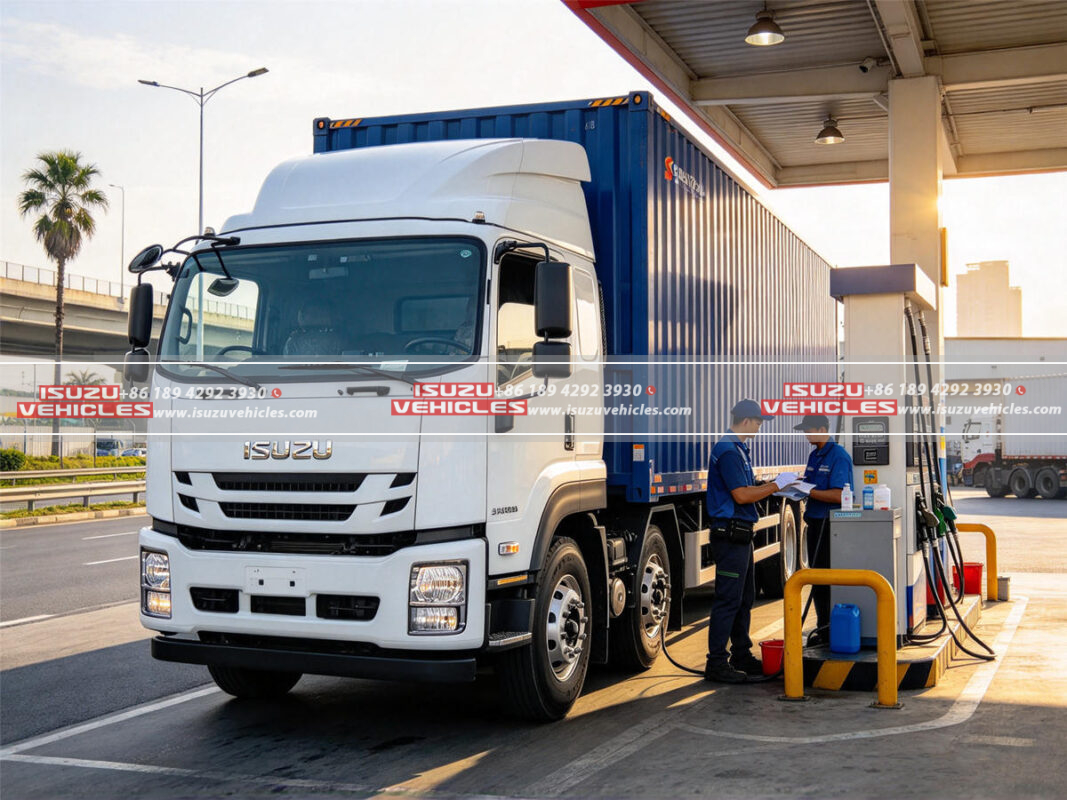
Fuel efficiency is one of the most important considerations when purchasing a commercial cargo truck because fuel is a continuous operating expense that can have a significant influence on the profitability of a transportation business. A truck may travel hundreds of kilometers every week, and over several years, even a small difference in fuel consumption can become a substantial cost. For this reason, understanding the factors that influence the fuel efficiency of an ISUZU cargo truck is much more useful than simply looking at a single fuel-consumption figure. Engine performance, vehicle weight, payload, transmission, driving speed, road conditions, tire pressure, maintenance, aerodynamics, and driver habits all contribute to the actual amount of fuel consumed during daily operation.
ISUZU Vehicles offers a broad range of cargo trucks designed for different transportation requirements, from compact urban delivery vehicles to medium-duty and heavy-duty trucks for regional and long-distance freight. A business delivering groceries in a crowded city, a distributor transporting packaged products between towns, and a logistics company carrying heavy freight on highways may all need different truck configurations. Choosing the right vehicle for the job is therefore the first step toward achieving good fuel economy. Once the correct truck has been selected, proper loading, driving, maintenance, and route planning can further improve its efficiency.
1. What Determines the Fuel Efficiency of an ISUZU Cargo Truck?
Fuel efficiency is not determined by the engine alone, although the engine is certainly one of the most important components. A commercial truck is a complete transportation system in which the engine, transmission, axle, tires, chassis, cargo body, and operating conditions all work together. If one part of this system is poorly matched to the application, the truck may consume more fuel even when the engine itself is technically efficient.
For example, a small urban delivery truck normally spends much of its working day accelerating, slowing down, turning, and stopping, while a highway cargo truck may spend several hours maintaining a relatively stable cruising speed. The two vehicles therefore experience very different operating conditions, and the most economical configuration for one application may not be ideal for the other.
This is why choosing a truck according to its normal workload is so important. ISUZU offers different cargo truck platforms for different payloads and operating environments, allowing customers to select a vehicle that is neither unnecessarily large nor insufficient for the job. A properly matched truck can use its engine power more efficiently, carry an appropriate amount of cargo, and avoid wasting fuel moving unnecessary vehicle weight.
Engine Power Should Match the Job
A common misunderstanding is that a more powerful engine must always consume more fuel, but the real relationship is more complicated. An engine that is unnecessarily large may consume additional fuel when its extra power is rarely needed, while an engine that is too small may have to work extremely hard when the truck is heavily loaded or traveling on steep roads. The ideal solution is a powertrain that provides enough torque and horsepower for the vehicle’s normal operating conditions without excessive capacity.
ISUZU commercial engines are designed around the requirements of different truck classes, allowing smaller models to handle urban distribution efficiently while larger engines provide the additional performance required by medium- and heavy-duty applications. The objective is not simply maximum horsepower, but a balanced relationship between power, torque, payload, gearing, and operating conditions.
2. How Payload and Vehicle Weight Affect Fuel Consumption
Every cargo truck has to move its own weight before it can move the customer’s cargo, which means vehicle weight is an important part of fuel consumption. However, reducing vehicle weight as much as possible is not always the best transportation strategy. A truck that is too small for the business may require multiple trips to move the same amount of goods, and the additional journeys can consume more fuel overall than a properly sized vehicle carrying a larger load in fewer trips.
The better approach is to select a truck according to the typical payload rather than an occasional maximum or minimum requirement. If a business normally transports several tons of goods, a medium-duty cargo truck may be more economical over the long term than repeatedly overloading a smaller vehicle. On the other hand, if the average cargo is relatively light and the truck operates mainly in congested urban areas, a compact model can provide better maneuverability and lower operating costs.
The ISUZU cargo truck range includes different chassis and body configurations, giving operators more flexibility when matching the truck to the actual transportation task. Smaller vehicles can be used for local distribution, while larger platforms can handle heavier loads and longer routes.
Overloading Can Quickly Destroy Efficiency
Overloading is one of the simplest ways to increase fuel consumption while also creating additional mechanical and safety risks. A heavily overloaded truck requires more energy to accelerate, needs greater braking effort, places additional stress on the tires and suspension, and can cause the engine to operate under higher load for longer periods. Fuel consumption can therefore rise while component wear also accelerates.
For fleet operators, maintaining the correct payload is not simply a matter of following regulations. It is also an effective way to protect fuel economy and reduce long-term maintenance costs. A truck that consistently operates within its designed capacity will generally provide a more predictable and sustainable operating cost.
3. Transmission and Driving Speed Have a Major Influence
The transmission is another important part of the fuel-efficiency equation because it determines how engine power is transferred to the wheels and helps keep the engine operating within an appropriate speed range. A diesel engine does not consume fuel at exactly the same rate under every operating condition, so selecting suitable gears and maintaining a sensible engine speed can make a noticeable difference over a long working period.
This is particularly important for cargo trucks that operate on mixed routes. Urban roads require frequent changes in speed, while highways allow the vehicle to maintain a more consistent cruising speed. A driver who selects the appropriate gear for each situation can avoid unnecessary engine revving and make better use of the available torque.
The final-drive ratio is also important because it affects the relationship between engine speed and road speed. A configuration intended for heavy loads or difficult terrain may use different gearing from a truck designed primarily for highway transportation. The correct combination depends on how the vehicle will actually be used rather than on one specification viewed independently.
Moderate Highway Speeds Can Save Fuel
Speed has a particularly strong effect on fuel consumption because aerodynamic resistance increases as the vehicle moves faster. A tall cargo truck already has a relatively large frontal area, and pushing that vehicle through the air at excessive speed requires considerably more engine power than maintaining a moderate cruising speed.
For this reason, driving at a consistent and reasonable highway speed is usually more efficient than repeatedly accelerating to high speeds and then braking. Smooth acceleration also matters because hard acceleration demands a large amount of fuel in a short period, while unnecessary braking wastes some of the energy that has already been used to accelerate the vehicle.
For commercial fleets, encouraging drivers to maintain smooth acceleration, anticipate traffic, avoid unnecessary overtaking, and maintain a steady cruising speed can improve fuel economy without requiring any mechanical modification to the truck.
4. Cargo Body Design: Cargo Truck, Van Box Truck, and Specialized Vehicles
The cargo body has a greater influence on fuel efficiency than many buyers initially expect. The shape, height, weight, and aerodynamic characteristics of the body all affect the amount of energy required to move the vehicle, particularly when it operates at highway speeds.
A conventional open cargo body may offer easy loading from different directions and can be suitable for construction materials, machinery, agricultural products, and other goods that do not require complete weather protection. A van box truck, on the other hand, provides an enclosed cargo compartment that protects products from rain, dust, sunlight, and other external conditions, making it particularly useful for distribution and logistics.
The important point is that an enclosed body is not automatically an inefficient choice. If the cargo requires protection, the additional body weight and aerodynamic characteristics are justified by the commercial value of protecting the goods. The operator should instead choose a body size that matches the cargo requirement and avoid carrying unnecessary empty space or excessive weight.
The ISUZU box truck range provides enclosed cargo solutions for different delivery applications, including urban distribution, retail transportation, logistics, and general freight. A properly selected box body can improve cargo security and loading efficiency while still allowing the truck to operate economically.
Freezer Trucks Require a Different Efficiency Strategy
A freezer truck is an excellent example of why fuel economy must be evaluated according to the complete transportation mission. Unlike a conventional cargo truck, a freezer truck has to maintain a controlled low temperature inside its cargo compartment, which means the refrigeration unit introduces another energy requirement in addition to the energy needed to move the chassis.
Insulation quality is therefore extremely important. A well-insulated cargo box reduces heat transfer from the outside environment and allows the refrigeration system to maintain the required temperature more efficiently. Frequent door opening, high outside temperatures, poor loading practices, and inadequate insulation can all increase the workload of the refrigeration unit.
The ISUZU 4.2-meter freezer box truck is designed for temperature-controlled transportation and combines an ISUZU chassis with an insulated cargo body and refrigeration equipment. For businesses transporting frozen foods, fresh products, pharmaceuticals, and other temperature-sensitive goods, the right combination of chassis, body, insulation, and refrigeration system can be more important than simply selecting the vehicle with the lowest empty fuel consumption.
5. Tire Pressure, Maintenance, and Vehicle Condition
Even a well-engineered cargo truck can lose its fuel-efficiency advantage if maintenance is neglected. A truck operates under considerable mechanical stress, especially when it carries heavy loads for long distances, so regular inspection and servicing are essential for maintaining both reliability and fuel economy.
Tire pressure is one of the simplest factors to check. Underinflated tires create greater rolling resistance because more of the tire deforms against the road surface, requiring additional engine power to maintain movement. This can increase fuel consumption while also generating more tire heat and accelerating wear.
Wheel alignment is another important consideration. If the wheels are not correctly aligned, the tires may resist forward movement instead of rolling efficiently, and the driver may also notice uneven tire wear or steering behavior. Correct alignment helps the vehicle move more smoothly and protects the tires over the long term.
Regular Engine and Drivetrain Maintenance
Engine oil, air filters, fuel filters, cooling systems, belts, brakes, bearings, transmission components, and other systems should be maintained according to the manufacturer’s recommendations. A dirty air filter, poorly functioning injector, dragging brake, or other mechanical problem can increase fuel consumption even when the driver is operating the truck correctly.
Preventive maintenance is therefore not merely about avoiding breakdowns. It is also a method of controlling operating costs. A small mechanical issue discovered during routine maintenance may be inexpensive to correct, while allowing the same problem to continue for thousands of kilometers can lead to higher fuel consumption and more serious component damage.
6. Driver Habits Can Change Real-World Fuel Economy
The same truck can achieve noticeably different fuel consumption figures depending on who is driving it and how it is being operated. This is especially true for delivery trucks that spend long hours in urban traffic, where acceleration and braking behavior can have a major effect on total fuel consumption.
Smooth acceleration is generally preferable to aggressive starts, particularly when there is no need to reach a higher speed immediately. Drivers who observe traffic conditions ahead of them can often reduce unnecessary braking and acceleration by adjusting speed earlier. Maintaining a reasonable following distance can also make it easier to keep the truck moving smoothly instead of repeatedly stopping and starting.
Unnecessary idling should also be avoided whenever practical. A truck that remains stationary with the engine running is consuming fuel without transporting cargo, and repeated periods of idling can become a considerable expense for vehicles that operate throughout the day.
Drivers should also remove unnecessary items from the cargo compartment and cab whenever possible. Tools, materials, spare parts, and other equipment that are not required for a particular route add weight, and the engine must provide energy to move that weight every time the truck accelerates.
7. Route Planning and Cargo Management Improve Overall Efficiency
Fuel efficiency is not only a vehicle issue; it is also a logistics issue. A highly efficient truck can still generate unnecessary fuel costs if its routes are poorly planned, its cargo is badly distributed, or it repeatedly travels with insufficient loads.
For distribution businesses, grouping deliveries by geographical area can reduce unnecessary travel. Planning the order of stops can also reduce the distance traveled between customers, while avoiding congested roads where possible can reduce the amount of time spent idling and repeatedly accelerating.
Cargo loading should also be organized carefully. Heavy items should be distributed appropriately within the cargo area rather than concentrated in one location, while frequently delivered products can be positioned for convenient unloading. Good cargo organization can shorten loading and unloading times, allowing the vehicle to spend more of its working day actually transporting goods.
For freezer trucks, route planning is even more important because every unnecessary stop can increase both vehicle fuel consumption and refrigeration demand. Reducing the number of times the doors are opened and keeping delivery sequences efficient can help maintain the required temperature while reducing unnecessary energy use.
8. Choosing the Right ISUZU Cargo Truck for Better Long-Term Economy
The most fuel-efficient cargo truck is not necessarily the smallest truck, the lightest truck, or the vehicle with the smallest engine. The best choice is the vehicle that can complete the required transportation work efficiently while carrying the appropriate payload, protecting the cargo, and remaining reliable throughout its operating life.
For short-distance urban distribution, a compact ISUZU truck may provide excellent efficiency because it combines an appropriately sized engine with easy maneuverability and a practical cargo capacity. For heavier regional transportation, a medium-duty model may be more suitable because it can carry more cargo per trip without operating continuously at its maximum capacity. For demanding long-distance or heavy-load applications, a larger ISUZU platform can provide the necessary power and payload capacity.
This is why businesses should consider their average cargo weight, cargo dimensions, daily mileage, road conditions, delivery frequency, and expected service life before choosing a model. The ISUZU ELF truck range, for example, is suitable for many compact and urban transportation applications, while larger F-Series and GIGA models can address more demanding commercial requirements.
Ultimately, ISUZU cargo truck fuel efficiency comes from the interaction of many factors rather than from one special component. A correctly matched engine and transmission provide the foundation, while appropriate payload, aerodynamic body design, correct tire pressure, regular maintenance, sensible driving, and efficient route planning determine how well that foundation performs in real-world operation. Whether the vehicle is a conventional cargo truck, a van box truck, or a specialized freezer truck, the same principle applies: the most economical vehicle is the one that is correctly matched to its actual working environment and managed properly throughout its service life. With its broad range of commercial vehicle platforms and body configurations, ISUZU Vehicles provides practical transportation solutions that can help businesses balance payload, reliability, productivity, and long-term operating costs.