
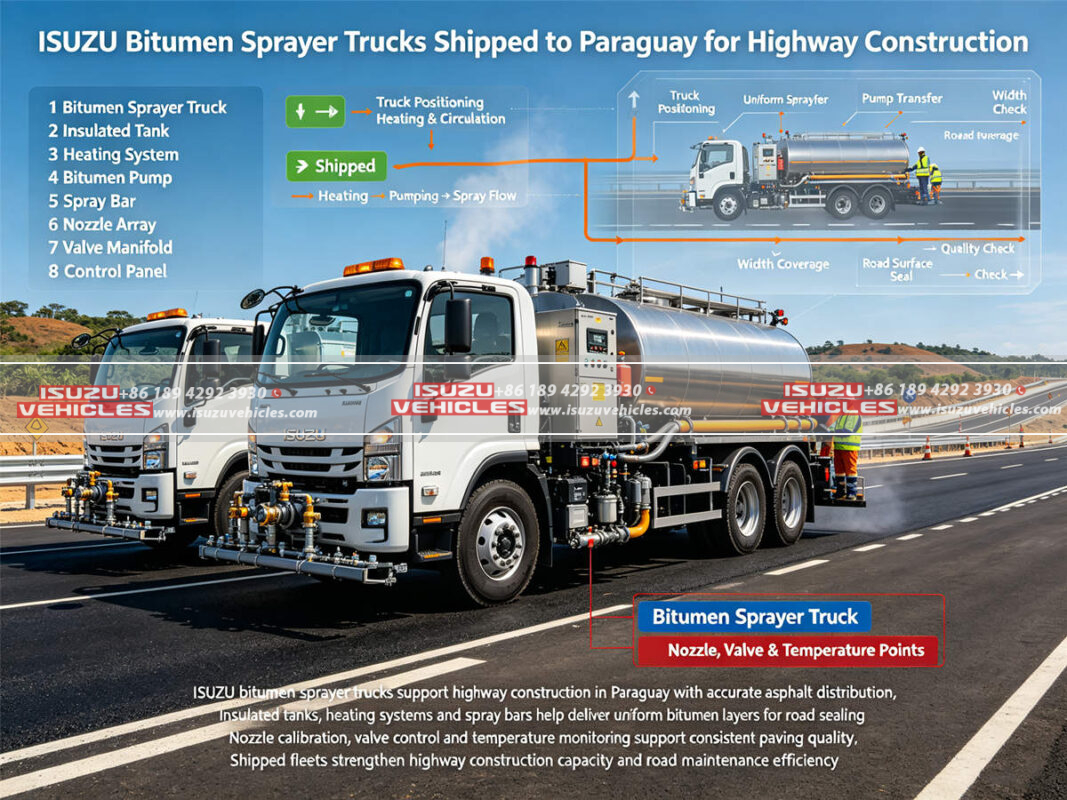
ISUZU Vehicles has completed a new commercial vehicle export project with a major local company in Paraguay, shipping a fleet of ISUZU Bitumen Sprayer Trucks to support highway construction and asphalt pavement development. The contract was made directly between ISUZU Vehicles and the Paraguayan company, which selected specialized asphalt distribution vehicles to strengthen its road construction capabilities and improve the efficiency of pavement preparation and maintenance operations.
For highway contractors, achieving a durable asphalt surface requires more than transporting paving materials and operating heavy construction machinery. The application of bitumen, asphalt emulsion, and other bonding materials must be carefully controlled to ensure consistent coverage and proper adhesion between pavement layers. The newly shipped ISUZU trucks are designed for this important task, combining a commercial vehicle chassis with an insulated asphalt tank, heating equipment, pumping system, and precision spraying components. Their arrival will provide the local contractor with practical equipment for highway projects, road rehabilitation, and other infrastructure construction activities throughout Paraguay.
1. Supporting Paraguay’s Highway Construction and Road Development
Highway construction plays an important role in connecting cities, industrial areas, agricultural regions, and commercial transportation networks. As traffic volumes and freight transportation requirements increase, road contractors need reliable equipment that can support both new pavement construction and the maintenance of existing roads. A bitumen sprayer truck is an essential part of this process because it applies asphalt-related materials to prepared surfaces before subsequent pavement layers are installed.
The ISUZU Bitumen Sprayer Trucks shipped to Paraguay are intended to support operations such as prime coat application, tack coat spraying, asphalt surface treatment, and road maintenance. These processes help prepare pavement surfaces and improve bonding between different construction layers, contributing to more consistent road construction results when combined with suitable materials, surface preparation, and compaction procedures.
For the local company’s construction teams, having dedicated spraying vehicles can improve coordination between material transportation, surface preparation, asphalt application, and paving operations. Rather than depending on separate equipment for every spraying task, contractors can use a specialized vehicle that transports the material to the working area and distributes it through an integrated spraying system.
This delivery reflects the practical value of specialized commercial vehicles in infrastructure development, where equipment reliability, application accuracy, and efficient site coordination all contribute to project performance.
2. Specialized Bitumen Spraying Systems for Consistent Application
The main purpose of an asphalt distributor truck is to store, heat, circulate, and spray bitumen or suitable asphalt materials at a controlled rate. Each component plays an important role, and the overall spraying quality depends on the coordination of the tank, heating system, pump, spray bar, nozzles, and vehicle operating speed.
Insulated Asphalt Tank and Heating System
The insulated tank is designed to reduce heat loss and help maintain the asphalt material within its required working temperature range. Depending on the selected configuration and the material being applied, a heating system may use a burner and heat-transfer arrangement to maintain suitable material conditions during transportation and spraying. Proper temperature management is particularly important when handling hot bitumen or modified asphalt because changes in viscosity can affect pumping performance and spraying consistency.
Pumping System and Adjustable Spray Bar
The pumping system transfers material from the tank through the distribution pipelines and toward the spray bar, where multiple nozzles apply it across the road surface. An adjustable spray bar allows the operator to select a suitable spraying width, while nozzle arrangement and material flow control help achieve more uniform coverage. Depending on the equipment configuration, different nozzle groups may be controlled separately to accommodate varying pavement widths and construction requirements.
Vehicle speed is another important factor because the quantity of material applied per square meter is influenced by the relationship between pump output, spraying width, and forward movement. Proper calibration and trained operation therefore remain essential for minimizing uneven application, material waste, and unnecessary rework.
For contractors comparing specialized road construction equipment, the asphalt distributor truck category from ISUZU Vehicles provides an overview of available configurations for different road spraying and pavement maintenance applications.
3. Building a More Complete Road Construction Fleet
Large highway projects require several types of equipment working together, and the bitumen sprayer truck performs one specific but important role within this coordinated construction process. Before spraying begins, the road surface must be prepared and cleaned, loose materials removed, and the application area checked to ensure that the selected treatment is suitable for the pavement condition. After the spraying operation, other construction machinery can continue with the next stages of paving, material placement, and compaction.
A tanker truck can support construction projects by transporting water or other suitable liquids required for site operations, depending on its tank material and equipment configuration. Water transportation can be useful for dust suppression, equipment cleaning, and certain road preparation activities, although a general-purpose tanker should not be used to transport bitumen unless it has been specifically designed and equipped for that material.
For concrete structures associated with bridges, drainage systems, road barriers, and other infrastructure facilities, a concrete mixer truck provides a separate but complementary service by transporting and continuously mixing concrete during delivery. Its function differs from that of an asphalt distributor, but both vehicles can contribute to the same broader infrastructure development program.
Road contractors may also use a sweeper truck to remove dust, sand, and loose debris before pavement treatment, helping prepare a cleaner working surface. A sprinkler truck can support dust control and water distribution around construction sites, especially where earthworks and material handling generate airborne particles. Together, these specialized vehicles help contractors organize site operations and maintain better working conditions across different stages of a highway project.
4. ISUZU Vehicles and Its Paraguayan Partner Coordinate the Export Project
The delivery was made under a direct contract between ISUZU Vehicles and a major local company in Paraguay, with the vehicle configuration selected to support the customer’s road construction and maintenance requirements. For specialized equipment such as a bitumen sprayer truck, understanding the intended application is essential before confirming the final specification, because tank capacity, heating arrangements, pump performance, spraying width, chassis selection, and control systems all influence how the vehicle performs on a construction site.
ISUZU Vehicles focuses on supplying commercial and special-purpose trucks for international customers, including equipment designed for road construction, municipal services, transportation, and industrial applications. In this project, the emphasis is on providing a practical asphalt distribution solution that combines vehicle mobility with dedicated material storage and spraying functions.
Before a specialized vehicle enters service, the customer should review the supplied equipment configuration, inspect the tank and pipeline connections, and verify the operation of the heating, pumping, and spraying systems. Operators should also become familiar with temperature monitoring, nozzle adjustment, spray-width control, cleaning procedures, and the manufacturer’s safety recommendations. Proper training and routine maintenance are important for protecting the equipment and maintaining consistent application performance during demanding construction assignments.
Clear coordination between the supplier and the receiving company also helps ensure that vehicle documentation, operating instructions, export arrangements, and equipment details are properly addressed. This is particularly valuable for international projects where specialized vehicles must be integrated into an existing fleet and adapted to local working procedures.
5. Improving Road Construction Efficiency with Reliable Specialized Trucks
The shipment of ISUZU Bitumen Sprayer Trucks to Paraguay represents a practical investment in the customer’s highway construction equipment fleet. By combining an asphalt storage tank, heating and circulation equipment, a pumping system, and an adjustable spraying arrangement on a commercial truck chassis, these vehicles are designed to help contractors carry out pavement treatment operations with greater control and flexibility.
Long-term performance will depend on more than the vehicle itself. Regular inspection of the tank insulation, heating components, pumps, valves, pipelines, spray nozzles, and control equipment is essential for maintaining reliable operation. Asphalt residue must be managed according to the manufacturer’s cleaning instructions, and operators should follow appropriate procedures when working with hot materials, pressurized systems, and moving construction equipment.
For the Paraguayan company, the new vehicles can become important working assets across highway construction, road rehabilitation, and pavement maintenance projects. Their specialized spraying capability can help improve coordination between different construction teams while supporting more consistent application of asphalt materials under suitable operating conditions.
Through this cooperation, ISUZU Vehicles continues to support international infrastructure contractors with commercial vehicles developed for practical working applications. The successful shipment to Paraguay demonstrates how purpose-built road construction trucks can contribute to stronger equipment fleets, more organized site operations, and the ongoing development of transportation infrastructure.