
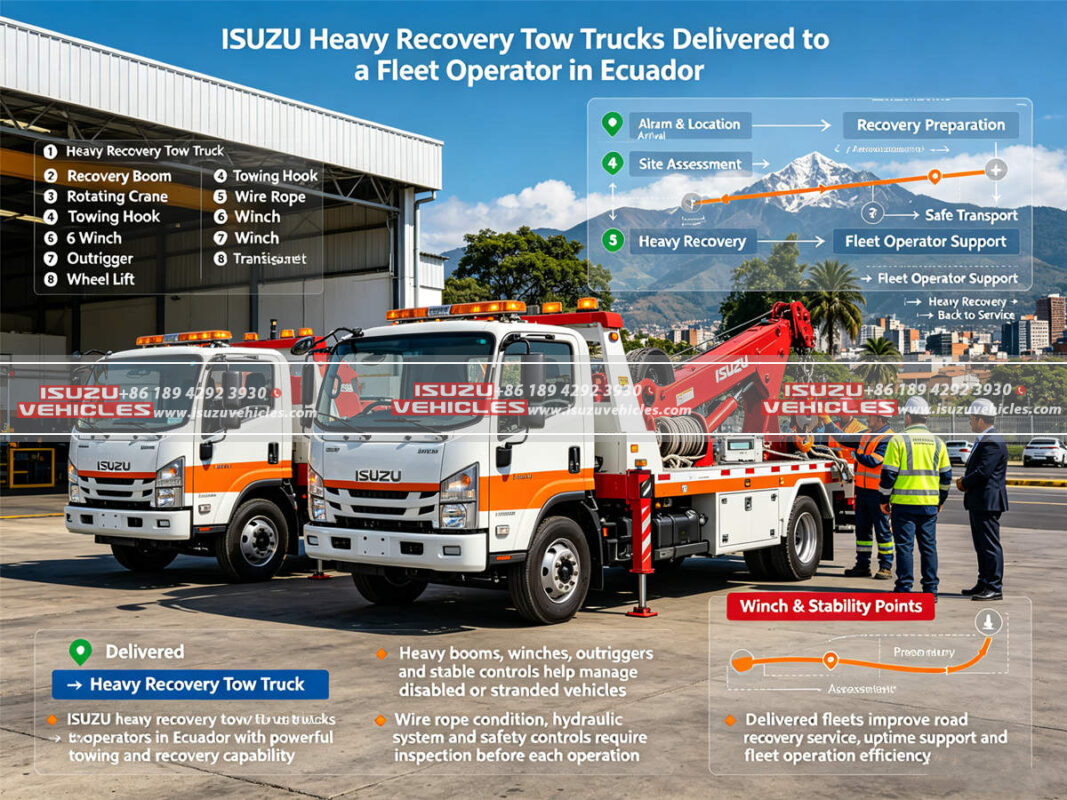
ISUZU Vehicles has successfully completed a new commercial vehicle delivery project for a major local company in Ecuador, supplying a fleet of ISUZU Heavy Recovery Tow Trucks designed to strengthen professional roadside assistance, commercial vehicle recovery, and heavy-duty transportation services. The contract was made directly between ISUZU Vehicles and the local company, reflecting the customer’s demand for dependable recovery equipment capable of supporting demanding fleet operations and helping disabled vehicles return to service safely and efficiently.
For a professional fleet operator, heavy recovery vehicles are essential assets rather than ordinary transportation trucks, because they must handle challenging situations involving disabled commercial vehicles, accident-damaged trucks, buses, and other heavy equipment. Ecuador’s varied operating environments, from busy urban roads and major freight corridors to mountainous routes and industrial areas, make dependable recovery capabilities particularly valuable. By introducing purpose-built ISUZU recovery vehicles into its operations, the customer can expand its service capacity, improve equipment availability, and provide more comprehensive assistance to commercial transportation businesses.
The delivery also demonstrates how ISUZU Vehicles works with international customers to supply specialized commercial vehicles according to their business requirements, combining established truck chassis platforms with professional hydraulic recovery equipment and practical operating configurations.
1. Heavy-Duty Recovery Capability for Ecuador’s Commercial Transport Industry
Commercial transportation depends on the continuous movement of goods, machinery, and essential supplies, meaning that an unexpected vehicle breakdown or road accident can affect not only the vehicle owner but also delivery schedules, logistics operations, and traffic conditions. When a loaded truck becomes immobilized or a commercial vehicle is involved in an accident, ordinary roadside assistance equipment may not provide sufficient lifting or towing capacity. A dedicated heavy recovery truck gives professional operators the tools required to manage these more demanding situations with greater control.
The newly delivered ISUZU Heavy Recovery Tow Trucks are intended to support a wide range of professional recovery applications, including disabled truck transportation, roadside accident assistance, commercial fleet support, and recovery work around industrial and logistics facilities. Their specialized recovery equipment can combine hydraulic lifting mechanisms, towing arms, winches, underlift assemblies, and stabilizing outriggers, depending on the selected vehicle configuration.
For the Ecuadorian fleet operator, these capabilities can help expand the range of vehicles it is equipped to recover, while allowing its service teams to respond to different operational requirements with a dedicated recovery platform. Instead of depending exclusively on smaller wreckers or external contractors, the company can strengthen its own heavy-duty recovery resources and develop a more flexible service network for commercial customers.
2. Integrated Recovery Systems Designed for Demanding Operations
The effectiveness of a heavy recovery tow truck depends on how well its chassis, hydraulic equipment, lifting mechanisms, and towing systems work together. A professional recovery vehicle must carry substantial equipment while maintaining suitable road performance, structural strength, and operational stability, particularly when its crew is working with a disabled vehicle that may be damaged, heavily loaded, or positioned in a difficult location.
Hydraulic Booms, Winches, and Underlift Equipment
Hydraulic winches provide the pulling force needed to move disabled vehicles into a suitable recovery position, while a lifting boom or underlift assembly can raise and support the vehicle before it is transported. These systems allow operators to choose an appropriate recovery method according to the condition of the vehicle, its weight distribution, the available attachment points, and the surrounding working environment.
For larger commercial vehicles, underlift equipment is especially important because it supports controlled lifting and towing while reducing the need for unsuitable attachment methods. Hydraulic outriggers or stabilizing supports can provide additional stability during operations that involve substantial lifting forces, although operators must always follow the equipment’s rated load charts, ground-condition requirements, and operating procedures.
Chassis Strength and Operator Safety
The truck chassis provides the foundation for the entire recovery system, carrying the recovery body, hydraulic components, winches, tools, and other equipment while transferring working loads through the vehicle structure. Selecting an appropriate chassis configuration is therefore essential for maintaining reliable performance during repeated recovery assignments.
Operator safety also depends on practical equipment layout, clear hydraulic controls, warning lights, suitable working illumination, and properly maintained towing accessories. Before beginning a recovery operation, trained personnel must assess the scene, secure the working area, position the vehicle appropriately, and confirm that the intended lifting or towing procedure remains within the equipment’s rated capacity.
Businesses comparing different recovery configurations can explore the heavy recovery tow truck range from ISUZU Vehicles, which includes solutions for different vehicle weights, recovery methods, and professional operating requirements.
3. Expanding Fleet Services Through Specialized Vehicle Solutions
For a large fleet operator, purchasing heavy recovery vehicles can create value beyond the immediate ability to tow disabled trucks. A professional recovery fleet can support internal vehicle maintenance, roadside assistance contracts, accident response, equipment relocation, and transportation services for customers who require specialized support. When recovery vehicles are properly scheduled and maintained, they can help reduce dependence on outside service providers and give fleet managers greater control over vehicle availability.
Heavy recovery operations may also involve lifting machinery, damaged components, or other equipment that cannot be moved safely using a conventional towing arrangement. In these circumstances, a dedicated crane truck can provide additional lifting and material-handling capability. With a suitable hydraulic crane, operators can handle certain loading, unloading, and equipment-positioning tasks that complement the work performed by recovery vehicles, although each operation must be evaluated according to the crane’s rated capacity and working radius.
Fleet operators serving infrastructure and utility customers may also benefit from an aerial work platform truck, which is designed to provide elevated access for telecommunications maintenance, streetlight servicing, electrical infrastructure work, and other tasks requiring a stable working platform. Although this vehicle performs a different function from a recovery tow truck, adding specialized equipment with clearly defined roles can help businesses build a more complete commercial service fleet.
Other municipal vehicles can support the company’s wider service activities as well. A sweeper truck helps maintain cleaner roads and industrial areas by collecting dust and debris, while a sprinkler truck can support road washing, dust suppression, landscaping, and water distribution. These vehicles do not replace recovery equipment, but they illustrate how a diversified fleet can serve different operational needs across transportation, infrastructure, and municipal services.
4. ISUZU Vehicles and the Local Partner Strengthen Recovery Operations
The cooperation between ISUZU Vehicles and the major Ecuadorian company represents a practical partnership focused on supplying specialized vehicles for demanding commercial applications. For the local customer, the most important consideration is obtaining recovery equipment that corresponds to its actual service requirements, rather than simply purchasing a truck based on appearance or general performance claims. Factors such as the weight of vehicles to be recovered, required towing capacity, lifting range, hydraulic equipment configuration, chassis arrangement, and local operating conditions all influence the final vehicle specification.
During the vehicle selection process, these requirements help determine which recovery system is most appropriate for the customer’s daily work. A fleet that frequently handles disabled heavy trucks may require a different configuration from a business primarily transporting passenger vehicles or providing light roadside assistance. Matching the vehicle’s capabilities to the expected workload can improve equipment utilization and help avoid unnecessary operating limitations.
ISUZU Vehicles also recognizes that the delivery process involves more than supplying the completed vehicles. Vehicle inspection, equipment documentation, operating instructions, export preparation, and communication with the receiving customer all contribute to a successful international project. Clear technical information is particularly important for specialized recovery vehicles because operators need to understand the equipment’s rated capacities, control functions, inspection requirements, and safety procedures before putting the trucks into service.
For the Ecuadorian partner, the delivered fleet provides an opportunity to strengthen its professional recovery resources and serve commercial transportation customers with a more capable range of equipment. The cooperation also reflects the importance of reliable supplier relationships when businesses invest in specialized vehicles intended for long-term operational use.
5. Supporting More Reliable Roadside Assistance and Fleet Management in Ecuador
The delivery of ISUZU Heavy Recovery Tow Trucks to the Ecuadorian fleet operator marks a meaningful step toward improving its ability to manage demanding vehicle recovery assignments. With dedicated hydraulic lifting and towing equipment, the company can better prepare for situations involving disabled commercial trucks, accident-damaged vehicles, and other heavy-duty recovery requirements that call for specialized machinery and trained personnel.
To achieve the best long-term results, the new vehicles should be supported by a consistent maintenance program covering the chassis, engine, transmission, hydraulic pumps, cylinders, winches, lifting arms, underlift assemblies, hoses, and safety devices. Recovery equipment should be inspected regularly, and operators should receive practical training in load assessment, vehicle attachment, stabilization, and safe towing procedures. These measures help protect personnel and equipment while supporting dependable service performance.
As the local company’s recovery capabilities develop, the vehicles can become valuable assets for supporting logistics businesses, transportation fleets, repair facilities, and roadside assistance customers throughout its service network. Their contribution is not limited to moving disabled vehicles; professional recovery services can also help reduce traffic disruption, support more efficient fleet maintenance, and improve the coordination of commercial transportation operations.
Through this cooperation, ISUZU Vehicles continues to demonstrate its commitment to providing practical commercial vehicle solutions for international customers. The delivery to Ecuador highlights the value of combining dependable truck platforms with purpose-built recovery equipment, helping professional operators strengthen their fleets, expand their service capabilities, and approach demanding roadside recovery work with greater confidence.