
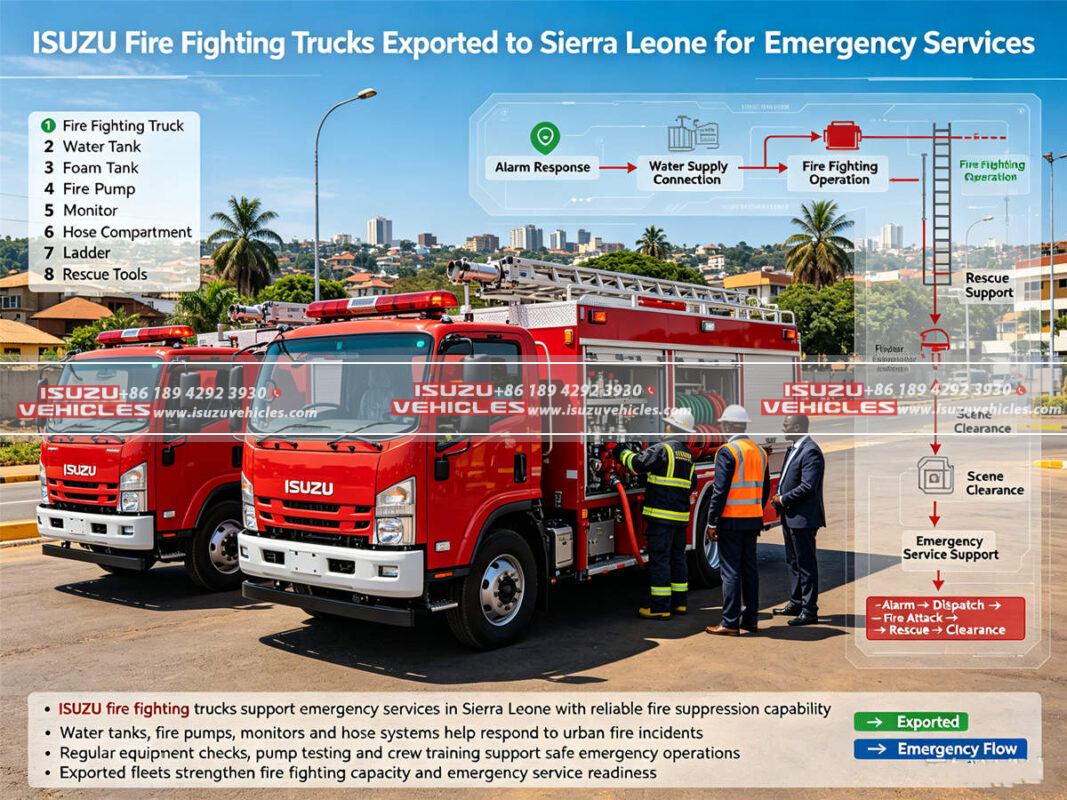
Reliable firefighting vehicles are essential to protecting communities, commercial facilities, public infrastructure, and industrial operations, particularly in regions where emergency teams must respond to a wide variety of incidents across urban areas, developing communities, and major transportation routes. With this in mind, ISUZU fire fighting trucks exported to Sierra Leone represent an important addition to the country’s emergency response capabilities, providing professional firefighting equipment on a dependable commercial vehicle platform. Supplied by ISUZU Vehicles, the vehicles are intended to support local emergency services with practical equipment for fire suppression, water delivery, and related rescue operations.
For emergency response organizations, selecting a suitable fire truck involves much more than choosing a vehicle with a large water tank or a powerful engine. The complete configuration must bring together chassis performance, firefighting equipment, water storage, pump capacity, hose connections, crew accommodation, and operational safety. These systems need to work together under demanding conditions, allowing firefighters to reach an incident, establish a water supply, and begin suppression activities as efficiently as possible. A properly configured ISUZU fire truck can provide this combination of transportation and specialized emergency equipment in one integrated vehicle.
The export to Sierra Leone also reflects the importance of matching commercial vehicle technology with local operational requirements. From responding to residential fires and commercial property incidents to supporting industrial facilities and public infrastructure, fire departments need equipment that can perform consistently across different working environments. Through vehicle configuration and equipment selection, ISUZU Vehicles aims to provide practical firefighting solutions that can be adapted to the needs of emergency service operators.
1. Supporting Emergency Response and Fire Protection in Sierra Leone
Fire protection is a critical public service because fires can develop rapidly and cause serious damage to homes, businesses, warehouses, workshops, vehicles, and public facilities. When emergency teams have to travel through busy streets or reach incidents outside major urban centers, the availability of suitable firefighting vehicles can make a meaningful difference to their response capabilities. A dedicated fire fighting truck gives crews a mobile platform that carries essential suppression equipment directly to the scene instead of relying entirely on separate water sources and manually transported equipment.
In Sierra Leone, emergency services may face different types of fire incidents depending on the location and surrounding environment. Residential areas can involve closely spaced buildings and limited access, while commercial districts may contain shops, storage facilities, offices, and other properties with different fire risks. Industrial and logistics operations can also require specialized response planning because stored materials, machinery, electrical installations, and vehicle traffic may complicate firefighting work.
For these situations, an ISUZU fire truck can serve as a central part of an emergency response fleet. Its chassis provides the mobility needed to transport firefighters and equipment, while the specialized bodywork accommodates the systems required for fire suppression. Depending on the selected configuration, the vehicle can be equipped with a water tank, foam tank, fire pump, roof-mounted monitor, hose compartments, and additional firefighting accessories.
The export of these vehicles is therefore not simply about supplying another commercial truck. It is about providing emergency organizations with a purpose-built working platform that can support coordinated firefighting activities, improve equipment availability at incident scenes, and help local teams carry out their duties with greater operational flexibility.
2. ISUZU Fire Truck Design: Chassis, Water Tank, and Firefighting Equipment
A professional fire fighting truck combines a road vehicle with a specialized firefighting system, and every major component has a specific role in the overall operation. The chassis must carry the vehicle body, water or foam storage, pump assembly, hoses, tools, and crew without compromising driving stability. At the same time, the firefighting body must provide organized storage and convenient access to the equipment that firefighters need during an emergency.
Reliable Chassis and Practical Vehicle Configuration
The ISUZU commercial vehicle platform offers a foundation for different emergency vehicle configurations, from relatively compact fire engines intended for municipal use to heavy-duty models designed for larger water capacities and more demanding applications. The appropriate chassis depends on factors such as the required tank volume, vehicle dimensions, road conditions, crew capacity, and the type of firefighting equipment installed.
For emergency services, vehicle maneuverability is particularly important when operating in residential neighborhoods, narrow streets, or locations where roadside parking and other obstacles restrict access. A suitable wheelbase and overall vehicle size can help the driver position the truck close enough to the incident while maintaining a safe working area for firefighters. Meanwhile, a properly selected engine and transmission provide the driving performance needed to transport the fully equipped vehicle between emergency stations and incident locations.
Water Storage and Pumping System
The water tank is one of the most important components of a conventional fire engine because it provides an initial supply of firefighting water before the crew establishes a connection to a hydrant, reservoir, or other external source. Tank capacity should be selected according to the expected operating conditions, vehicle size, available water infrastructure, and the department’s firefighting strategy.
A fire pump draws water from the onboard tank or an external supply and delivers it through the vehicle’s discharge outlets and hose connections. The pump’s flow rate and operating pressure influence how effectively firefighters can direct water toward a fire, although the actual performance also depends on hose diameter, hose length, nozzle selection, elevation differences, and the arrangement of the water supply system. A roof-mounted fire monitor can provide a controlled stream from an elevated position, allowing operators to direct water toward areas that may be difficult to reach with hand-held hoses.
Some configurations also include foam equipment for incidents involving flammable liquids or other situations where foam-based suppression is appropriate. The final equipment package should always be matched to the operational responsibilities of the receiving fire department rather than selected solely on the basis of maximum capacity.
Organizations looking for different firefighting configurations can explore the fire truck category from ISUZU Vehicles, which includes different vehicle types and equipment arrangements for municipal, industrial, and specialized emergency response applications.
3. How the Fire Fighting Trucks Support Different Emergency Operations
Although structural firefighting is one of the primary responsibilities of a fire department, emergency vehicles are frequently required to support a broader range of incidents. A versatile fire engine can help crews respond to building fires, roadside emergencies, commercial property incidents, and other situations where a mobile water supply and specialized firefighting equipment are needed. The exact role of each vehicle depends on its installed equipment, local emergency procedures, and the resources available at the incident scene.
Residential and Commercial Building Fires
Residential and commercial fires require rapid coordination between vehicle operators, pump personnel, and firefighters working with hoses and other equipment. Once the truck arrives, the crew must assess the surrounding area, position the vehicle safely, and determine the most appropriate water supply and discharge arrangement. The onboard tank can provide an initial source of water, while the pump helps deliver it to the required outlets.
Commercial buildings may present additional challenges because of larger floor areas, storage rooms, electrical installations, and materials that can produce substantial heat or smoke. In these circumstances, access to suitable hoses, nozzles, breathing equipment, and other emergency tools is just as important as the vehicle’s water capacity. Organized equipment compartments help firefighters locate essential accessories without unnecessary delays.
Industrial and Infrastructure Fire Protection
Industrial facilities, warehouses, workshops, transport facilities, and fuel-related installations may require firefighting resources that differ from those used for ordinary residential incidents. Certain locations may benefit from water-and-foam configurations, while others may require a larger water supply or specialized rescue equipment. Emergency service planners should evaluate the types of materials stored at each facility, the layout of the property, access roads, and the availability of external water sources before selecting the appropriate vehicle.
Fire fighting trucks can also support emergency operations around public infrastructure, including roads, transport terminals, utility facilities, and other important community assets. Their value comes from combining mobility with equipment that can be deployed directly at the scene, allowing emergency teams to establish an organized response rather than transporting individual tools separately.
Water Supply and Support Activities
Water availability can influence firefighting operations, particularly when an incident occurs in an area without convenient access to a hydrant or other reliable water source. A fire truck with an onboard tank can provide an initial supply, while suitable external connections allow the crew to replenish water or operate in coordination with other vehicles. In larger incidents, additional water transportation vehicles may be useful for maintaining a continuous supply to the firefighting operation.
A conventional tanker truck can support water transportation and other liquid-delivery tasks when configured for the intended material. However, a general-purpose water tanker is not automatically a substitute for a purpose-built fire engine, because professional firefighting requires dedicated pumps, discharge systems, hose connections, and appropriate safety equipment. For emergency organizations, the most effective fleet arrangement is often a combination of specialized fire engines and supporting water-supply vehicles.
4. Why Equipment Selection Matters for Sierra Leone’s Fire Services
Purchasing a fire fighting truck is a long-term fleet decision, and the initial vehicle specification should reflect the conditions in which the truck will actually operate. A model that performs well in one city or industrial environment may not be the most suitable choice for another location with different road conditions, water infrastructure, staffing arrangements, or maintenance resources. For this reason, emergency service organizations should evaluate the complete working environment before confirming the vehicle configuration.
One important consideration is the balance between water capacity and vehicle mobility. A larger tank can provide more onboard water, but it also increases the vehicle’s operating weight and places greater demands on the chassis, braking system, tires, and road access. A smaller vehicle may be easier to maneuver in congested areas, although its water supply may be more limited. The best solution depends on the types of incidents the department expects to handle and the availability of additional water resources.
Another consideration is the arrangement of firefighting equipment. Pump controls should be accessible to trained operators, hose compartments should be organized logically, and frequently used tools should be easy to reach. Clear labeling and practical storage arrangements can help crews work more efficiently, especially when several firefighters need to access different parts of the vehicle during an emergency.
Maintenance and operator training are equally important. Fire trucks contain mechanical, hydraulic, electrical, and water-handling systems that require regular inspection. Fire pumps, valves, monitors, tank fittings, hoses, warning lights, and other equipment should be checked according to the manufacturer’s instructions and the department’s maintenance procedures. Drivers and pump operators should also receive appropriate training so they understand the vehicle’s controls, operating limits, and safety requirements.
For locations where emergency services also perform elevated access or infrastructure-related duties, a separate bucket truck may be useful for utility maintenance, lighting repairs, and other aerial work. It is important to distinguish this type of vehicle from an aerial firefighting apparatus: a bucket truck is generally designed for elevated access and maintenance, while an aerial fire truck is engineered with specialized rescue and firefighting systems. Selecting the correct equipment for each task helps prevent unsuitable vehicles from being used outside their intended applications.
5. ISUZU Vehicles: Export Support and Vehicle Customization
Exporting specialized emergency vehicles requires coordination between the manufacturer, vehicle supplier, logistics providers, and the receiving organization. Unlike a standard cargo truck, a fire fighting vehicle contains several integrated systems that must be considered during specification, production, inspection, and delivery. The chassis, tank body, pump, monitor, piping, electrical equipment, warning systems, and storage compartments all need to be compatible with the intended operating requirements.
ISUZU Vehicles focuses on supplying commercial and special-purpose vehicles for customers in international markets, including firefighting trucks and other municipal equipment. For an export project serving Sierra Leone, the vehicle configuration should be discussed in relation to the receiving department’s actual needs, including the expected incident types, required water capacity, available water sources, road conditions, crew arrangements, and preferred firefighting accessories.
Customization can involve several practical details. The customer may need a particular tank capacity, a specific pump arrangement, additional hose compartments, a selected fire monitor, or a different layout for equipment storage. Other considerations may include left-hand or right-hand drive requirements, local road regulations, lighting and warning equipment, language requirements for labels and operating documents, and the availability of maintenance support.
Before shipment, the vehicle should undergo appropriate inspection and functional checks. These may include reviewing the chassis and body configuration, inspecting tank construction and fittings, checking the pump and pipeline system, testing the monitor and discharge outlets, and confirming that the supplied accessories match the agreed specification. Documentation should also be prepared to support transportation, customs clearance, vehicle registration, and subsequent operation in the destination market.
For international buyers, clear communication during the specification stage is especially valuable. Providing information about the intended application and operating environment helps the supplier recommend a more suitable vehicle rather than relying on a general-purpose configuration that may not meet the department’s requirements. This approach can also reduce misunderstandings about equipment, delivery arrangements, and after-sales support.
6. Building a More Capable Emergency Vehicle Fleet
The export of ISUZU fire fighting trucks to Sierra Leone highlights the importance of equipping emergency services with vehicles designed around practical operational requirements. A fire engine must be capable of reaching an incident, carrying the necessary crew and equipment, providing an initial water supply, and supporting coordinated firefighting work. Its effectiveness depends not on one specification alone, but on the integration of the chassis, tank, pump, monitor, hoses, safety equipment, and the people trained to operate them.
For local emergency organizations, the next step is to ensure that the vehicles are incorporated into a well-planned fleet and supported by appropriate operating procedures. Regular maintenance, pump testing, driver training, equipment inspections, and practical emergency exercises all contribute to reliable performance over the vehicle’s service life. Fire departments should also review their water-supply arrangements and determine whether additional tankers or other support vehicles are needed for incidents involving larger properties or locations with limited water infrastructure.
A well-planned emergency fleet may include conventional water fire trucks, water-and-foam fire engines, rescue vehicles, and specialized aerial firefighting equipment, with each vehicle assigned a clearly defined role. Supporting vehicles can provide additional water transportation, elevated access, or other services, but they should be selected according to their intended functions and should not replace dedicated firefighting equipment where it is required.
Through its range of commercial and special-purpose vehicles, ISUZU Vehicles aims to help international customers identify practical solutions for municipal services, industrial operations, and emergency response. The delivery of firefighting vehicles to Sierra Leone is an example of how specialized truck configurations can support local emergency organizations as they develop their operational resources. With suitable equipment, trained personnel, and a consistent maintenance program, these vehicles can become valuable assets in protecting communities, responding to emergencies, and strengthening fire protection services.