
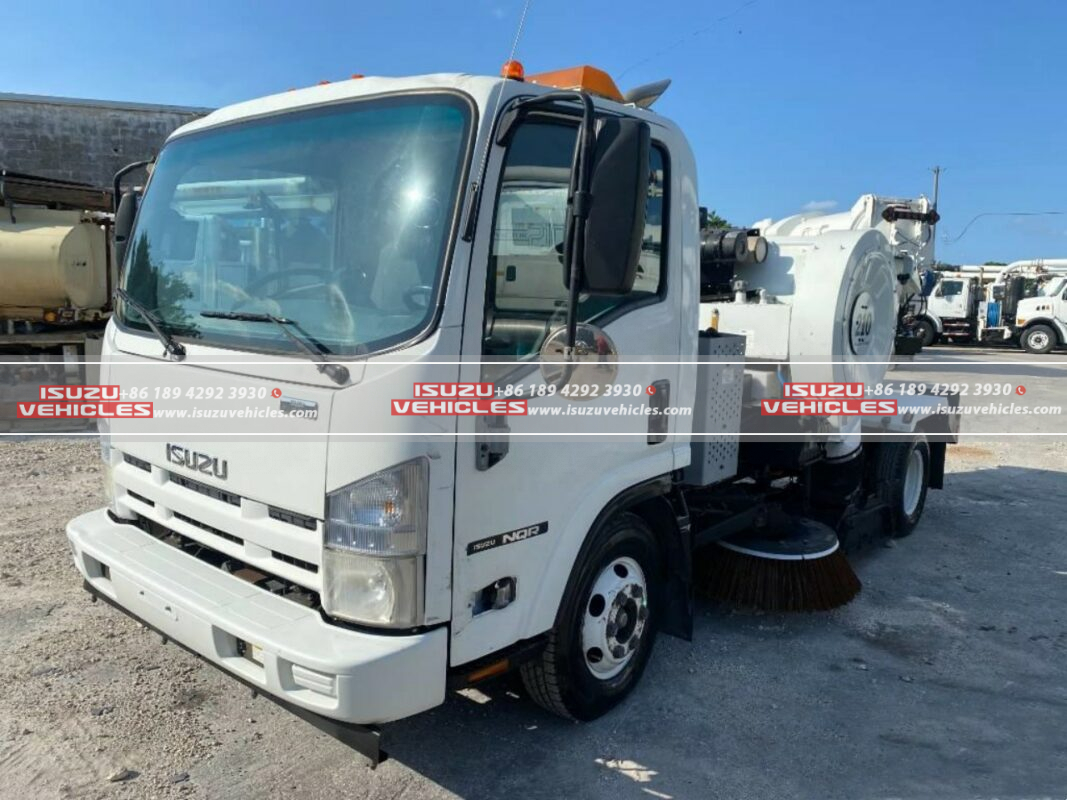
The arrival of a state-of-the-art ISUZU Road Sweeper Truck fleet in Kenya marks a transformative leap in the nation’s pursuit of sustainable urban sanitation, deploying precision cleaning technologies across Nairobi’s bustling arteries, Mombasa’s coastal corridors, and rapidly expanding secondary cities where particulate pollution, plastic waste, and seasonal flooding compromise public health and tourism economies. Engineered explicitly for East Africa’s diverse environmental challenges—from the arid dust storms of Northern Kenya to the monsoonal debris flows in Western highlands—these vehicles integrate AI-driven regenerative air systems capturing 99.5% of PM2.5 particulates while recycling 90% of water used, enabling county governments to slash street cleaning costs by 45% while achieving WHO air quality standards; this strategic infusion directly accelerates Kenya’s Vision 2030 goals for green cities, empowering municipalities to combat cholera outbreaks linked to clogged drains, elevate urban livability indices, and position Kenya as Africa’s benchmark for intelligent municipal hygiene management.
Cutting-Edge Sweeping Technology for African Metropolises
Redefining urban cleanliness through Japanese engineering rigor, the ISUZU GIGA-Series Sweepers fuse extreme-duty chassis with ecological innovation, featuring quad-stage filtration systems that sequester everything from construction silt to microplastics below 10 microns, while terrain-adaptive brush pressure automatically modulates cleaning intensity on surfaces ranging from tarmac highways to unpaved informal settlements.
Revolutionary Debris Management Capabilities
Patented vortex-assisted suction chambers generate 30kPa vacuum force to extract deeply embedded waste without damaging road surfaces, coupled with real-time debris classification sensors that identify hazardous materials like broken glass or medical waste, triggering automatic containment protocols; the closed-loop water recovery system purifies and recycles 8,000 liters per shift—a critical advantage in Kenya’s drought-prone regions.
Operational Resilience Architecture
Enhanced by flood-fording air intakes allowing operation during flash floods, and corrosion-resistant composite bodies resisting salt erosion in coastal counties, these trucks maintain 98% uptime in extreme conditions; crucially, solar-enhanced power trains extend daily operational windows by 5 hours, enabling nocturnal cleaning cycles that minimize traffic disruption across Kenya’s congested urban centers.
Intelligent Urban Ecosystem Integration
The fleet transcends mechanical cleaning to become networked environmental sentinels, with embedded IoT sensors mapping pollution hotspots and transmitting data to county command centers for predictive resource allocation.
Data-Driven Municipal Governance
Particulate matter analytics identify construction sites or markets requiring intensified cleaning, while route optimization algorithms slash fuel consumption by 25% through real-time traffic avoidance; simultaneously, blockage prediction AI forecasts drain choke points before flooding occurs, transforming reactive waste management into preemptive urban resilience.
Citizen Engagement Platforms
Integrated public QR code systems enable residents to report dumping incidents triggering sweeper redeployment within 15 minutes, fostering community co-stewardship of clean neighborhoods while generating granular performance metrics for county transparency audits.
Strategic Partnership: Localizing Green Technology Sovereignty
This deployment stems from a landmark alliance between ISUZU Vehicles and Kenya’s industrial leader, Jenga EcoCities Consortium, establishing a co-innovation framework that embeds manufacturing, technical upskilling, and circular economy principles within Kenya’s sanitation sector.
End-to-End Capacity Ecosystem
The collaboration launches East Africa’s first Sweeper Technology Academy in Nakuru, certifying 400+ Kenyan engineers in telematics and electric-hydraulic systems, while Nairobi-based assembly lines commence localized production of filtration modules and control units—reducing parts import dependency by 50% through ISUZU-endorsed quality standards. Concurrent waste valorization partnerships will convert collected plastics into recycled construction materials, creating self-sustaining funding loops for municipal hygiene programs.
Industrial Catalysis Through Vertical Integration
Beyond sanitation gains, the venture ignites Kenya’s manufacturing renaissance via domestic fabrication of high-torque suction fans and sensor arrays, creating 250+ specialized jobs and stimulating local steel and electronics suppliers—with 40% local content integration targeted by 2028. This model positions Jenga as Africa’s hub for self-reliant urban environmental technology.
Socioeconomic Renaissance Through Clean Cities
The ISUZU-Jenga initiative delivers quantifiable co-benefits beyond hygiene, where reduced respiratory diseases from dust suppression save county health budgets $12M annually, while enhanced tourism appeal for spotless urban centers boosts hospitality revenues by 9%. Marginalized waste pickers formalized into sweeper technician roles gain 300% income increases, embodying Kenya’s commitment to inclusive green growth where environmental progress and poverty alleviation converge.
Pioneering Kenya’s Holistic Urban Metabolism
The ISUZU-Jenga partnership lays foundations for Africa’s most advanced Integrated Municipal Services Platform, with imminent phase-two deployments including ISUZU vacuum trucks for deep drain maintenance and ISUZU garbage trucks featuring AI-guided compaction systems for synchronized waste collection. This fleet-level integration enables seamless material flow—from street to landfill—transforming Kenyan cities into laboratories of circular urbanism. By converting organic waste into biogas for sweeper fleets and repurposing recovered plastics for road repairs, Kenya pioneers a Zero-Waste Urban Future, setting replicable benchmarks for emerging economies battling the dual crises of pollution and climate vulnerability through technological leapfrogging.