
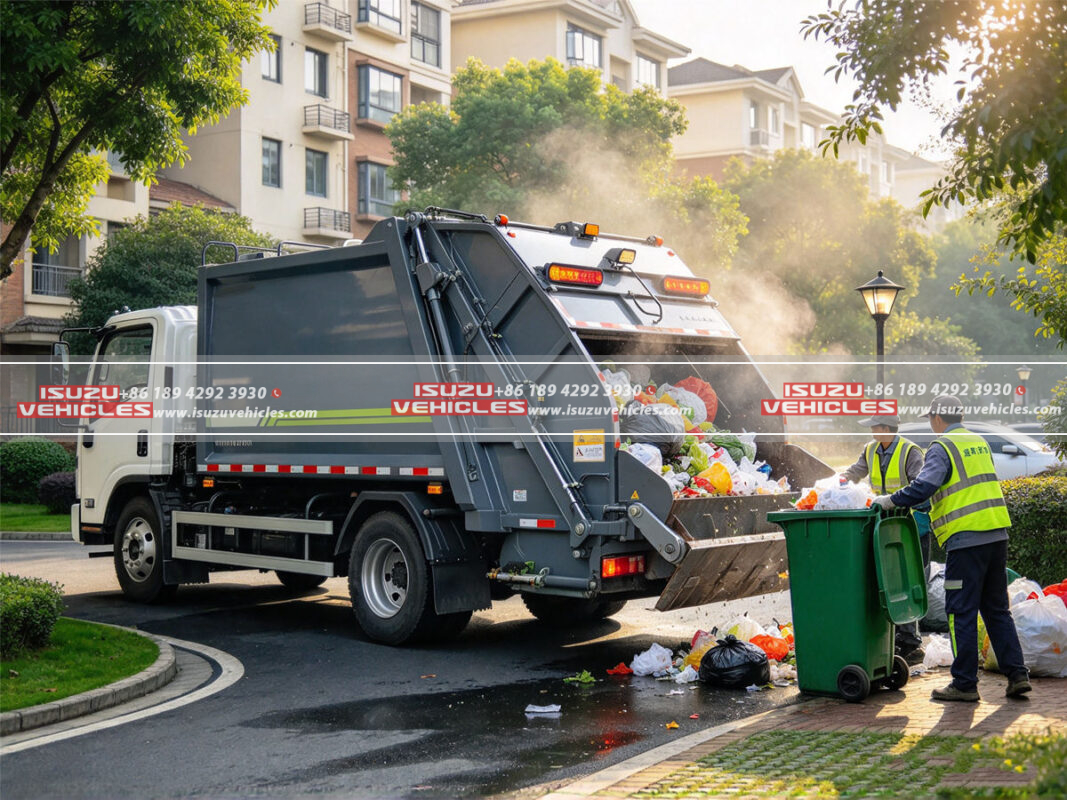
Modern municipal waste collection depends on much more than simply placing garbage into a truck and transporting it away. Household refuse is usually light but bulky, irregularly shaped, and mixed with a considerable amount of empty space, which means that an ordinary truck body can reach its physical volume limit long before its chassis reaches its allowable payload. An ISUZU garbage truck solves this problem by combining a specialized loading hopper, hydraulic cylinders, packer mechanisms, scraper and sliding plates, a sealed refuse body, and an ejection system that continuously reduces the occupied volume of waste during collection. The result is a vehicle capable of collecting considerably more refuse during a route while reducing unnecessary transportation trips.
The compaction process is a carefully coordinated sequence rather than a single hydraulic movement. Waste enters the rear hopper, the hydraulic system activates the packing mechanism, the refuse is scraped and compressed, and the compacted material is pushed into the main storage compartment. As the collection route continues, repeated cycles gradually fill the body with denser waste. When the truck reaches its disposal destination, an ejection plate pushes the compacted refuse outward, allowing the body to be emptied efficiently. Current ISUZU Vehicles compactor models use different body capacities and configurations, ranging from compact urban garbage trucks to large-capacity refuse vehicles designed for intensive municipal collection operations.
What Is the Compaction System of an ISUZU Garbage Truck?
The compaction system is the specialized working mechanism installed between the truck chassis and the garbage body, and its purpose is to receive loose refuse, reduce the amount of empty space between individual pieces of waste, and transfer the resulting compacted mass into the storage compartment. Unlike an ordinary cargo body, which simply stores whatever material is loaded into it, a compactor body actively processes the waste throughout the collection operation.
A typical ISUZU rear-loading compactor incorporates a rear hopper, packer plate, scraper mechanism, sliding or skateboard plate, hydraulic cylinders, hydraulic pump, directional control valves, a storage body, sewage collection components, and an ejection plate. Each part performs a different task, but the system is designed so that these movements occur in a coordinated sequence. The hydraulic cylinders provide the mechanical force, while the control system determines when and how each component moves.
For example, the ISUZU 8 CBM Compactor Garbage Truck uses a high-strength steel refuse body together with packer plate cylinders, a scraper cylinder, a skateboard cylinder, an ejection cylinder, and an ejection plate. Its listed maximum compression ratio can reach 1:3, depending on the operating conditions and waste characteristics, allowing a substantial amount of loose household refuse to be reduced in occupied volume before transportation.
This explains why the term “compaction” is so important in municipal sanitation. The truck is not simply carrying a fixed volume of garbage; it is continuously changing the physical arrangement and density of the material so that the available storage space can be used more effectively.
How Does Garbage Enter the Compaction System?
The process begins at the rear of the truck, where the loading hopper provides a temporary receiving area for incoming refuse. During a residential or commercial collection route, garbage can be placed into the hopper manually or transferred using a mechanical bin-lifting mechanism, depending on the configuration of the truck and the type of collection service.
The hopper is important because household garbage rarely arrives as a neat, uniform material. Plastic bags, cardboard, food packaging, paper, textiles, containers, and other everyday waste can have completely different shapes, sizes, and densities. If this material were pushed directly into a storage body without controlled processing, large air gaps would remain between objects, causing the truck to fill rapidly without making efficient use of its available capacity.
The Hopper Creates a Controlled Loading Area
Instead of allowing incoming waste to spread randomly throughout the body, the rear hopper temporarily gathers the material in front of the compaction mechanism. Once enough refuse has accumulated, the hydraulic system activates the packing cycle and begins moving the material toward the storage compartment.
Some ISUZU compactor configurations also include mechanical bin lifters that allow standardized waste containers to be raised and emptied into the hopper, reducing manual handling and making repeated collection operations more consistent. The current ISUZU 8 CBM configuration, for example, can be equipped with a bin lifter designed for 120-liter and 240-liter garbage bins, providing a practical solution for organized residential and commercial collection routes.
The hopper therefore serves as the transition point between the collection activity outside the vehicle and the hydraulic compression process inside the vehicle. Its size, shape, material strength, and relationship with the packer mechanism all affect how smoothly the truck can process incoming refuse.
How Does the Hydraulic Compaction Cycle Work?
The hydraulic system is the power source behind the compaction mechanism. In a typical truck, engine power is transferred through a Power Take-Off, or PTO, to a hydraulic pump, which pressurizes hydraulic oil and sends it through control valves to the appropriate cylinders. These cylinders convert hydraulic pressure into controlled mechanical movement, allowing the packer plate, scraper, sliding plate, and other components to perform their individual functions.
Step 1: The Scraper Gathers the Waste
Once refuse has accumulated in the hopper, the scraper mechanism begins the initial movement. Its purpose is to gather waste and prepare it for the main compression movement, helping prevent material from remaining in corners or around the edges of the loading area.
This stage is particularly important because household waste can contain flexible bags and irregular objects that do not naturally move as a single mass. The scraper helps reorganize the material so that the following packing movement can process it more effectively.
Step 2: The Packer Plate Compresses the Material
The packer plate then moves through the hopper and forces the gathered refuse toward the main garbage compartment. As the plate advances, plastic bags collapse, cardboard is flattened, containers are pressed together, and the empty spaces between individual pieces of waste are substantially reduced.
The pressure generated by the hydraulic cylinders must be sufficient to compact the waste without placing excessive stress on the mechanical structure. This is why the hydraulic system, cylinder dimensions, valve configuration, steel body construction, and control sequence are engineered as a complete system rather than selected independently.
The ISUZU 7 CBM Compactor Garbage Truck, for instance, is equipped with a 7 CBM compaction chamber and a listed working cycle time of approximately 20 seconds, while its high-strength steel hopper and hydraulic equipment are designed for repeated municipal collection cycles.
Step 3: The Sliding Mechanism Transfers the Waste
After the refuse has been compressed, the sliding or skateboard mechanism helps move the material farther into the storage body. This creates space in the hopper for the next load and prevents compacted material from remaining concentrated near the rear of the truck.
The process is repeated continuously throughout the collection route. Each cycle adds another compressed layer of waste to the storage compartment, gradually increasing the overall density of the load while making better use of the body’s available volume.
How Does the Compacted Waste Fill the Garbage Body?
One of the most important advantages of the compaction system is that waste is not simply compressed once and left in the same location. Instead, the hydraulic mechanism gradually transfers compacted material into the main body, where repeated loading cycles build up a dense mass of refuse. This allows the vehicle to use its storage volume much more efficiently than an open-body collection truck.
The relationship between body capacity and compaction performance is particularly important when comparing garbage trucks. A truck advertised with an 8 CBM refuse body, for example, has a physical storage volume of approximately eight cubic meters, but the actual mass of waste it can transport depends on the density of the refuse and the chassis payload limit. Compaction allows more waste to occupy that physical space, but it does not eliminate the vehicle’s legal or structural payload limitations.
The ISUZU 18 CBM Compactor Garbage Truck demonstrates how the same principle is applied to a much larger municipal vehicle. It uses an 18 CBM effective refuse container, an approximately 1.5 CBM hopper, a hydraulic compaction mechanism, and an automated/manual control system, allowing it to process larger waste volumes for municipalities and professional sanitation contractors.
For larger fleets, this increased carrying efficiency can have a meaningful effect on route planning. If a compactor truck can collect more refuse before its body reaches the practical limit, the vehicle may require fewer trips to a transfer station or disposal facility. Fewer unnecessary trips can mean improved route productivity, lower fuel consumption, reduced driver time, and better utilization of the sanitation fleet.
How Does the Hydraulic System Control Compaction?
The hydraulic system can be regarded as the working muscle of the compactor body, but its effectiveness depends on precise control rather than raw pressure alone. Hydraulic oil is delivered from the pump through valves that direct it to individual cylinders, allowing the operator or automated control system to determine which component moves, in which direction, and at what stage of the compaction cycle.
PTO and Hydraulic Pump
The Power Take-Off transfers mechanical power from the truck’s drivetrain to the hydraulic pump. Once the PTO is engaged, the pump generates the hydraulic flow needed to operate the compactor equipment. This arrangement allows the main vehicle engine to provide energy to the specialized sanitation body without requiring a completely separate primary power source.
Cylinders and Directional Valves
Hydraulic cylinders are responsible for converting hydraulic pressure into linear movement. Different cylinders can control the packer plate, scraper, sliding plate, hopper, tailgate, or ejection mechanism. Directional control valves determine whether a cylinder extends or retracts and coordinate the sequence of these movements.
Modern systems can use manual controls, semi-automatic controls, or programmable electronic control systems, depending on the truck specification. Larger configurations can incorporate intelligent control technology to coordinate multiple operations and improve repeatability. The ISUZU 18 CBM model, for example, uses an intelligent PLC control system alongside automated and manual operating modes.
Reliable hydraulic control is especially important because garbage collection is a repetitive operation. A truck may perform hundreds of compression cycles during a working route, so the hydraulic components must withstand continuous pressure changes, vibration, contamination risks, and mechanical loading without losing consistent performance.
How Does an ISUZU Compactor Handle Sewage and Leakage?
Compaction does more than reduce waste volume; it can also force liquid out of household refuse. Food waste, wet paper, organic material, and other refuse may contain substantial moisture, and when the material is compressed, this liquid can accumulate at the bottom of the hopper or refuse body.
For this reason, a professional compactor garbage truck requires appropriate sewage collection and sealing arrangements. Instead of allowing contaminated liquid to leak onto the road, the body can incorporate dedicated sewage tanks and sealing components that help contain the liquid during loading and transportation.
The ISUZU 8 CBM garbage truck configuration, for example, incorporates a sewage tank beneath the hopper as well as a sewage tank associated with the compactor body, while rubber sealing strips and reinforced steel structures help improve containment.
This is an important difference between a specialized refuse truck and an ordinary cargo vehicle. Municipal waste can contain unpleasant odors, contaminated liquids, and materials that should not be exposed to the surrounding environment during transportation. A properly engineered compactor body therefore needs to address containment, sealing, drainage, loading, compression, and unloading as part of one integrated design.
How Is the Compacted Garbage Discharged?
Once the garbage truck reaches a transfer station, landfill, treatment facility, or other authorized disposal location, the compaction process is reversed through the discharge system. The rear structure is opened or raised as required, and the internal ejection plate moves forward or backward to push the compacted refuse out of the storage compartment.
The ejection plate is particularly useful because compacted waste can become dense and difficult to remove through gravity alone. Simply tipping a heavily filled body may leave material sticking to the interior walls, especially when the refuse contains wet organic matter, plastic bags, or compressed cardboard.
A hydraulic ejection cylinder therefore pushes the refuse toward the discharge opening, helping empty the body more completely and reducing the need for workers to enter or manually clean the garbage compartment. The precise discharge sequence depends on the specific body design, but the fundamental principle is the same: hydraulic force is used to move the compacted waste out of the truck in a controlled manner.
Fast discharge is particularly valuable in high-volume municipal operations because time spent at disposal facilities directly affects the number of collection cycles a vehicle can complete during a working day. Current ISUZU models provide different discharge arrangements and cycle times according to their capacity and body configuration.
After discharge, the compactor mechanism returns to its initial position, the tailgate and hopper are secured, and the vehicle can return to its collection route. This creates a complete operational cycle of loading, scraping, compressing, transferring, transporting, discharging, and returning to service.
Why Is Compaction Important for Municipal Waste Collection?
The primary benefit of compaction is improved use of available storage volume, but its operational advantages extend beyond simply carrying more garbage. By reducing the amount of empty space within the refuse load, a compactor can increase the amount of waste collected per trip, potentially reduce the number of journeys to disposal facilities, and improve the productivity of the overall sanitation route.
A compactor garbage truck also provides a more controlled method of transporting refuse. The sealed body reduces the possibility of loose waste falling from the vehicle during transportation, while sewage tanks and sealing systems help control contaminated liquid. These features are particularly important when trucks operate through densely populated residential districts where cleanliness, traffic safety, and environmental protection are major concerns.
It is also useful to understand how a compactor garbage truck differs from other municipal sanitation vehicles. A sweeper truck, for example, is primarily designed to remove dust, leaves, sand, and scattered debris from road surfaces using brushes, suction systems, and water spraying equipment. A vacuum truck uses powerful suction to collect liquids, sludge, wastewater, or other materials depending on its specialized configuration. A garbage compactor, by contrast, is designed specifically around the collection, compression, containment, transportation, and discharge of solid municipal refuse.
These vehicles can nevertheless work as part of the same sanitation fleet. A sweeper truck can clean the streets after waste collection, while a vacuum truck can handle wastewater and sludge-related tasks, and the garbage truck can transport household and commercial solid waste. ISUZU Vehicles offers these different specialized vehicle categories, allowing municipalities and sanitation contractors to build fleets around their actual operational requirements rather than trying to make one truck perform every possible task.
The compaction system is therefore the central working technology that distinguishes a modern refuse truck from a conventional cargo vehicle. Through the coordinated movement of hydraulic cylinders, packer plates, scrapers, sliding mechanisms, and ejection plates, loose garbage is progressively reorganized into a denser load that can be transported more efficiently. Combined with a high-strength body, reliable hydraulic equipment, proper sealing, sewage containment, and practical loading mechanisms, this system enables an ISUZU garbage truck to perform repeated collection cycles with a high level of consistency.
For municipalities, waste management companies, industrial parks, residential communities, schools, hospitals, and commercial districts, choosing the right compactor configuration ultimately depends on more than body capacity alone. Route length, daily waste volume, waste composition, loading method, chassis payload, disposal distance, required automation level, and local operating conditions all influence the ideal vehicle specification. When these factors are properly matched, the hydraulic compaction system becomes far more than a simple pressing mechanism: it becomes the core of an efficient waste collection process that helps ISUZU Vehicles turn repeated loading operations into a productive, controlled, and hygienic municipal sanitation service.