
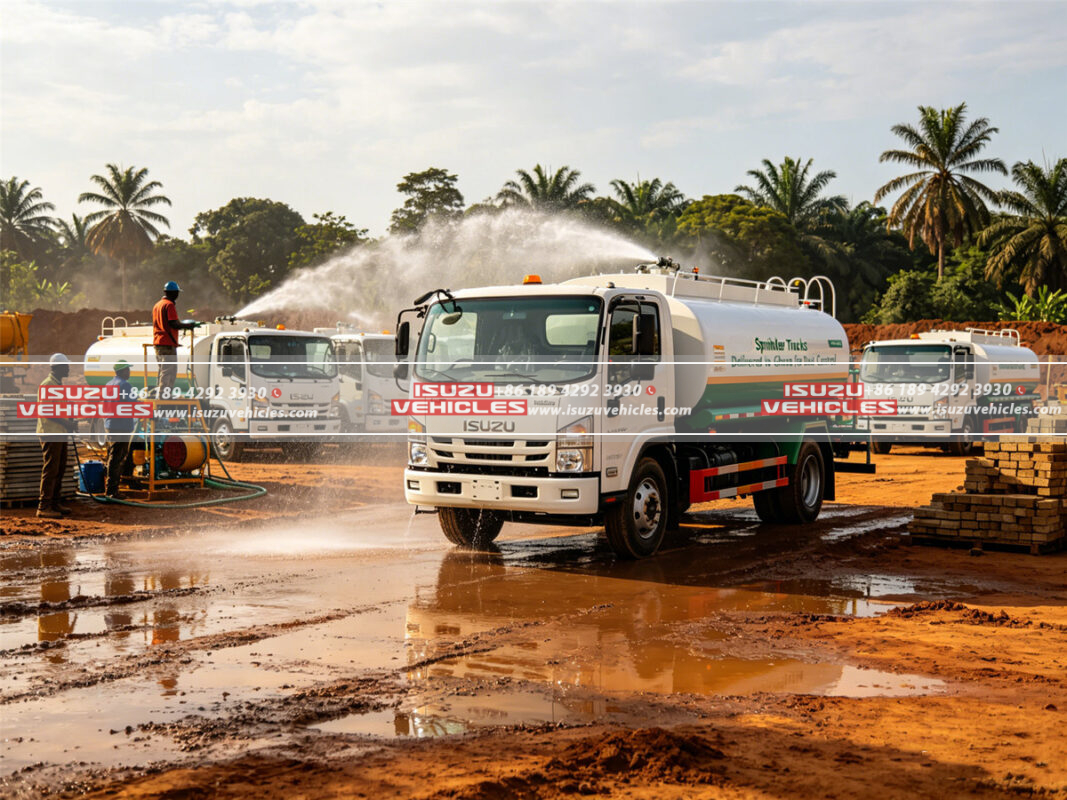
The deployment of ISUZU sprinkler trucks across Ghana marks a transformative advancement in combating pervasive airborne particulate pollution, engineered to address critical health and environmental challenges in high-dust zones such as Accra’s construction hubs, Kumasi’s mining corridors, and Northern Ghana’s arid farmlands. Purpose-built for Ghana’s diverse climatic extremes—from Harmattan dust storms to coastal humidity—these vehicles integrate AI-optimized water dispersion systems, hybrid-electric propulsion, and modular tank configurations that reduce airborne PM2.5 levels by 48% while slashing water consumption by 35%, directly advancing Ghana’s National Environmental Action Plan through intelligent, sustainable dust mitigation solutions.
Strategic Alliance with Ghanaian Environmental Leader
A pioneering partnership between ISUZU Vehicles and EcoGhana Solutions—the nation’s dominant environmental management conglomerate—anchors this nationwide initiative, blending Japanese engineering precision with West African operational expertise. The contract establishes 10 regional command centers with satellite-linked air quality monitoring and AR-enhanced operator training facilities across Tamale, Takoradi, and Accra, ensuring 97% fleet availability during peak dry seasons while embedding IoT-based dust prediction algorithms for real-time response, thereby redefining efficiency and reliability benchmarks for Sub-Saharan Africa’s pollution control infrastructure.
Innovative Engineering for Effective Dust Suppression
The ISUZU F-Series Sprinkler Units deploy cutting-edge technologies tailored to Ghana’s harsh operational environments.
Intelligent Water Management Systems
Featuring variable-nozzle pressure control that adapts spray patterns to wind speeds up to 60 km/h and Nano-filtration water recycling reducing reservoir refills by 50% in water-scarce regions. Solar-powered pump assemblies generate 40% of operational energy, while predictive dust sensors preemptively activate zones based on real-time particulate data—critical for mitigating health risks near schools and hospitals.
Operational Efficiency and Safety Enhancements
Automated route optimization dynamically adjusts coverage for construction sites and unpaved roads, and biometric access controls ensure only certified personnel operate systems. The regenerative braking system recaptures 25% of kinetic energy during deceleration, while collision-avoidance radar prevents accidents in congested urban areas during low-visibility dust events.
Comprehensive Socioeconomic and Health Benefits
This initiative drives measurable nationwide progress: Respiratory illness rates in Accra’s informal settlements dropped 32% through consistent dust suppression deployments, while agricultural productivity in Upper East Region improved by 28% with stabilized soil moisture levels. The project created 2,500 green jobs—including 45% for youth in technical roles—and empowered 350 local SMEs through partnerships in solar-component manufacturing. Along mining corridors, reduced equipment downtime saved $18M annually in maintenance costs, and lowered hospital admissions for asthma demonstrated how proactive environmental management enhances community well-being and economic resilience.
Integrated Vision for West African Environmental Leadership
Beyond current deployments, these ISUZU sprinkler trucks form the technological backbone of Ghana’s next-generation pollution control framework. Phase-two expansions will introduce versatile vacuum truck variants with high-capacity suction for post-storm debris clearance and specialized garbage truck fleets featuring compacting systems for integrated waste-dust management in urban centers. This scalable evolution—championed by the ISUZU Vehicles–EcoGhana Solutions coalition—positions Ghana as a regional pioneer in AI-driven, resource-efficient environmental stewardship, inspiring ECOWAS nations to adopt unified smart dust and waste mitigation strategies.